49 works in this view — arrow keys or swipe to move between them.
Dance in Art
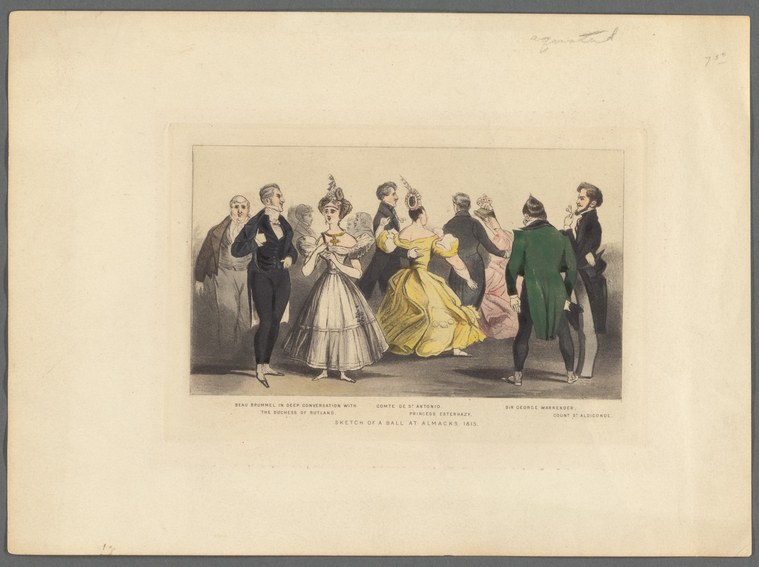
Sketch of a ball at Almack's, 1815. Beau Brummel [sic] in deep conversation with the Duchess of Rutland, Comte de St. Antonio, Princess Esterhazy, Sir George Warrender, Count St. Aldigonde
Unknown artist
- Collection:
- Prints depicting dance
- Source:
- New York Public Library
- Rights:
- Public domain — free to use, share and adapt.
- Recorded as:
- Public Domain
For historians of Regency dance and social history, this print is a primary document of how a specific social world choreographed itself through dress, gesture, and spatial arrangement. It shows that the history of ballroom dance includes not only the figures and steps, but the entire apparatus of propriety and social control that made those steps meaningful. The named figures and specific venue make it a historical record of an actual institution and its culture.
What you are looking at
This hand-coloured engraving depicts a formal ball at Almack's Assembly Rooms, the most exclusive social venue in Regency London. The scene shows a gathering of aristocratic figures in full evening dress arranged in a loose group within an ornate interior. At the centre stands a woman in an elaborate pale yellow gown with a high waistline and layered skirt, her posture upright and composed. Around her stand several gentlemen in dark tailcoats and breeches, and other women in white or pastel gowns. The figures are positioned as if in conversation or about to engage in dance, with some turning toward one another. The setting conveys the formal etiquette of Regency ballroom society: the figures maintain decorous distance, their stances restrained, their expressions dignified. Light falls evenly across the scene, emphasizing the detail of dress and the social hierarchy implicit in positioning and costume.
The dancing
The central female figure stands with her weight balanced, her arms held loosely at her sides in the manner prescribed for a young woman of quality in this period—neither raised nor gesticulating. The gentlemen around her stand in formal posture, some with one hand resting or held before them, in the restrained masculine bearing of Regency fashion. No couple is locked in a closed dance hold; instead, the grouping suggests the moment before dancing begins, or the social standing and observation that framed actual dancing. The composition allows each figure individual space and prominence rather than showing the interlocked movement of a dance in progress.
The dance depicted
This is a scene of Regency ballroom society at the point of social assembly rather than active dancing. The dances of this period—quadrilles, cotillions, country dances, and cotillions—required formation and music, and this scene appears to capture the moment of greeting, introduction, or preparation. The refined posture and the formal grouping are consistent with the etiquette governing Regency dances, in which dancers moved within prescribed figures and maintained upright carriage. Almack's was famous for its strict adherence to propriety and its role in the London social season; dancing there was as much about social positioning and the approval of patronesses as about the movement itself.
How it was made
This is a hand-coloured engraving, a technique that allowed for mass production and wide circulation among the London reading public and the social set itself. The engraving provides sharp detail in the rendering of dress, jewellery, and facial features, while the hand-colouring adds specificity to the gowns and the overall atmosphere. The technique was well-suited to social satire and commentary, which was popular in Regency print culture. The inscription at the base identifies named figures and the venue, marking this as a work of social documentation as well as artistic observation.
About this work
This is a social documentary engraving of Almack's Assembly Rooms during the Regency era, capturing the formal dress and restrained decorum of high society at its most exclusive. Rather than depicting dancing itself, it shows the social ritual that framed dance—the gathering, the introductions, the display of rank and fashion that preceded the actual figures and movement of the cotillion or quadrille. The work is a valuable record of Regency ballroom culture and the visual conventions used to represent it in print. It belongs in a dance history context as evidence of how dance was understood and presented in its social context: not as bodily exertion or technical accomplishment, but as the enactment of hierarchy, restraint, and civility.
How to look at it
Observe the posture and positioning of the figures: no one is in motion or in a dance hold, but all are oriented toward the centre of the group, indicating a moment of social anticipation or greeting. Notice the extreme formality of dress—the high waistlines, the pale colours for women, the dark tailcoats for men—which signals wealth and adherence to fashion. Look at the faces and expressions, which are calm and composed; there is no exuberance or abandon. The print records a social moment that is about display and hierarchy as much as about dance itself.
The artist
The artist is not recorded in the catalogue. The engraving is executed in the style of Regency social satire and documentary prints, of which there was a large output in London during the 1810s–1820s. Such prints were often produced by commercial publishing houses and sold as single sheets or in series, reaching a wide audience of middle- and upper-class readers. The hand-colouring was sometimes added by the purchaser or a specialist workshop.
The period
Almack's Assembly Rooms, located on King Street in London, opened in 1765 and became the arbiter of fashionable London society from the Regency period onward. Admission was by ticket only, and the patronesses (often aristocratic women) controlled who could attend, making a place at Almack's essential to a successful social season for the young and ambitious. The dances performed there—quadrilles, cotillions, and country dances—were the standard repertoire of fashionable ballrooms. This engraving dates to 1815, during the Napoleonic Wars and at the height of Regency fashion and the social season. The formal, almost frozen quality of the scene reflects the Regency ideal of composed gentility, in which restraint and propriety were marks of rank.
Where it lives
This engraving is held in the New York Public Library's collection of prints depicting dance. It is a single-sheet social documentary print of the kind mass-produced in Regency London for distribution to the public and to members of fashionable society.
Dance in this work
Questions about this work
What was Almack's Assembly Rooms?
Almack's was the most exclusive assembly and ballroom in Regency London, located on King Street. Admission was strictly controlled by a group of aristocratic patronesses, and a voucher to Almack's was essential for social success during the London season. It was the place where young women were presented and where fashionable society danced, gossiped, and arranged marriages.
Who are the named figures in this print?
The inscription identifies Beau Brummell (the famous dandy and fashion authority), the Duchess of Rutland, the Comte de St. Antonio, Princess Esterházy (one of the patronesses of Almack's), Sir George Warrender, and the Count St. Aldigonde. These are real historical figures of the Regency social world.
What dances were performed at Almack's?
The standard dances of Regency ballrooms were the quadrille, the cotillion, country dances, and the waltz (which was newer and more controversial). All were performed in formal dress and within strict protocols of behaviour. Dancing at Almack's was as much about social positioning as about the steps themselves.
Is anyone actually dancing in this image?
No—the scene shows a moment of social assembly and conversation rather than active dancing. The figures are arranged as if at the beginning of an evening or in the interval between dances, when the real social work of greeting, introduction, and negotiation took place.
More dance artwork





