49 works in this view — arrow keys or swipe to move between them.
Dance in Art
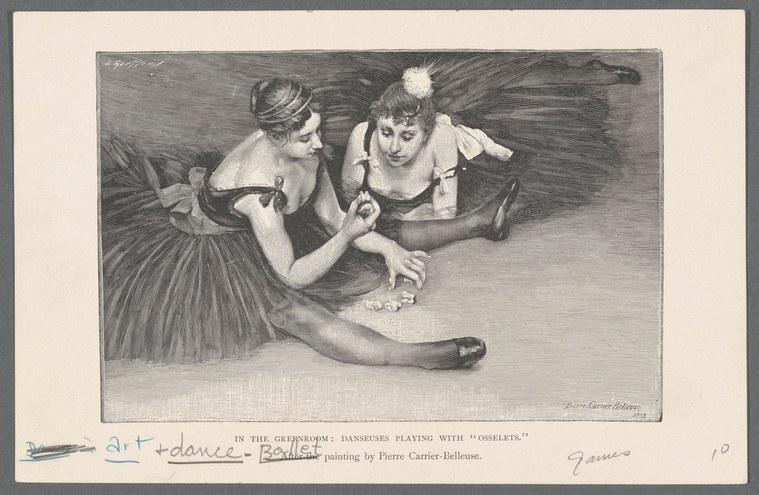
In the greenroom: danseuses playing with "osselets"
Unknown artist
- Collection:
- Prints depicting dance
- Source:
- New York Public Library
- Rights:
- Public domain — free to use, share and adapt.
- Recorded as:
- Public Domain
The image is a counterpoint to the idealized, ethereal imagery of Romantic and late-19th-century ballet—it shows dancers as young women with agency and social life, engaged in friendship and play rather than serving as muses or decorative objects. For historians of dance, it documents the material reality and social culture of the ballet world at a moment when theatre was becoming a major site of public life and when images of dancers were beginning to circulate widely in prints and periodicals.
What you are looking at
Two young women in a greenroom or backstage space recline on what appears to be a bench or divan, their bodies angled toward each other in intimate, playful conversation. Both wear the pale, gathered tutus and low-cut bodices typical of late 19th-century ballet costumes, their hair pinned up with decorative elements—one wears a headpiece or tiara. The woman on the left leans forward with animated expression, her hand gesturing; the woman on the right tilts her head toward her companion. Between them lies a scattered game of osselets—knucklebones or jacks—the traditional parlour game visible on the surface before them. The composition is intimate and candid, lit to suggest the backstage gaslit or lamplight of a theatre, with heavy cross-hatching in the background creating depth and shadow. The print captures a moment of ease and camaraderie between performers between scenes or during rehearsal.
The dancing
Both figures are seated or semi-recumbent, their bodies relaxed rather than arranged in dance posture. The woman on the left is propped on one elbow, her arm extended in animated gesture; the woman on the right sits upright but turned toward her companion, her gaze and body language engaged in conversation. Neither figure displays turnout, line, or the formal carriage of a dancer in performance; instead, they occupy the ungainly, collapsed postures of rest. The artists shows no interest in balletic form here—the point is the human ease of the moment offstage.
The dance depicted
This is not a depiction of dance itself, but of dancers—specifically, ballerinas—in their offstage life. The title and the costumes (tutus, ballet bodices) make clear these are members of a ballet company, and the greenroom setting indicates this is the space where performers gathered between acts or rehearsals. The game of osselets (knucklebones or jacks) was a popular parlour pastime of the period, and its presence here shows dancers as ordinary young women engaged in everyday leisure, not as idealized performers. The print documents the social reality and character of theatre life in the late 19th century.
How it was made
This is an engraving or etching, executed in fine linear cross-hatching to model form and create atmospheric depth. The technique allows the artist to capture subtle gradations of tone and the delicate textures of fabric—the gathered tulle of the tutus, the soft folds of skin and fabric in shadow. The precision and control required suggest this is a professional studio print, likely made for publication in a fine arts periodical or as an independent print for collectors. The technique and subject matter—a moment of contemporary theatre life—suggest this belongs to the tradition of belle époque society and theatrical prints, works made for a literate, urban audience interested in the behind-the-scenes life of the stage.
About this work
This engraving documents a private moment in the lives of late 19th-century ballerinas—two dancers in costume, backstage or in the greenroom, engaged in the simple pleasure of a game of knucklebones. The work is a rare image of dancers as themselves rather than as performers, showing the unglamorous, human reality of theatrical life. It belongs to a rich tradition of backstage and greenroom imagery in 19th-century printmaking, where artists recorded the social and domestic spaces of theatre as much as the spectacles staged on the stage itself. The print captures the social bonds between performers and the off-duty ease of women who spent their professional lives in disciplined, formal performance.
How to look at it
Notice the contrast between the elaborate, formal costume—the tutus and bodices that mark these women as professional dancers—and the completely informal, collapsed posture in which they occupy their bodies. The artist is playing with the gap between the public persona of the dancer (disciplined, ethereal, formally posed) and the private reality (relaxed, gossipy, absorbed in play). The osselets scattered on the surface before them are the narrative anchor—this is a specific moment, a game in progress, a pause in the working day. The composition, with its angled viewpoint and intimate scale, invites the viewer into a private space, as if overhearing a conversation.
The artist
The artist is not recorded in the catalogue. However, the signature visible in the lower right corner reads "Robichon" or similar. The print is attributed in the caption as a "painting by Pierre Carrier-Belleuse," suggesting Carrier-Belleuse created the original artwork from which this engraving was made. Carrier-Belleuse (1848–1913) was a French painter known for society scenes, theatrical subjects, and intimate domestic interiors. He was part of the circle of artists documenting Parisian theatrical life in the belle époque period.
The period
The late 19th century saw an explosion of theatrical printmaking and illustrated periodicals devoted to theatre, opera, and ballet. The greenroom scene—backstage and offstage—became a subject of fascination for artists and viewers, offering a glimpse into the private world of performers. At the same time, the rise of naturalism and realism in visual art encouraged artists to move beyond idealized representations toward more candid, observational scenes. The osselets game itself was a popular theme in genre painting and prints of the period, signifying youth, leisure, and feminine companionship. This print sits at the intersection of theatrical documentation, social observation, and the growing interest in the quotidian lives of performers.
Where it lives
The work is held in the New York Public Library's collection of prints depicting dance. It is catalogued as a print made from a painting by Pierre Carrier-Belleuse. The NYPL collection of dance-related prints is extensive and includes works spanning from the 16th century to the early 20th century, documenting the history of theatrical dance through visual culture.
Dance in this work
Questions about this work
What are osselets?
Osselets (also called astragals or knucklebones) are small bones—traditionally from the hind legs of sheep or goats—used in a parlour game similar to jacks or dice games. Players toss and catch the bones, following various rules and sequences. The game was popular among European women and children in the 18th and 19th centuries and appears frequently in period imagery as a symbol of leisure, youth, and feminine companionship.
What is a greenroom?
The greenroom was the space in a theatre where actors, dancers, and other performers gathered offstage—a lounge, waiting area, and social space. The name's origin is debated; it may derive from the colour of the walls or simply be a traditional term. Greenrooms became famous sites of theatrical socializing, gossip, and rest between performances, and they were frequently depicted in 19th-century theatrical imagery.
Who was Pierre Carrier-Belleuse?
Pierre Carrier-Belleuse (1848–1913) was a French painter specializing in society scenes, theatrical subjects, and intimate domestic interiors. He was part of the circle of Parisian artists documenting belle époque social and theatrical life, and his works were frequently engraved and reproduced in contemporary periodicals and as independent prints for art collectors.
Is this a dance scene?
No—this is a scene of dancers at rest, not a depiction of dance itself. The women wear ballet costumes and are identified as performers by their dress and setting, but they are shown in a moment of private, social leisure rather than in performance or rehearsal. The image is valuable precisely because it documents the lives of dancers beyond the stage.
More dance artwork





