49 works in this view — arrow keys or swipe to move between them.
Dance in Art
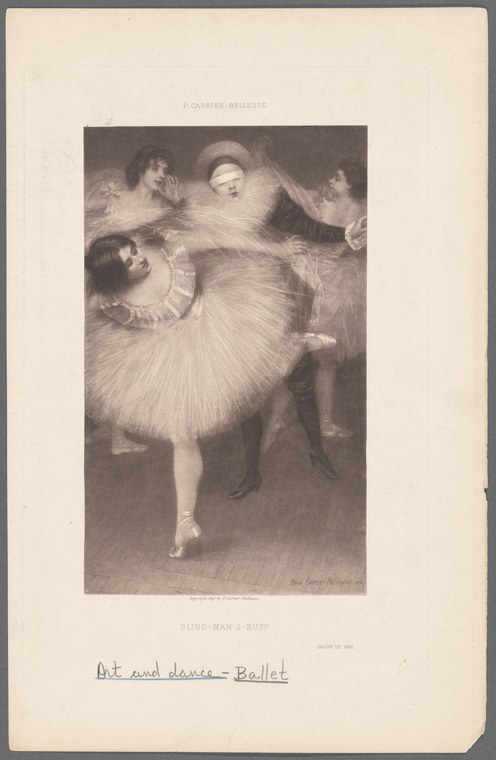
Blind-man's-buff, Salon de 1896
Unknown artist
- Collection:
- Prints depicting dance
- Source:
- New York Public Library
- Rights:
- Public domain — free to use, share and adapt.
- Recorded as:
- Public Domain
The image offers insight into how trained balletic movement and aesthetic ideals of femininity infused even non-professional social dancing and games in the 1890s. It is evidence that the vocabulary of ballet—turned-out legs, upright carriage, graceful extension—had become the grammar of how women's bodies were expected to move and to be looked at in elite social settings. For dance historians, it is a window into the everyday aestheticization of movement in spaces outside the theater.
What you are looking at
A tonal lithograph or engraving capturing a moment from the parlor game of blind man's buff. A young woman in an elaborate white tulle tutu stands at center, her body in a graceful contrapposto, one leg extended and slightly flexed. She wears the full skirts typical of 1890s ballet dress. Around her, four other figures—some identifiable as other young women in lighter dress, others in darker clothing suggesting men—gesture and lean toward her with expressions of playful excitement. The composition is asymmetrical and dynamic: the central figure maintains a composed, almost balletic poise while those around her create a circling, taunting energy. The background is spare and atmospheric, rendered in soft gradations of tone that suggest an interior space lit by diffuse light. The overall effect captures the moment of suspense in the game—the blindfolded or sightless player caught in a moment of delightful vulnerability while others close in.
The dancing
The central female figure carries herself with the upright carriage and turned-out legs of a trained dancer, her posture suggesting either balletic training or the idealized feminine deportment of the period. Her extended leg and the drape of her tulle skirts suggest controlled movement frozen mid-action. The surrounding figures lean and gesture with hands raised or extended, their bodies angled inward—a compositional choice that emphasizes the game's predatory playfulness. The contrast between the protagonist's serene, centered bearing and the animated poses of those encircling her creates visual and psychological tension.
The dance depicted
Blind man's buff is not a formal dance but a participatory game that was frequently depicted in art of the period as a metaphor for social flirtation, courtship, and the pleasures of the ballroom. The image captures it in the context of salon entertainment or a private ball—precisely the setting where such games would occur. The woman's pose and costume suggest that the image is interested in the aesthetic and bodily display of the player as much as in the game itself: her tutte and balletic carriage evoke the vocabulary of theatrical ballet, suggesting that even parlor games were aestheticized through dance-trained movement. This is social dance in the broadest sense—not a prescribed choreography but improvised movement within a licensed framework of play.
How it was made
The work is a tonal print, likely a lithograph or photogravure reproduction, executed in soft grayscale with sensitive modeling of light and fabric texture. The technique excels at rendering the luminosity of tulle and the subtly differentiated tones of interior space. The reproductive quality suggests this was a salon art print or magazine illustration intended for a wide educated audience, consistent with its provenance as a Salon work. The delicate tonal range and soft edge work are characteristic of late 19th-century art reproduction technology.
About this work
This is a salon picture from 1896 depicting blind man's buff—a parlor game that intersected social, sexual, and aesthetic play in the world of the belle époque elite. The work treats the game not as raw comedy but as an occasion for elegant bodily display and psychological narrative. The central figure's balletic poise and the carefully composed surrounding figures transform a domestic game into a moment of social and visual significance. The print belongs to a large body of salon art from the period that found subjects in the leisure and courtship rituals of bourgeois social life, but it stands out for its restraint and psychological sensitivity—the artist is interested in the moment of suspense and the bodily languages of flirtation rather than in broad comedy.
How to look at it
Attend to the precise moment chosen: not the capture or the unseeing rush, but the moment of suspense just before contact, when the protagonist still maintains her composure while danger (or delightful capture) draws near. Notice how the artist has used the contrast between the centered, almost stationary figure and the animated circling figures to create a sense of psychological and physical tension. The balletic posture of the central woman is essential to the composition's meaning—it is her grace and poise that makes the game a subject worthy of serious artistic treatment, rather than mere farce. The soft, diffuse handling of light and fabric invites a contemplative rather than a comic viewing mode.
The artist
The artist is not recorded. The work was exhibited in the Salon of 1896, the major annual juried exhibition in Paris, suggesting it came from a professional artist working in the academic tradition. The subject matter and refined execution point to someone working in the salon-picture tradition—a category that encompassed figurative scenes of contemporary life, often centered on women and the rituals of leisure and courtship.
The period
The 1890s were a moment of intense interest in the aesthetics of movement, femininity, and the body, driven in part by the influence of ballet (then undergoing a major revival) and in part by broader fin-de-siècle fascination with grace, elegance, and the sensory dimensions of social life. Degas's ballet scenes and the success of works depicting fashionable leisure had established the salon picture of dancers and dancing women as a respectable and popular genre. Blind man's buff was a traditional parlor game that appeared frequently in 19th-century literature and visual art as a metaphor for flirtation and the asymmetries of desire. By 1896, such games were often depicted in an elegiac mode—as remnants of an older, more intimate style of sociability being displaced by modern entertainment. The work's treatment of the game through the language of ballet suggests a nostalgia for grace and refinement even in casual social play.
Where it lives
The work comes from the New York Public Library's collection of prints depicting dance, catalogued simply as a salon work from 1896. Its survival in a dedicated dance print collection suggests that even in the early 20th century, when the collection was formed, curators recognized the significance of such images for understanding how dance and trained movement functioned in society beyond the professional stage.
Dance in this work
Questions about this work
What is blind man's buff and why was it painted?
Blind man's buff is a parlor game in which one blindfolded player tries to catch and identify others by touch. Artists of the 18th and 19th centuries were drawn to it because it enacted social anxieties and pleasures—vulnerability, the gaze, the thrill of pursuit—in a compressed form. For salon painters, it offered an excuse to depict fashionable women and the aesthetics of contemporary leisure. By the 1890s, such scenes also carried a note of nostalgia for older, pre-modern forms of sociability.
Why does the woman in the center look like a ballet dancer?
She almost certainly was trained in ballet or deportment. By the 1890s, balletic carriage—turned-out legs, upright posture, graceful arm position—had become the standard of feminine refinement for elite women. Even in a parlor game, a woman of her class would have been expected to move with that aesthetic discipline. The artist has used her balletic poise to elevate the game from mere entertainment into a moment worthy of serious artistic attention.
Is this a photograph or a drawing?
It is a print—most likely a lithograph or photogravure. The soft tonal gradations and the way light is rendered in the fabric suggest a reproductive technique that could capture the subtleties of painted or drawn artwork. The 'Salon de 1896' label indicates it was a work shown in the Paris Salon, but salon works were often reproduced in print form for circulation to a broader audience.
More dance artwork





