49 works in this view — arrow keys or swipe to move between them.
Dance in Art
A ball-room scene: a fragment
Unknown artist
- Collection:
- Prints depicting dance
- Source:
- New York Public Library
- Rights:
- Public domain — free to use, share and adapt.
- Recorded as:
- Public Domain
This work demonstrates that dance history includes the spaces around dance—the waiting, the observation, the courtship rituals that surrounded the actual steps. For historians of social dance and etiquette, it is invaluable evidence of how a ballroom was actually used and how the dancing body was positioned within a larger field of social performance.
What you are looking at
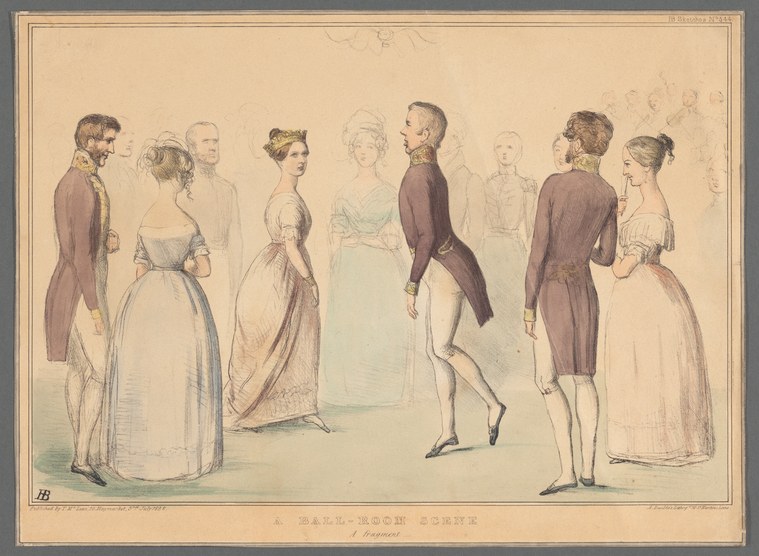
A formal ballroom scene rendered in delicate line work and subtle wash, depicting eight fashionably dressed figures arranged in a loose social grouping. The composition suggests a moment of social interaction rather than active dancing—several figures stand in conversation or observation while others assume the poised, upright carriage typical of ballroom etiquette. The men wear dark tailcoats with fitted breeches; the women are in high-waisted Empire silhouette gowns with short puffed sleeves, their hair arranged in elaborate updos with ringlets. The figures are distributed across the page with considerable negative space, giving the scene an air of refinement and restraint. The technique is economical: faces and hands are rendered with careful attention, while clothing and background are suggested through minimal but assured line and a pale wash of color. The overall effect is of a preparatory study or refined sketch rather than a finished narrative scene.
The dancing
The bodies display the formal posture and composure required by Regency-era ballroom etiquette: erect spines, controlled arm placement, and a sense of restrained elegance. Several figures stand at conversational distance; one man at center-right turns to engage with the group, his weight slightly forward on a straight leg. The women maintain the upright frame and small, neat steps characteristic of period ballroom movement. No figure is shown in the act of dancing; rather, all are in the social positions—standing, waiting, engaging in conversation—that structure a formal ball.
The dance depicted
This depicts the social sphere of Regency-era ballroom culture (approximately 1811–1820), capturing the moment before or between dances rather than dance itself. The period was dominated by country dances, cotillions, quadrilles, and the increasingly popular waltz, but the image shows the dancers in a state of social waiting—a crucial part of the ritual. The formal dress, the careful spacing, and the evident concern with proper deportment all confirm this as ballroom society, but the artist has chosen to show the social choreography of the ballroom rather than the kinetic choreography of the dance.
How it was made
This is a hand-colored engraving or lithograph in the manner typical of early 19th-century fashion and society prints. The primary image is in fine line work, with pale watercolor or ink wash applied to clothing and flesh tones. This technique allowed for rapid production and wide circulation; such prints were popular as social records and as aids to understanding proper dress and deportment. The delicacy of the line work and the restraint of the coloring suggest this was aimed at an educated, fashionable audience.
About this work
This is a documentary record of Regency ballroom society, capturing not a dance in motion but the social and sartorial codes of the formal ball. It belongs in a gallery of dance in art as evidence of how the ballroom functioned as a total social system—one in which the standing, waiting, and conversation between dances were as important to the spectacle as the dances themselves. The image records a specific historical moment (the Regency period) and a specific social technology (the formal ball) at the height of its influence and refinement.
How to look at it
Notice the careful attention to posture and the precise rendering of the women's dresses—high waists, short sleeves, and the characteristic silhouette of 1810–1820. Observe how the artist has distributed the figures to emphasize the social structure of the ballroom: some are in active conversation, others stand apart, and all maintain the formal bearing required by the period. The absence of motion is deliberate; this is a study of ballroom society as a system of statuses and rituals, not as a kinetic event.
The period
This dates to the Regency era (1811–1820, though the style may extend slightly before or after), a period of intense interest in ballroom dancing in Britain and Europe. The quadrille, newly arrived from France, was competing with older country dances and cotillions; the waltz, scandalous for its close hold and speed, was beginning to appear. Regency society prints were a major form of mass media, recording and codifying proper dress, etiquette, and social behavior. Artists and publishers used these prints to educate the aspiring middle classes and to document the style of the ton (fashionable society).
Where it lives
Held in the New York Public Library's collection of prints depicting dance, this work is part of a broader archive of ballroom and social dance imagery spanning several centuries. It survives as a loose print and represents the kind of ephemeral visual document that was widely produced and consumed in the early 19th century.
Dance in this work
Questions about this work
Is this a depiction of an actual dance?
No. The figures are standing and conversing, not dancing. The artist has captured the social and sartorial experience of the ballroom—the waiting, the conversation, the display of dress and deportment—rather than the kinetic moment of the dance itself. This is still a valuable record of dance culture, as it shows how dancers actually spent their time at a ball.
What period is this from?
The dress and style suggest the Regency era, approximately 1811–1820, a period of intense fashionability and social change in British ballroom dancing. The high-waisted gowns and the men's tailcoats are diagnostic of this decade.
What dances would these people have danced?
A Regency ballroom would have featured country dances, cotillions, quadrilles, and possibly the newly fashionable waltz. The image does not specify which, but the formal dress and restraint suggest an elite event where all the major forms would have been danced in turn.
More dance artwork





