49 works in this view — arrow keys or swipe to move between them.
Dance in Art
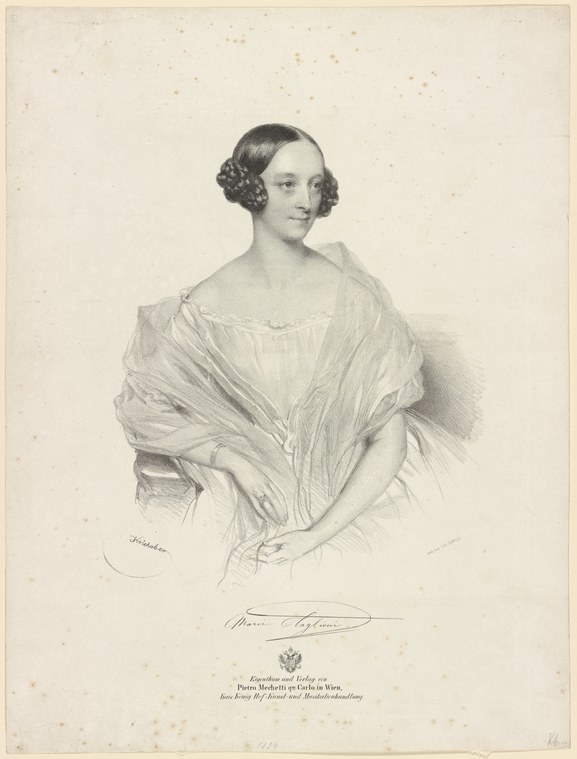
Marie Taglioni (fac. sig.)
Unknown artist
- Collection:
- Prints depicting dance
- Source:
- New York Public Library
- Rights:
- Public domain — free to use, share and adapt.
- Recorded as:
- Public Domain
Taglioni is the central figure in Romantic ballet and the first international dance superstar; her image was circulated across Europe and America in prints like this, making her recognizable far beyond those who saw her perform. This portrait captures not her in motion but the idea of her—the refined, otherworldly presence that made her the defining dancer of an era and shaped how ballet was understood as an art form.
What you are looking at
A three-quarter-length portrait of a young woman, shown from the waist up, facing slightly to the left. She wears a flowing off-shoulder dress in a soft, neoclassical style with loose, gathered sleeves and delicate pleating across the bodice. Her dark hair is arranged in the fashionable style of the mid-nineteenth century, parted in the center and swept back into a neat coil at the nape of her neck. She gazes downward with a composed, almost melancholic expression. Her left arm drapes gracefully across her torso; her right arm rests at her side. The drawing is rendered in graphite with fine hatching and subtle shading that gives the fabric an ethereal quality. The background is plain cream paper, focusing all attention on the figure's delicate features and the soft fall of her garments.
The dancing
The sitter's posture is upright but relaxed, with the weight evenly distributed. Her shoulders are pulled back slightly, the left shoulder higher than the right, creating a gentle contrapposto. The arms hang naturally, neither engaged in any specific dance position nor gesturing dramatically. The head is inclined downward in a pose of quiet introspection. The overall bearing is that of a trained performer at rest—poised but not in action.
The dance depicted
This is a portrait of Marie Taglioni, the Swedish-Italian prima ballerina assoluta who revolutionized Romantic ballet in the 1830s and 1840s. The inscription at the foot confirms the identification. The drawing captures Taglioni in an informal moment rather than mid-performance, presenting her as a celebrated artist worthy of fine portraiture rather than documenting a specific dance or role. Taglioni's fame rested on roles like the Sylphide, performed in the lightweight, ethereal style that this portrait's soft drapery seems to evoke.
How it was made
This is a lithograph, a process that allowed for fine tonal gradation and was the dominant medium for theatrical celebrity portraiture in the nineteenth century. The artist has used crayon or lithographic stone to build delicate grey tones across the face and fabrics, with linear work defining the folds of cloth and the contours of the figure. Lithography's ability to render subtle modulation made it ideal for capturing the ethereal quality demanded by Romantic ballet aesthetics. The technique also ensured this portrait could be mass-produced and circulated to the many admirers of Taglioni's celebrity.
About this work
This is a celebrity portrait of Marie Taglioni, the legendary ballerina of the Romantic era, rendered as a lithograph in the mid-nineteenth century. It belongs to the visual culture of theatrical fame and the promotion of ballet as a refined art form. The portrait does not show Taglioni dancing but rather presents her as an artist of refinement and sensibility—a cultural icon whose image was circulated and collected by the public who followed her celebrated performances. The soft handling of the medium and the restrained, introspective pose align perfectly with the aesthetic values of Romantic ballet: ethereality, grace, interiority, and the cult of the individual performer.
How to look at it
Observe the artist's choice to capture Taglioni not in performance but in a moment of repose, her gaze directed downward in introspection rather than outward in engagement. This reinforces the Romantic ideal of the ballerina as a creature of inner sensibility and grace rather than mere technical display. Notice how the soft, loose drapery of her dress and the handling of light across her face and shoulder emphasize weightlessness and refinement—qualities inseparable from her reputation. The lithographic technique itself, with its delicate tonal work, was chosen to evoke the ethereal quality that made her performances revolutionary.
The artist
The artist's name is not recorded in the catalogue. The inscription 'Taglioni' and the facsmile signature are visible on the stone, but the lithographer's name is absent. Many such theatrical portraits were unsigned or signed only by their publishers, and attribution often requires consulting print catalogues or archival research. The work belongs to a substantial commercial practice of producing celebrity likenesses for public consumption.
The period
This portrait dates to the height of Romantic ballet in the 1830s–1840s, when Marie Taglioni was transforming the art form through innovations in technique, costuming, and theatrical illusion. The Romantic era prized ethereality, emotional interiority, and the figure of the idealized (often unattainable) woman—all of which Taglioni embodied. The medium of lithography was itself a product of this period's revolution in print technology, enabling the mass circulation of celebrity images. Ballet had shifted from courtly entertainment to a major public spectacle, and dancers like Taglioni became international celebrities whose likenesses were eagerly sought and widely distributed.
Where it lives
This print is held in the New York Public Library's collection of prints depicting dance. It is a lithograph, likely published in the 1830s–1840s during or shortly after Taglioni's period of greatest fame. The work is part of the wider visual archive of nineteenth-century theatrical celebrity.
Dance in this work
Questions about this work
Who was Marie Taglioni?
Marie Taglioni (1804–1884) was a Swedish-Italian prima ballerina assoluta who dominated the Romantic ballet era. She created the role of the Sylphide in 1832, a role that defined Romantic ballet and showcased her extraordinary technique and ethereal stage presence. She was the first international dance superstar and revolutionized ballet through innovations in costuming, choreography, and the expression of emotion through movement.
What style of dance did Taglioni perform?
Taglioni was a Romantic ballerina, performing in the style that emerged in the 1830s and emphasized ethereality, emotional interiority, and the illusion of weightlessness. She danced on pointe (in soft ballet slippers, not the modern pointe shoe), wore lightweight costumes and crowns rather than the heavier court dress of Classical ballet, and performed roles that often cast her as a supernatural or idealized being rather than a mortal character.
Is this a portrait of Taglioni dancing?
No. This is a seated or resting portrait—a celebrity image created for circulation and collection. It presents Taglioni as a refined and introspective artist rather than documenting a specific performance. The soft drapery and ethereal quality of the image evoke the aesthetic she was famous for, but the pose is one of repose, not dance.
What is a lithograph?
Lithography is a printing process based on the principle that oil and water do not mix. An image is drawn on a stone with a greasy crayon, the stone is wetted and inked, and the ink adheres only to the drawn areas. Paper pressed against the stone transfers the image. This process allowed fine tonal gradation and was ideal for theatrical portraits in the nineteenth century, as it could be printed in multiple copies and distributed to the public.
More dance artwork





