49 works in this view — arrow keys or swipe to move between them.
Dance in Art
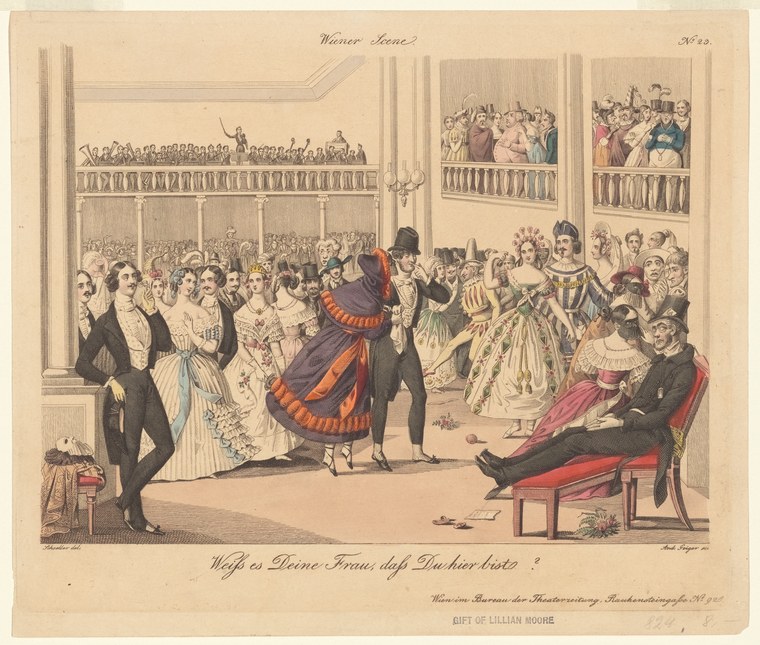
Weiss es Deine Frau, dass Du hier bist?
Unknown artist
- Collection:
- Prints depicting dance
- Source:
- New York Public Library
- Rights:
- Public domain — free to use, share and adapt.
- Recorded as:
- Public Domain
This image preserves the visual grammar of early 19th-century court dance — the posture, spacing, dress, and architectural setting that framed these highly codified social rituals. The presence of the tiered galleries and supervising figures shows that formal dance was as much spectacle and social judgment as it was movement. It is a rare document of how dance functioned as a mechanism of courtship, rank assertion, and public performance in Regency and Napoleonic culture.
What you are looking at
A grand ballroom scene depicts a formal dance gathering, likely from the early 19th century. Couples and groups populate a spacious interior with classical architectural elements — fluted columns, panelled walls, and a coffered ceiling. Two tiers of viewing galleries above are crowded with spectators, some leaning forward in animated attention. The floor is occupied by formally dressed figures: men in dark coats with bright decorative sashes or ribbons across the chest, women in high-waisted white or pale gowns with short sleeves. One prominent male figure in the centre wears a striking dark coat with a broad orange-red sash, drawing attention as he gestures or moves. The lighting is warm and even, suggesting daylight from the upper reaches of the room. In the foreground right, two figures sit on red-cushioned chairs, seemingly supervising or observing the proceedings. The scene conveys the formal etiquette and spectacle of Napoleonic-era court or aristocratic dance.
The dancing
The dancers move in the upright, restrained posture typical of formal court dance. Men and women stand at a distance appropriate to Regency-period propriety, with arms in controlled positions. The central male figure's broad sash and animated arm position suggest he may be leading or demonstrating a figure. Most couples are either standing in conversation or holding the loose frame suitable for a promenade or march. There is no evidence of closed ballroom hold or the body contact of later 19th-century waltzing. The spectators above lean and gesture, indicating this is a spectacle being watched, not an intimate private dance.
The dance depicted
This depicts a formal aristocratic or court ball of the Regency or Napoleonic period. The setting — tiered galleries, formal dress, the presence of supervising figures, and the restrained deportment of the dancers — all point to a quadrille, cotillion, or grand march. The German title suggests a Central European context, possibly a Vienna court ball or similar formal gathering. The dance is characterized by geometric floor patterns, prescribed figures, and the careful orchestration of couples through sequences. The presence of spectators in galleries indicates this is a public or semi-public event of social importance, not a private entertainment.
How it was made
This is a hand-coloured engraving or aquatint, evident from the fine linear hatching visible in the architectural details and the careful delineation of fabric and dress. The colour — pale yellows and creams for the background, blue and red for uniforms and cushions — is applied by hand with considerable skill. The technique allowed for mass distribution of such theatrical or social documentation in the early 19th century. The print's circulation as a hand-coloured reproduction suggests it was a popular or commercially published work documenting a notable social event or scene type.
About this work
This is a coloured engraving documenting a formal Regency- or Napoleonic-era court or aristocratic ball. The composition captures not the dance itself but the social theatre of formal dancing — the orchestrated geometry of courtship and rank, the separation of performers and observers, the restraint of gesture and body position mandated by court etiquette. It is a record of how dance functioned as a public ceremony of class and power in early 19th-century European society. The work exemplifies the period's fascination with scenes of fashionable life, rendered in the print medium and coloured by hand for circulation among an educated public. For historians of dance, it documents the physical vocabulary and social context of Regency ballroom culture with unusual specificity.
How to look at it
Attend first to the architecture and the galleries: this is a public or semi-public event, not a private gathering. Notice the formal dress codes — the sashes of office or military rank on the men, the high waistlines and demure sleeves of the women — as markers of the social stakes of the occasion. Look at the spacing and arm positions of the dancers: there is no close contact, no exertion, no sense of pleasure in physical virtuosity. The dance is geometric and restrained. Finally, observe the supervising figures in the foreground right: their seated position and attentive posture suggest that social order and decorum are being monitored, not merely assumed. The scene is a tableau of social ritual as much as of movement.
The period
The work dates to the early 19th century, a period of intense interest in documenting fashionable society and its rituals. The Napoleonic wars had consolidated a new aristocracy across Europe, and formal dance remained a principal means of establishing and displaying rank and eligibility. The Regency period in England (1811–1820) and the Restoration period across Europe saw a codification and widening of formal ballroom dances — the quadrille, the cotillion, the allemande — as social performance. Hand-coloured engravings of scenes of fashionable life were a major commercial and artistic genre, circulating among the upper and rising middle classes as both entertainment and a form of social instruction. This print belongs to that tradition: a window into the manners of the elite, made available to a broader audience through the reproductive print market.
Where it lives
The work is held in the NYPL Prints depicting dance collection and is credited to the 'Bibl. of Lilian Moore', a major collection of dance documentation. It is catalogued under the era label 'unknown', though the imagery dates it securely to the early 19th century.
Dance in this work
Questions about this work
What dance are they doing?
The scene most likely depicts a quadrille, cotillion, or grand march — the formal ballroom dances of the Regency and Napoleonic period. The exact figure cannot be determined from a single moment, but the geometry, spacing, and restrained posture are consistent with these highly codified social dances. The presence of supervising figures and spectator galleries indicates this is a formal state or court occasion.
Why are there so many people watching from above?
The tiered galleries show that formal ballroom dancing in this period was a public or semi-public spectacle, not a private entertainment. The dance was a ceremony of rank and courtship, conducted under observation. For young unmarried people, especially women, the ball was a marketplace and a test of social accomplishment. The presence of observers — family members, chaperones, social rivals — was integral to the event's meaning.
What do the sashes mean?
The broad orange-red sash worn by the central male figure, and the narrower coloured ribbons visible on other men, indicate military rank or court office. In the Napoleonic era and after, such insignia were a marker of Napoleon's new meritocratic hierarchy and the restructuring of European aristocracy. Wearing them to a ball demonstrated social standing and was itself a form of performance.
How was this made?
This is a hand-coloured engraving, a popular commercial medium for documenting fashionable society in the early 19th century. The image was engraved on a copper plate, then printed on paper, and each copy was hand-coloured. This made it relatively affordable for wealthy private collectors and created a market for prints of social scenes, fashion, and theatrical events.
More dance artwork





