49 works in this view — arrow keys or swipe to move between them.
Dance in Art
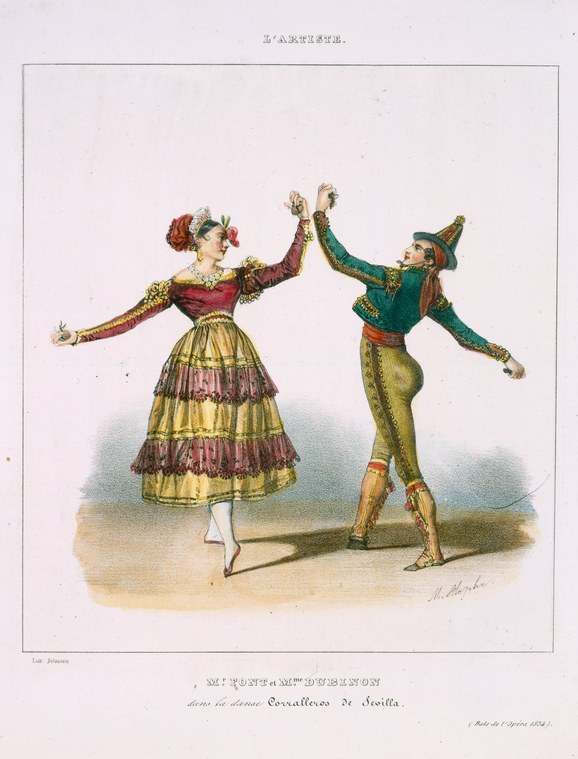
Mr. Font et Mme. Dubinon dans la danse Corralleros de Sevilla
Unknown artist
- Collection:
- Prints depicting dance
- Source:
- New York Public Library
- Rights:
- Public domain — free to use, share and adapt.
- Recorded as:
- Public Domain
This print preserves a vanished dance tradition and a moment of theatrical stardom that would otherwise be invisible to history. The *Corralleros de Sevilla* left almost no notation and survives only in images, music, and description; this engraving is therefore primary evidence of how the dance was costumed, performed, and understood by its contemporary audience.
What you are looking at
A hand-colored engraving shows two dancers in a moment of playful interaction on an empty stage or studio floor. The woman on the left wears an elaborate costume of the 1830s–40s: a fitted bodice in deep red or crimson with gold embroidery, puffed sleeves, and a voluminous skirt composed of horizontal bands in yellow, pink, and brown. Her reddish-brown hair is dressed high and crowned with flowers. The male dancer on the right, dressed in tight breeches of olive-yellow and a blue-green jacket with gold trim and a matching hat with a plumed crown, leans backward in an exaggerated pose of mock alarm or delight. His right arm is raised and his body weight shifts onto one leg in a theatrical attitude. The woman extends her left arm toward him in a gesture of playful invitation or taunt, her posture light and sprung. The composition isolates the two figures against a pale background with a faint shadow beneath them, emphasizing the moment of flirtation.
The dancing
Both dancers are caught in a moment of social interaction rather than synchronized movement. The woman stands with lifted carriage, her weight balanced and her extended arm light and expressive—the posture of a trained dancer. The man's exaggerated backward lean and raised arm suggest a comedic or courtship gesture, his body relaxed and reactive rather than formally posed. Their relative positions—face-to-face, separated by arm's length—suggest a folk or regional dance in which dialogue and flirtation between partners is central. The costumes are those of performers rather than ordinary people, indicating a theatrical or professional presentation.
The dance depicted
The title identifies this as the *Corralleros de Sevilla*, a Spanish regional dance associated with Seville. This was a popular social and theatrical dance of the 19th century, often featuring couples in playful, gallant exchange—the visual language matches the title precisely. The dance was performed in ballrooms and on stages across Europe, and appears in several musical theatre and ballet contexts of this era. The costume and the moment of playful antagonism between the dancers are entirely consistent with the corrallero tradition, in which male and female dancers engage in dramatic pursuit, evasion, and courtship.
How it was made
This is a hand-colored engraving, as evidenced by the fine linear work visible in the drapery and the precise outlines, with watercolor or gouache applied to create the vivid costume colors. The technique allowed for mass reproduction of the image with hand-finishing, making it affordable for a broad theatrical audience. The signatures visible at lower left and in the composition suggest this was a professional theatrical print, likely produced in France or a French-influenced European center. Such prints were distributed to advertise performances and celebrate popular dancers and roles.
About this work
This engraving documents a moment from the *Corralleros de Sevilla*, a Spanish regional dance that enjoyed considerable popularity in European ballrooms and theatres during the 19th century. The dancers are identified as Mr. Font and Mme. Dubinon, performers of sufficient renown to warrant a printed record of their partnership. The work captures not just a dance step but a social narrative—the playful courtship that lay at the heart of the corrallero—and presents it as a scene worthy of preservation and circulation. It belongs to a rich tradition of theatrical dance prints that documented both the choreography and the star performers of the age.
How to look at it
Notice the precision of the engraver's line in rendering the woman's complex costume, which would have been difficult to convey in any other medium of the time. The moment chosen is neither a static pose nor an action frozen mid-leap, but a moment of social interaction—the woman's gesture and the man's reaction. This reflects the corrallero's emphasis on dialogue and flirtation rather than virtuosity. The theatrical exaggeration in the man's backward lean and the woman's poised arm tell the viewer that this is a performed entertainment, not a snapshot of vernacular dancing, and invite appreciation of the performers' skill in projecting personality and charm.
The artist
The engraving is unsigned in the catalogue record provided, but the signatures visible in the print suggest a professional theatrical printmaker working in the mid-19th century. The style and technique are consistent with Parisian or other major European theatrical print production of the 1830s–1840s, when such images were an important medium for advertising performances and celebrating favorite dancers.
The period
The 1830s–1840s saw a European craze for Spanish and Spanish-colonial culture—*costumbrismo*—reflected in paintings, literature, music, and dance. Regional Spanish dances were adapted for the ballroom and the stage, often filtered through a romanticized vision of Spain as exotic and passionate. The *Corralleros de Sevilla* fit perfectly into this moment, celebrated as an authentic folk expression while being packaged for cosmopolitan audiences. Simultaneously, this was the era of Romantic ballet, but social and national dances remained equally fashionable in theatrical contexts.
Where it lives
This print is held in the New York Public Library's collection of prints depicting dance. It is catalogued with minimal information, suggesting it arrived as part of a larger collection or acquisition without full documentation.
Dance in this work
Questions about this work
What is the Corralleros de Sevilla?
The *Corralleros de Sevilla* is a Spanish regional dance associated with Seville, popular in 19th-century ballrooms and theatres. It is built on playful, flirtatious interaction between male and female partners, with a tradition of mock pursuit and gallantry. The dance was widely performed across Europe, adapted from or influenced by authentic Andalusian traditions but presented as a theatrical entertainment.
Who were Font and Dubinon?
Mr. Font and Mme. Dubinon were theatrical performers known for the *Corralleros de Sevilla*, apparently prominent enough to warrant a printed portrait. The catalogue record provides no biographical details, and no other documentation of them has been located. The print is the primary evidence of their practice.
Why does the man look so alarmed?
The exaggerated backward lean and raised arm are part of the courtship vocabulary of the corrallero, expressing mock alarm, surprise, or playful resistance to the woman's advance. This is a performance of personality and charm rather than a genuine expression of fear—the gesture belongs to the theatrical tradition of flirtation dances.
How do we know this is the corralleros and not another Spanish dance?
The title of the print explicitly names the dance. Additionally, the costume—particularly the woman's layered skirt in contrasting colors and the man's fitted breeches and ornate jacket—matches descriptions and other visual records of the corrallero tradition from this period.
More dance artwork





