49 works in this view — arrow keys or swipe to move between them.
Dance in Art
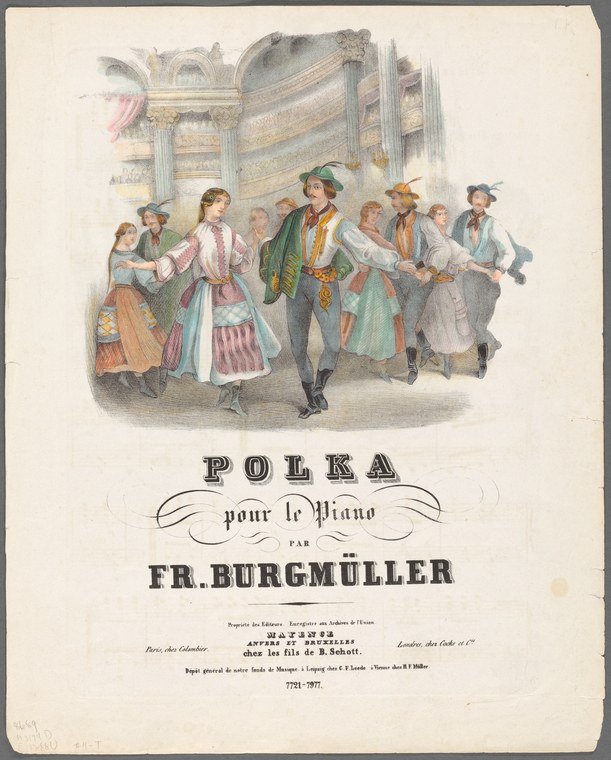
Polka pour le piano par Fr[édéric] Bürgmuller
Unknown artist
- Collection:
- Prints depicting dance
- Source:
- New York Public Library
- Rights:
- Public domain — free to use, share and adapt.
- Recorded as:
- Public Domain
Polka sheet-music covers are primary documents of 19th-century dance history, showing not only the music people played but how they understood the social meaning of the dance they danced. This image testifies to the polka's status as *the* modern social dance of the industrial 19th century—more democratic and energetic than the baroque minuet or the romantic waltz, and documented in thousands of such prints across Europe and America.
What you are looking at
A lively gathering of nine figures in 19th-century European dress fills an interior space marked by classical architectural details—fluted columns, arched doorway, and ornamental cornice. At center, a man in green coat and brown hat gestures expansively toward a young woman in a white dress with pink and orange trim; she turns toward him with evident delight. Around them, four other couples and single figures stand or move in animated conversation and preparation to dance. The lighting is warm and diffuse, suggesting gaslight or candlelight. The composition suggests a parlor or ballroom at the moment dance is about to commence—a snapshot of courtship, music, and the social excitement of the dance floor.
The dancing
The central couple are not yet in closed hold, but the man's open gesture and the woman's turned attention show the moment of invitation. The surrounding figures stand in loose groupings, some with arms at rest, others with hands raised in conversation or readiness. The poses are varied—some upright and formal, others leaning slightly forward in engagement. The dress of the men includes tailored coats and hats; the women wear full skirts typical of 1850s fashion. No visible footwork or technical frame is evident; these are social dancers at ease before the music begins.
The dance depicted
This is a polka, identified by the title. The polka emerged in Bohemia in the 1840s and became the dominant fashionable dance of the mid-to-late 19th century across Europe and America. It was danced in couples in closed position with a lively 2/4 rhythm, and was socially central to balls and parlor dancing. The scene captures not the technical moment of the dance itself, but the social occasion around it—the flirtation, the assembly, the anticipation. This was the dance of courtship and urban sociability, more energetic and less formal than the waltz, and enormously popular with both men and women.
How it was made
This is a hand-colored lithographic print, visible from the soft modeling, the registration marks, and the characteristics of chromolithographic layering—the distinct color separation, the gentle transitions, the slight imprecision at edges that lithography allowed and encouraged. The medium made such prints affordable and reproducible, circulating widely as sheet-music covers, parlor decoration, and souvenirs. The colored lithograph could convey both the informality of the social scene and the period detail of dress and architecture, making it ideal for marketing dance music to middle-class households.
About this work
This is the cover of a polka for solo piano by Frédéric Burgmüller, a prolific composer of salon dances in 19th-century Paris. The image is not a representation of a specific performance, but rather a romantic social scene meant to embody the mood and occasion of the music—the parlor, the couples, the anticipation of dance. The print belongs to a vast publishing tradition of illustrated sheet music from the 1840s through 1890s, when such covers served as both marketing and as visual guides to the social context of the music within.
The polka was the dominant social dance of its era, and sheet-music covers are among the richest documentary sources for how it was dressed, framed, and valued. This print shows it as an urban, middle-class, heterosexual courtship ritual—formal enough to require special dress and architectural setting, but informal and playful enough to permit the direct, animated gesture and the evident pleasure visible in every face.
How to look at it
Notice the moment chosen: not the dance itself, but the instant before it begins, when invitation meets acceptance and social pleasure is visible on every face. The architectural setting—the formal columns and cornice—anchors this as an indoor, urban, probably middle-class scene. The dress is scrupulously detailed and fashionable, signaling that this is contemporary and aspirational. The composition is a conversation piece, not a dance picture; it shows the social world the polka inhabited, not the technique of the polka itself.
The artist
Frédéric Burgmüller (1806–1874) was an Alsatian pianist and composer of salon music, highly regarded in Paris during the mid-19th century. He composed over 100 works, most of them for solo piano or small ensemble—dances, character pieces, and pedagogical works. His polkas and other salon dances were extremely popular with amateur musicians and music teachers, and his works circulated widely through published sheet music with illustrated covers such as this. He represents the vast publishing industry that made dance music accessible to middle-class households.
The period
The polka emerged in Prague in the 1840s and spread to Vienna, Paris, and London within a decade, becoming the fashionable dance of the 1850s and 1860s. It was danced at all social levels and in all contexts—from aristocratic balls to middle-class parlors to public dance halls. In the same period, chromolithographic printing was revolutionizing the music publishing industry, allowing publishers to issue thousands of copies of illustrated sheet music at affordable prices. Dance music was among the best-selling categories of printed music, and polka publications were a major segment of that market. The image dates to that moment when printed dance music had become a mass-market commodity.
Where it lives
This print is held in the New York Public Library's collection of prints depicting dance. Such illustrated sheet-music covers are common in major music and print collections; this one is documented as a published work, likely from the 1850s–1860s, and was part of the commercial music publishing trade.
Dance in this work
Questions about this work
Was the polka really danced by ordinary people, or just aristocrats?
The polka was democratic by 19th-century standards. It was danced at all social levels—at aristocratic balls, at middle-class assemblies and parlor dances, and at public dance halls. Sheet-music covers like this one were aimed at middle-class home musicians and suggest the polka was accessible to anyone with a piano and enough social standing to host or attend a dance.
Why doesn't this image show people actually dancing?
Sheet-music covers often depicted the social occasion rather than the technical dance, because they needed to appeal to purchasers who might not know the dance well. Showing the moment of courtship and anticipation was more commercially effective and emotionally resonant than showing footwork or choreography.
Who was Frédéric Burgmüller?
Burgmüller was an Alsatian composer (1806–1874) based in Paris, prolific in salon music—dances, character pieces, and pedagogical works for piano. His polkas and mazurkas were widely published and performed by amateurs. He represents the vast commercial apparatus of 19th-century music publishing that made dance music available to middle-class households.
What is a polka?
The polka is a couple dance in 2/4 time that emerged in Prague in the 1840s and became the fashionable social dance across Europe and America by the 1850s. It is faster and more energetic than the waltz, with a characteristic hop-step pattern, and was danced in closed position. Thousands of polkas were composed, published, and danced in the 19th century.
More dance artwork





