49 works in this view — arrow keys or swipe to move between them.
Dance in Art
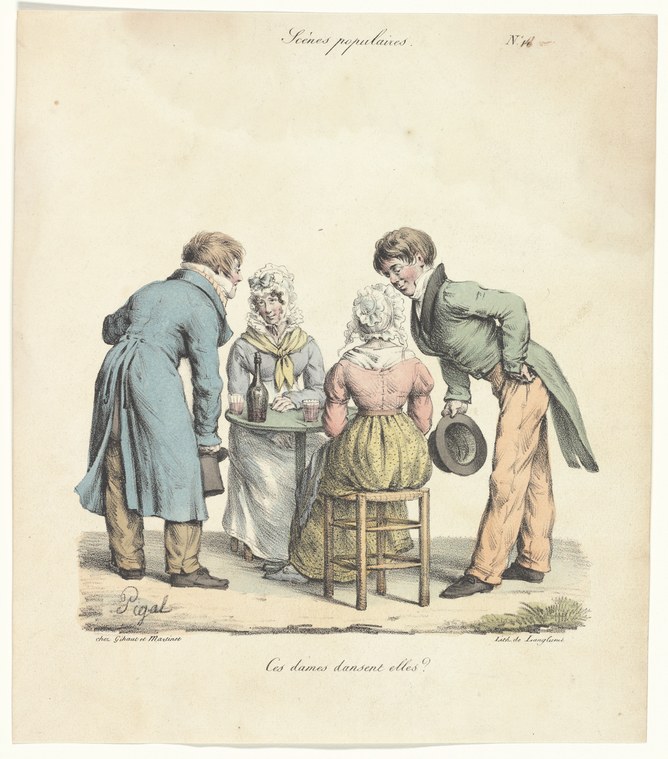
Ces dames dansent elles?
Unknown artist
- Collection:
- Prints depicting dance
- Source:
- New York Public Library
- Rights:
- Public domain — free to use, share and adapt.
- Recorded as:
- Public Domain
This image reveals that early 19th-century artists and audiences understood dance not as isolated movement but as embedded in courtship ritual and gender negotiation. The title's satirical tone—questioning whether the ladies will dance—shows that women's agency in accepting or refusing dance invitations was a subject of contemporary humor and interest, making this a document of changing attitudes toward women's social power.
What you are looking at
A hand-colored engraving depicting four fashionably dressed figures in an interior or neutral setting, apparently engaged in social interaction around a seated woman. Two men in tailcoats and trousers flank the scene—one in blue on the left, one in green on the right—while a woman in a yellow-gold dress sits on a simple wooden chair, and another stands behind her in a gray-blue dress with a yellow bow. The seated woman wears an elaborate white bonnet or headdress and appears to be the focal point of attention. The standing woman's posture suggests she is in motion or about to move. The title, "Ces dames dansent elles?" (Do these ladies dance?), is printed below the image, framing the scene as a satirical or rhetorical question about dance and courtship. The composition is intimate and theatrical, with the figures arranged in a tight group that suggests a moment of social negotiation or flirtation.
The dancing
The two women occupy the visual and social center: one seated with hands folded, upright and composed; the other standing with a dynamic posture and raised arm, suggesting readiness or invitation to movement. The men lean inward toward the women with attentive, engaged body language. All four figures are upright and formally dressed, with no obvious dance hold or embrace. The arrangement and gestures suggest conversation and courtship negotiation rather than an active dance.
The dance depicted
This is likely a satirical social commentary on ballroom dancing and courtship convention in early 19th-century France, rather than a depiction of an actual dance in progress. The title's question format implies skepticism or humor about whether the ladies will accept an invitation to dance. The image captures the moment of social negotiation that precedes dancing—the formal offer and response between potential dance partners—rather than the dance itself. The dress and formality suggest the context of salon or ballroom society.
How it was made
This is a hand-colored engraving or possibly aquatint, evident from the fine line work and the application of watercolor or hand-applied pigment. The signature "Boizot" (or similar) is visible in the lower left. The technique allowed for satirical social imagery to be produced affordably and distributed widely to a middle-class audience interested in humor about manners and courtship. The hand-coloring gives specificity to fabrics and fashionable dress details that would enhance its appeal to contemporary viewers conscious of fashion.
About this work
This is a satirical engraving from the early 19th century that uses the question of whether ladies will dance as a vehicle for commentary on courtship and social negotiation in Regency-era society. Rather than depicting an actual dance, it freezes the moment of negotiation—the formal approach, the offer, and the woman's response—as the real subject of interest. The work belongs in a dance gallery not because dancing is occurring, but because it documents the social and gender dynamics that structured dance as a courtship ritual, and because the artist uses the expectation of dance as the frame for satirizing these conventions.
How to look at it
Attend to the postures and spatial relationships: the men's inward lean, the seated woman's composure, the standing woman's raised arm and forward stance. Notice that despite the title's reference to dancing, no one is actually dancing—the image captures the negotiation that precedes dance. The carefully rendered fabrics and fashionable details of dress are not incidental; they anchor the scene in a specific social class and moment. The artist is asking the viewer to recognize themselves in this familiar, slightly ridiculous scene of courtship.
The artist
The work is signed by what appears to be Boizot or a similar hand, likely a French satirical engraver or illustrator of the Regency period. The style, humor, and subject matter are consistent with French social-commentary printmaking of the 1810s–1820s, a period when such images were produced for middle-class consumption. Without certain attribution, the artist's full practice cannot be established, but the competent draftsmanship and understanding of fashion suggest professional training.
The period
In early 19th-century France, the ballroom waltz and contradance were becoming central to courtship and social life, especially among the middle classes and gentry. Dance was highly codified: women did not invite men, and acceptance of a dance invitation carried social and romantic implications. Satirical prints about manners and courtship were enormously popular during this period, offering audiences a way to laugh at social pretension and the anxieties of courtship. The Regency era (1811–1820 in Britain, comparable periods elsewhere) saw intense interest in fashion, etiquette, and the rules governing male-female interaction.
Where it lives
The work is held in the New York Public Library's collection of prints depicting dance. It is part of a larger body of social-commentary engraving from the Regency era, though the specific catalogue information is minimal.
Dance in this work
Questions about this work
Is anyone actually dancing in this image?
No. The title asks whether the ladies will dance, but the image shows the social negotiation that happens before dancing begins—the formal approach and offer. The artist has chosen to freeze the moment of courtship negotiation rather than the dance itself, using the expectation of dance as a frame for social satire.
What does the question mark in the title mean?
It signals satire and skepticism. The question 'Do these ladies dance?' is rhetorical and gently mocking, inviting the viewer to laugh at the formal politeness and the woman's apparent composure or resistance. It suggests doubt about whether the ladies will agree.
What period of dress and dance is this?
The style and fashion suggest the Regency era, roughly 1810–1820, when the waltz was becoming fashionable and courtship through dance was a central feature of ballroom society. The men's tailcoats, the women's high-waisted dresses and elaborate bonnets, and the formal interior setting are all consistent with this period.
More dance artwork





