49 works in this view — arrow keys or swipe to move between them.
Dance in Art
La mazurka
Unknown artist
- Collection:
- Prints depicting dance
- Source:
- New York Public Library
- Rights:
- Public domain — free to use, share and adapt.
- Recorded as:
- Public Domain
The mazurka was a pivotal dance in the 19th-century social world, more complex and varied than earlier dances like the cotillion and a vehicle for romantic expression between partners. This image documents both the dance itself and the fashion and deportment of the period in which it flourished, making it valuable evidence for understanding how the mazurka was actually performed and presented to the fashionable public.
What you are looking at
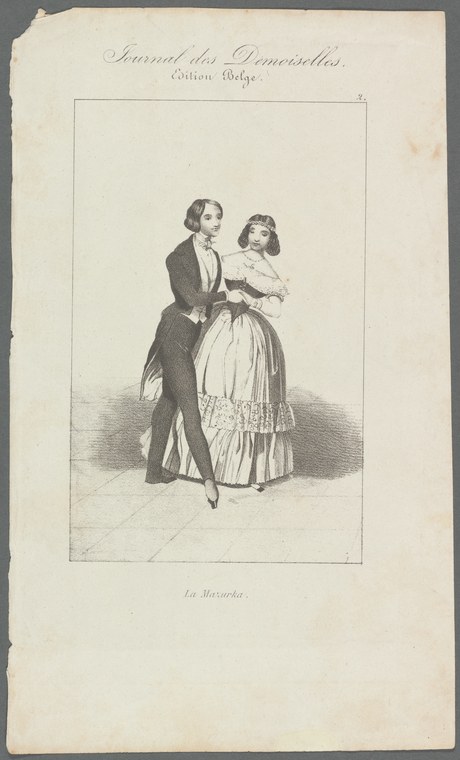
A young couple is depicted in an intimate moment of dance, set against a plain background. The man, dressed in a dark formal coat and trousers with a white shirt front, stands behind and to the side of the woman, his right arm around her waist in a close embrace. The woman wears a white or pale dress with a full skirt gathered at the waist, the fabric rendered with delicate cross-hatching to suggest volume and texture. Her dark hair is parted and drawn back in the fashion of the 1840s–50s. Both figures are shown mid-movement, with the woman's body angled slightly forward and her weight shifted, suggesting rotation or forward progression. The composition is intimate and carefully balanced, with the couple occupying the center of the frame. The print shows skilled use of light and shadow to model the figures and suggest the fabric of their clothing, while the empty background focuses all attention on the dancers themselves.
The dancing
The hold is characteristic of 19th-century ballroom dancing: the man's right arm encircles the woman's waist while his left arm would support her right hand (though her arms are not clearly detailed in the print). The woman leans slightly into her partner, her torso angled to the right. Both dancers appear to be turning or traveling forward together, their bodies aligned in the closed position standard to European couple dances of this period. The artist has captured a moment of partnership and momentum, with the woman's skirt suggesting the rotational energy of the dance.
The dance depicted
The title identifies this as *La Mazurka*, one of the most fashionable ballroom dances of the 19th century. The mazurka originated in Poland but became a staple of European ballrooms from the 1830s onward, particularly popular in salons and at formal dances. The closed hold, the woman's skirt volume, and the formal dress confirm the ballroom context. The mazurka was danced by couples in a triple meter with a characteristic accent on the second beat, and it allowed for both prescribed figures and improvisational movement within the frame of the closed position. This print captures the essential partnership and elegance that made the mazurka so appealing to the 19th-century social dance world.
How it was made
This is a lithograph or engraving, printed on paper, from the French publication *Journal des Demoiselles* (a ladies' journal). The technique, identifiable from the fine parallel lines (cross-hatching) used to model form and fabric, and the crisp black-and-white rendering, suggests a wood engraving or possibly lithography—common processes for periodical illustration in the mid-19th century. The title and publication note are printed in an elegant cursive script at the head and foot of the page. The print's circulation as part of a periodical aimed at women made it a vehicle for disseminating fashionable dance and dress to a broad audience.
About this work
This is a mid-19th-century ballroom dance scene, a lithographed or engraved illustration from a French ladies' magazine, depicting a couple performing the mazurka in formal dress. The mazurka was at the height of its fashionable popularity in European salons and ballrooms during the 1840s and 1850s, and prints such as this served both as documentation of current dance practice and as aspirational images of genteel social life. The work captures the intimate partnership and graceful carriage that defined ballroom dancing in this period, at a moment when dance was central to the courting rituals and leisure life of the European middle and upper classes.
How to look at it
Observe the closed embrace and the tilt of the woman's torso into her partner, which conveys both the physical mechanics of turning and the emotional closeness the mazurka was designed to express. The artist has frozen the couple mid-rotation, capturing the moment of dynamic partnership. Note also the rendering of the woman's skirt: the way the fabric is detailed suggests the momentum of the dance and the volume of the costume, which was essential to the visual spectacle of the ballroom. The blank background is deliberate—it isolates the couple and emphasizes the form of the dance itself rather than any particular social setting.
The period
The mazurka became wildly fashionable in European ballrooms from the 1830s onward, following the Romantic era's enthusiasm for folk traditions and 'exotic' national dances. Polish officers and aristocrats brought the dance to Paris and London, where it was quickly adopted and refined in the ballroom context. The 1840s and 1850s saw the mazurka at its zenith of popularity; it appears constantly in ballroom manuals, dance notation systems, and popular prints like this one. The dress shown here—the man's formal coat and the woman's full skirt with fitted bodice—is consistent with ballroom fashion of the 1845–1855 period. By this time, the mazurka had become so established in polite society that it was considered an essential accomplishment for young women and men of good family.
Where it lives
This print is held in the New York Public Library's collection of prints depicting dance. It is reproduced from *Journal des Demoiselles*, a French publication aimed at a female readership, suggesting it was circulated as a fashionable illustration available to a broad middle-class audience.
Dance in this work
Questions about this work
What is the mazurka and why was it so popular?
The mazurka is a Polish dance in triple meter that became the rage of European ballrooms in the 19th century. It was more complex and emotionally expressive than earlier formal dances, allowed room for variation and improvisation, and served as a vehicle for romantic interaction between partners. Its association with Polish national identity and its elegance made it irresistible to the Romantic era's taste.
How do you dance a mazurka?
The mazurka is danced by couples in a closed position (as shown here), in triple meter with a characteristic accent on the second beat. Dancers move in rotating, traveling figures while maintaining the embrace. The man leads the direction and rotation while the woman follows, moving backward or turning as needed. There are many prescribed figures, but skilled dancers could also improvise within the basic framework.
What does the dress in this image tell us?
The woman's full skirt, fitted bodice, and the hair style are consistent with 1840s–1850s fashion. The man's formal coat and trousers were standard ballroom dress for gentlemen. These garments confirm that this is a scene of fashionable urban social dancing, not folk dancing or theatrical performance. The woman's skirt would have been supported by layers of petticoats, adding to the visual effect of the dance.
More dance artwork





