49 works in this view — arrow keys or swipe to move between them.
Dance in Art
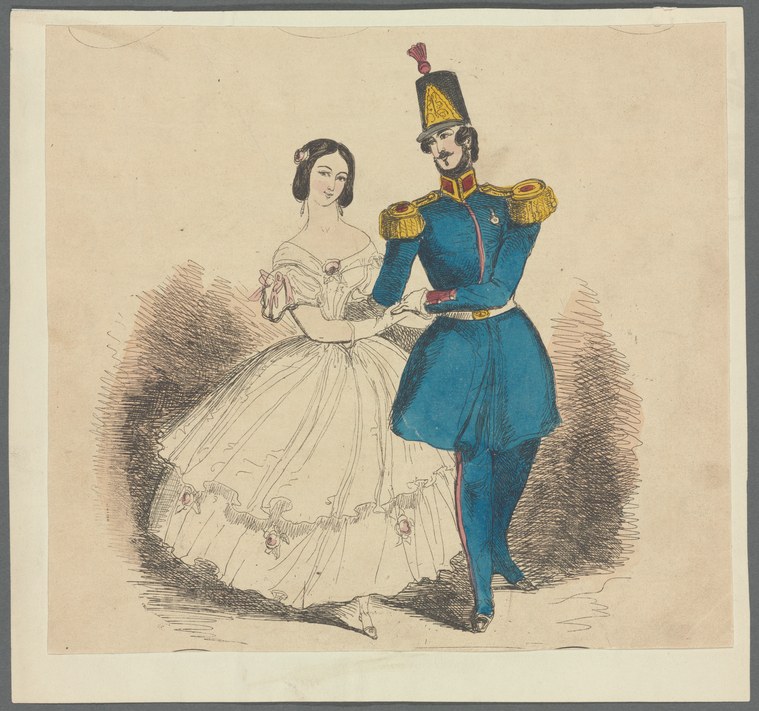
Woman with man in military uniform
Unknown artist
- Collection:
- Prints depicting dance
- Source:
- New York Public Library
- Rights:
- Public domain — free to use, share and adapt.
- Recorded as:
- Public Domain
Ballroom dance in the nineteenth century was the primary sanctioned context for unmarried men and women of the respectable classes to touch and move together; prints like this one show how dance was inseparable from courtship, propriety, and social hierarchy. The military uniform marks the officer's status; the ball gown marks the woman's eligibility. Understanding how dance functioned in this period requires seeing not just the movement but the costume, the ritual, and the social stakes that surrounded it.
What you are looking at
A young woman in an elegant white ball gown stands beside a military officer in a formal blue dress uniform. The woman wears a low-cut bodice with off-shoulder sleeves and a full skirt decorated with what appears to be embroidered or appliquéd detail at the hem; her dark hair is parted in the center and styled close to her head in the fashion of the 1840s–50s. The officer stands upright in a double-breasted coat with gold epaulettes on the shoulders, a tall plumed military hat, and holds what appears to be a sword or ceremonial object. The pair are positioned close together in a formal stance against a neutral background with light cross-hatching suggesting depth. The woman's posture is demure and upright; the officer's is martial and assertive. The composition suggests a moment of courtship or formal social encounter rather than active dance movement, though the proximity and formal dress evoke the ballroom context in which couples would have danced together.
The dancing
Both figures are standing rather than actively dancing, with no visible contact between them or evidence of a dance hold. The woman's arms hang naturally at her sides; the officer's arms are similarly relaxed. Their bodies are parallel and frontal to the viewer, angled slightly toward each other. The stance is static and posed rather than captured mid-movement, suggesting a formal presentation or introduction scene rather than an action shot. Neither figure shows the dynamic weight shift, extension, or frame typical of ballroom dance as it would be executed, though their proximity and formal dress place them in a dance context.
The dance depicted
While the figures are not actively dancing, the image is a representation of ballroom courtship culture, most likely depicting a moment before or after a waltz or other social dance popular in mid-nineteenth-century European ballrooms. The woman's white gown and the officer's dress uniform are the standard costume for such formal occasions. The image documents the social ritual of the dance rather than the dance itself—the moment of introduction or invitation that would precede or follow the actual movement. The stillness and formality suggest an engraved illustration intended to depict social custom rather than choreographic technique.
How it was made
This is a hand-colored engraving or possibly a hand-tinted lithograph, executed in the style of mid-nineteenth-century fashion and social illustration. The line work and cross-hatching are characteristic of engraving; the figures are rendered with careful attention to dress detail while the background is kept simple and atmospheric. The coloring—the blue of the uniform, the pale tones of the gown, the pink of the feather—has been applied by hand or in limited color passes. This technique allowed for relatively inexpensive reproduction and mass circulation through print shops and fashion journals, making it an accessible form of visual documentation of contemporary ballroom etiquette and dress for a middle-class audience.
About this work
This is a mid-nineteenth-century engraving depicting a formal moment of courtship in the ballroom—a young woman in an elaborate white ball gown and a military officer in full dress uniform, standing in proximity that suggests introduction or invitation to dance. The work documents not the choreography of ballroom dance but its social context: the costumes, the gender roles, the formality of encounter that structured dancing in elite and aspiring-middle-class society. Such prints were common in the period, circulating through fashion journals and popular prints to establish and reinforce codes of courtship and social behavior.
The image belongs in a dance gallery because it is a cultural document of how dance operated as a ritual of courtship and social climbing. The ballroom was not simply a place where people moved to music; it was a stage for negotiating marriage, status, and eligibility. This engraving freezes the moment of approach—the moment before the music, the moment that made the dance socially meaningful.
How to look at it
The stillness of this image is significant: the artist has chosen not to depict movement, but presentation. Note how the woman and officer are turned slightly toward each other but do not touch—this was the moment of approach, before the dance began. The woman's modest downward gaze and the officer's formal bearing encode social rules about gender and deference in the ballroom. The careful rendering of fabrics and insignia tells us that costume mattered enormously—that who you were (officer, eligible woman) was legible from what you wore. The background is almost entirely absent, focusing all attention on the figures and their dress, which is typical of fashion and etiquette illustration.
The period
The 1840s–1860s were the heyday of the waltz in European ballrooms, and with it came intense anxiety about propriety—the waltz brought couples into closer contact than earlier dances, and its rotational movement was considered by some to be scandalously intimate. This engraving likely dates to this period, when visual documentation of correct ballroom behavior was in high demand, both as fashion illustration and as a guide to social conduct. Military officers were among the most desirable ballroom partners, and dance cards and prints frequently featured them. The formal dress depicted here—the woman's off-shoulder white gown and the officer's full-dress uniform—are the standard costume for the most formal court balls and state occasions.
Where it lives
This work is held in the New York Public Library's collection of prints depicting dance. It is an example of the popular illustrated literature on ballroom culture and fashion that circulated widely in mid-nineteenth-century Europe and North America, likely reproduced in journals, sold as individual prints, or bound into guides to etiquette and social conduct.
Dance in this work
Questions about this work
Is this couple actually dancing?
No. The figures are standing in a formal pose, not executing a dance. However, the image documents ballroom culture and the moment of courtship that preceded or followed dance. The woman's white ball gown and the officer's dress uniform identify the social context: the formal ballroom where dancing was a primary ritual of courtship.
What does the military uniform tell us?
Military officers were among the most desirable ballroom partners in nineteenth-century society, signaling status, eligibility, and social authority. The full-dress uniform with epaulettes indicates a formal court ball or state occasion. His prominence in the image reflects the social prestige of the military in this period.
What kind of dance would they have danced together?
Most likely a waltz, the dominant ballroom dance of the 1840s–60s, or possibly a quadrille or other figure dance. The formal dress and the proximity suggest a waltz, which required couples to maintain closer contact than earlier dances and was considered more intimate and modern.
What is the white dress embellished with?
The hem appears to have embroidery or appliquéd decoration—a common feature of evening wear in this period. The off-shoulder neckline and full skirt are characteristic of mid-nineteenth-century formal ball gowns, designed to display fabric, needlework, and the wearer's status.
More dance artwork