49 works in this view — arrow keys or swipe to move between them.
Dance in Art
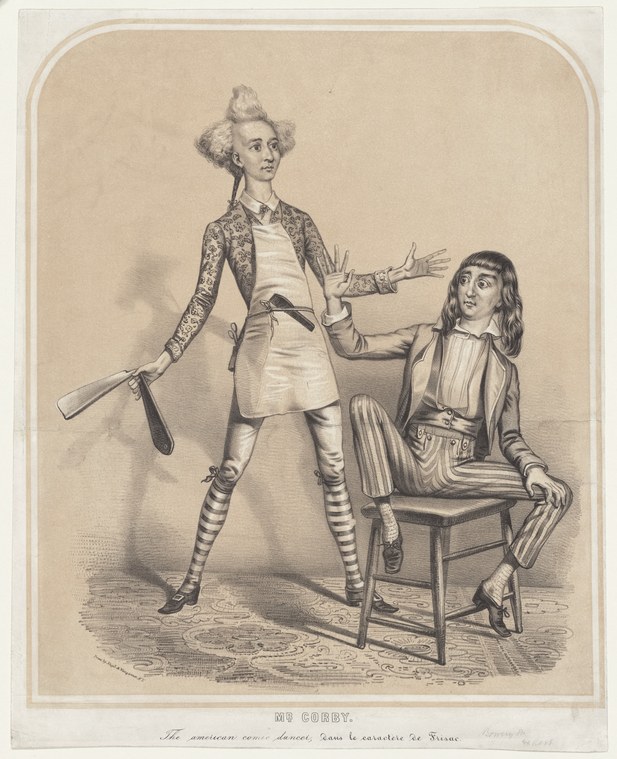
Mr. Corby: the American comic dancer, dans le caractère de Frisac
Unknown artist
- Collection:
- Prints depicting dance
- Source:
- New York Public Library
- Rights:
- Public domain — free to use, share and adapt.
- Recorded as:
- Public Domain
This print captures the style and costume of a specialized but now-obscure theatrical tradition—the American comic or character dance of the 19th century. For historians of vernacular and theatrical dance, the image is invaluable evidence of the physical technique, the movement vocabulary, and the performance aesthetic of a genre that left little written documentation. The identification of the specific dancer and character role also anchors the image within a broader theatrical ecosystem, connecting individual performers to named roles and styles.
What you are looking at
A standing male dancer in striped stockings and a patterned jacket dominates the composition, one leg extended in a wide stride, his upper body angled forward with arms open in an expressive gesture. He wears a white shirt and waistcoat beneath the jacket, and his hair is styled high and swept back in the fashion of the early 19th century. Beside him sits a younger male figure in striped breeches and a pleated shirt, watching the standing dancer with an expression of surprise or concern. The seated figure is perched on a simple wooden chair, his body turned toward the performer. The setting is plain and undefined, rendered in light tones with minimal background detail, focusing all attention on the two figures and the moment of performance. This is a theatrical print, likely from a playbill or promotional material, capturing the physical comedy and energy of the standing dancer's solo turn.
The dancing
The standing dancer's weight is shifted onto one leg with the other extended and slightly turned, creating a diagonal line across the body. His torso leans forward at the hip, arms spread wide—one raised, one extended downward—in an open, expansive frame characteristic of comic or character dance. The seated figure maintains an upright posture, one leg bent, the other extended, his arms at his sides, his attention fixed on the performer. The contrast between the two bodies—one in active, exaggerated motion, the other static and observing—creates a clear performance dynamic. Both figures display the articulate leg and footwork positioning typical of theatrical dance of the period, with visible attention to the placement and extension of the limbs.
The dance depicted
This image documents 'Mr. Corby,' identified in the title as an American comic dancer performing in the character role of 'Frisac.' The pose and costume suggest a 19th-century theatrical tradition of character and comic dance, likely drawn from pantomime or stage farce. The exaggerated stance, wide legs, and open arm frame are consistent with the broad physical vocabulary of music-hall or legitimate theater dance of the Gilded Age, when such character comedians performed elaborate solo turns. The titled identification of both dancer and character role indicates this was a known performer with a recognized specialty, likely capturing a famous or signature moment from his act. The print itself is promotional material for theatrical performance, preserving the image of a specific artist and role for circulation among audiences and theater managers.
How it was made
This is a lithograph or engraving on paper, rendered in black ink with light tonal shading to suggest form and depth. The technique allows for fine detail in the rendering of fabric texture (the patterning of the jacket, the striping of the stockings) and facial expression, while the linear approach emphasizes the clarity of the pose and the silhouette of the body. The medium was standard for theatrical promotional prints of this era, allowing for multiple copies to be distributed to theaters, performers, and collectors of theatrical memorabilia. The clean line work and the relatively simple background suggest this was a commercial print made for wide circulation, not a fine-art engraving.
About this work
This is a theatrical promotional print of the American comic dancer Mr. Corby performing as the character 'Frisac,' likely made in the mid-to-late 19th century. The image preserves the pose, costume, and performance style of a specialized theatrical genre—the comic or character dance that flourished on American and European stages during the Gilded Age. The print documents both the physical vocabulary of the dance (the exaggerated leg extension, the open arm positions, the forward-tilted torso) and the theatrical context (the costume, the character identification, the staged moment captured for promotional purposes). This work belongs in a dance archive as evidence of how comic dance was marketed, performed, and remembered in the theatrical culture of this period.
How to look at it
Attend to the exaggerated openness of the pose—the wide stride, the spread arms, the forward lean of the torso. This is not the closed, controlled frame of ballet or the compact, grounded stance of social dance; it is the vocabulary of comic or burlesque performance, where the body is displayed and extended for visual impact. Notice also the contrast between the two figures: the performer's energy and extension are set against the seated watcher's stillness and surprise, a compositional choice that frames the dance as spectacle. The striped stockings and patterned jacket draw the eye to the legs and to the articulation of the lower body, suggesting that footwork and leg extension were key elements of this performer's technique.
The artist
The artist is not recorded. The print bears a publisher's mark or imprint but no signature of a draftsman. The work is characteristic of theatrical lithography or engraving of the mid-19th century, a commercial practice that prioritized clarity of costume and pose over the distinctive hand of the maker. Many such prints were produced anonymously or by house artists working for theatrical publishers and printing houses.
The period
This print dates to the era of music-hall, vaudeville, and legitimate theatrical dance, when comic and character roles were staples of stage entertainment in America and Europe. The early-to-mid 19th century saw the rise of the specialized 'character dancer'—a performer distinct from both the ballet dancer and the social dancer, trained in pantomime, acrobatics, and comic business. The Gilded Age theatrical world promoted these performers through images like this one, creating a visual record of their acts for audiences and for the archive of theatrical memory. The costume and styling suggest a date in the 1860s–1880s, when such character performers were at the height of popularity.
Where it lives
The print is held in the New York Public Library's collection of prints depicting dance. It is catalogued as promotional or theatrical memorabilia rather than as fine art, reflecting its original purpose and circulation as a commercial object for theatrical promotion and audience engagement.
Dance in this work
Questions about this work
Who was Mr. Corby?
Mr. Corby was an American comic dancer known for character roles, particularly the role of 'Frisac.' Beyond this image and title, little is currently known about him. He was active in the 19th-century theatrical world, performing in the tradition of character and comic dance that flourished in music halls and on legitimate stages. If you have additional information about his career or performances, the NYPL would welcome a contribution to the record.
What is 'character dance' as performed here?
Character dance is a theatrical tradition distinct from ballet or ballroom dance, combining pantomime, acrobatics, comic business, and stylized movement. Performers like Corby were specialists in roles requiring exaggerated physicality, elaborate costumes, and often a named character persona. This tradition was especially popular in 19th-century music halls and vaudeville theaters, and it remains a recognized category in theatrical training and performance today.
How was this print made and used?
This is a lithograph or engraving, a commercial print technology that allowed multiple copies to be made inexpensively. Such prints were distributed to theaters, sold to collectors and fans, and used as promotional material in playbills and theatrical advertisements. They served as a permanent record of a performer's costume and pose, circulating the image of the act to wider audiences than could see the live performance.
What does the pose tell us about the dance?
The wide stance, extended leg, and open arm frame indicate a dance style emphasizing extension, exaggeration, and visual display. The forward-tilted torso and the asymmetrical positioning suggest movement that is neither the vertical alignment of classical ballet nor the compact frame of social dance, but rather a specialized athletic and comic vocabulary designed for maximum visual impact on a theatrical stage.
More dance artwork





