49 works in this view — arrow keys or swipe to move between them.
Dance in Art
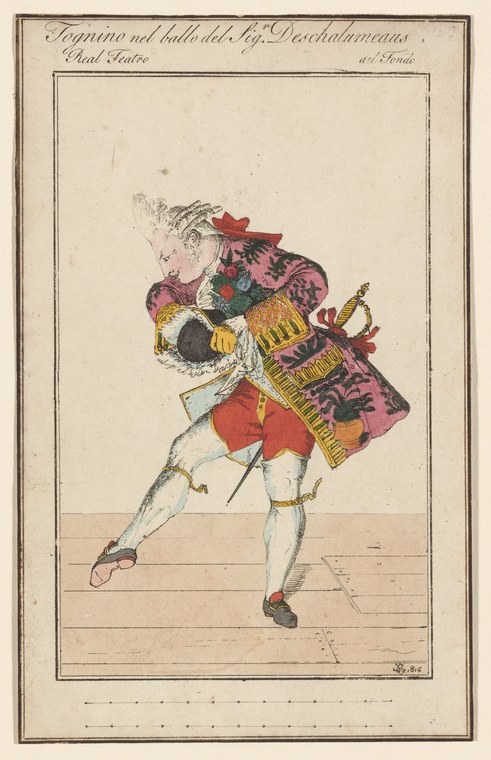
Tognino nel ballo del Sig'r Deschalumeaus, Real Teatro del Fondo
Unknown artist
- Collection:
- Prints depicting dance
- Source:
- New York Public Library
- Rights:
- Public domain — free to use, share and adapt.
- Recorded as:
- Public Domain
This work preserves evidence of a theatrical dance tradition—commedia dell'arte character dancing—that is often overlooked in histories that focus on court ballet and classical technique. It shows that 18th-century professional entertainment incorporated athletic, comic, full-bodied movement far removed from formal courtly models, and that such performances were documented, celebrated, and circulated as prints for a paying public.
What you are looking at
A single male dancer in theatrical costume occupies the center of a shallow stage space defined by a simple wooden floor. He wears an elaborate coat of purple and gold brocade with large puffed sleeves, ornate buttons, and gold braid trim, paired with red breeches and pink hose. A large red bow adorns his head above a white powdered wig. He holds a black tricorn hat in his left hand and a long sword or cane in his right. His body is caught in a dynamic, high-spirited pose: weight shifted onto his back leg, his torso tilted forward, one leg extended, his right arm raised in an expressive gesture. The figure has an air of theatrical exaggeration and performative energy characteristic of 18th-century stage entertainment. The image is hand-colored in reds, purples, golds, and flesh tones over a printed base, and is mounted on laid paper with a simple ruled border.
The dancing
A single dancer in a three-quarter profile view, with his weight on his back leg and his front leg extended in a dynamic kick or extension. His upper body leans forward with theatrical flair, his right arm raised and bent at the elbow in an expressive pose, while his left arm holds a hat at his side. His posture combines elements of a formal court stance with an energetic, almost acrobatic quality—the raised leg and forward torso tilt suggest athletic control and deliberate showmanship rather than the measured steps of a social dance.
The dance depicted
This is a theatrical dance character, most likely a comedic or pantomimic role from 18th-century commedia dell'arte or Italian theatrical tradition, as suggested by the inscribed title 'Tognino' (a stock character name) and the reference to a specific performer or production ('Sig'r Deschalumeaus') at a real theater ('Real Teatro del Fondo'—possibly a reference to the Teatro del Fondo in Naples). The dress, gesture, and theatrical setting point to a type of entertainment that combined music, dance, and comedy popular in Italian courts and public theaters. The athletic, exaggerated pose suggests this was not a courtly minuet or formal social dance, but rather a character dance or comic pantomime performed for entertainment.
How it was made
This is a hand-colored engraving or etching on laid paper, evidenced by the fine linear hatching visible in the shadows and the printed baseline of the composition. The coloring is applied by hand in opaque watercolor or gouache, with visible brushwork in the coat and wig. Such prints were widely circulated in the 18th century as both souvenirs of theatrical performances and as documentation of famous dancers and comedic roles. The technique allowed for rapid, affordable reproduction and distribution to audiences and collectors across Europe.
About this work
A theatrical character portrait from the 18th century showing Tognino, a named stock character or performer role, in mid-performance. The work documents not formal dance training but theatrical comedy and entertainment—likely from Neapolitan theater or the commedia dell'arte tradition. The figure's athletic pose, elaborate costume, and expressive gesture capture a moment of performance intended to amuse and delight, marking the intersection of dance, theater, and comedy in early modern popular entertainment.
How to look at it
Observe the extremity of the pose: the high extension of the leg, the forward lunge of the torso, the raised arm—this is not the measured elegance of a baroque minuet, but athletic and comedic exaggeration. The costume is equally theatrical: the enormous coat with puffed sleeves, the red bow, the oversized buttons are designed to read from a distance and to move with the body for comic effect. The artist has frozen a moment of obvious physical exertion and theatrical energy, capturing the moment when the performer commands attention through sheer vitality and comic presence.
The period
This print dates to the 18th century, a period when theatrical dance in Italy was dominated by commedia dell'arte, pantomime, and comic performance, running parallel to the more formal world of court ballet. The 'Real Teatro del Fondo' reference suggests Neapolitan origins. At this time, character dances and comic roles were integral to theatrical spectacle; named performers like Tognino and Deschalumeaus achieved celebrity status, and their likenesses were circulated as prints. This was the era before the modern theatrical dance hierarchy, when comedy, acrobatics, and pantomime held equal status with courtly forms.
Where it lives
This work is held in the New York Public Library's collection of prints depicting dance. It is a hand-colored engraving or etching, likely produced in Italy in the 18th century as a theatrical souvenir or documentation of a famous performance or performer.
Dance in this work
Questions about this work
Who was Tognino?
Tognino was a stock character name in commedia dell'arte and Italian theatrical tradition, similar to Arlecchino or Pantalone. The inscription suggests this print documents a specific performer or performance by 'Sig'r Deschalumeaus' at the Real Teatro del Fondo, likely in Naples, in the 18th century. Without further research into theater records, we cannot determine if Tognino was a named character type or a specific performer's stage name.
Is this ballet?
No. This is theatrical dance or comic pantomime from the commedia dell'arte tradition, performed in popular Italian theaters. It is fundamentally different from court ballet or classical theatrical dance in training, aesthetic, and purpose. The emphasis is on comedy, athleticism, and character rather than formal technique.
What does the pose tell us?
The high leg extension, forward lean, and raised arm indicate a performer trained in acrobatics, mime, and theatrical movement rather than formal dance technique. This was full-body, athletic entertainment designed to amuse through exaggeration and physical daring, very different from the contained, line-focused movement of ballet.
More dance artwork





