49 works in this view — arrow keys or swipe to move between them.
Dance in Art
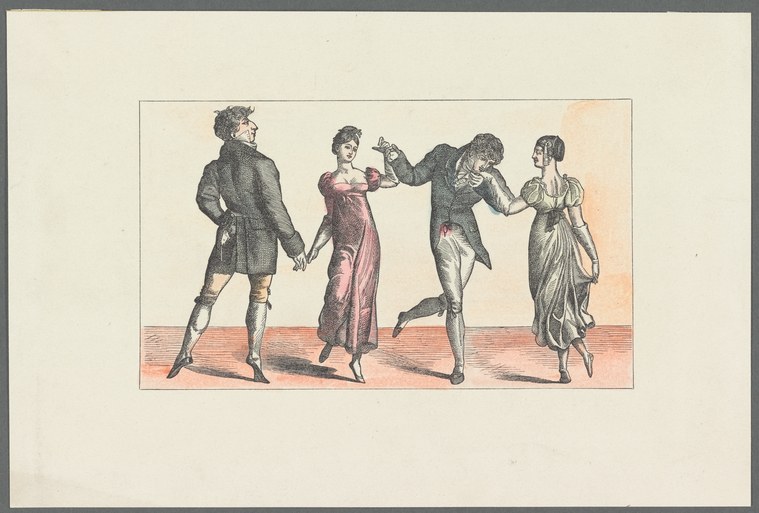
The first quadrille at Almack's
Unknown artist
- Collection:
- Prints depicting dance
- Source:
- New York Public Library
- Rights:
- Public domain — free to use, share and adapt.
- Recorded as:
- Public Domain
Quadrille images are crucial evidence for understanding how Regency social dance was actually structured and performed. This print, identified with Almack's, offers precise visual documentation of costume, posture, and formation in the most exclusive ballroom setting of its time, making it rare material for historians of dance, fashion, and society.
What you are looking at
Four figures are arranged in a line across a shallow stage space with a terracotta-coloured floor and pale background. From left to right: a man in dark coat and breeches stands with weight on one leg, looking back; a woman in a high-waisted Empire-line dress of muted purple or mauve, with her arm raised; a man in dark coat with his arm extended toward the woman; and a woman in a pale neoclassical gown in profile, her arm extended. The composition captures a moment of social interaction—a dance formation frozen mid-movement. The print shows careful attention to the posture and costume of Regency-era formal dress, with the women in the high-waisted silhouettes and simple draping characteristic of the 1810s–1820s. The scene appears to be an illustration of ballroom choreography rather than a naturalistic moment.
The dancing
All four figures are upright and formal, maintaining the postural reserve of Regency social dance. The men's frames are stiff and controlled; the women hold themselves with elongated spines and raised chests. Arms are extended but not flowing—held at specific angles that suggest a prescribed geometric pattern. The spacing and orientation suggest a set quadrille formation rather than paired waltzers; the figures do not embrace or turn as couples but stand in relation to each other as positions in a larger choreographed pattern. No footwork is legible, but the weight distribution on each leg suggests a deliberate, measured step rather than vigorous movement.
The dance depicted
This is almost certainly a quadrille, the dominant social dance of the Regency ballroom. The title 'The first quadrille at Almack's' identifies it as occurring at Almack's Assembly Rooms in London, the most prestigious ballroom venue of the era. The quadrille was a square dance for two couples (eight dancers total) arranged in a square, performing a sequence of set figures. This image shows part of that choreography—likely one of the opening or featured figures—frozen at a moment when all four dancers are standing in a line, their arms lifted or extended in the prescribed positions. The Regency quadrille was imported from France, standardized in form, and danced to specific music; it was taught, not improvised.
How it was made
This is a coloured engraving or hand-coloured print, executed with fine line work and selective colour application (the subtle wash of purple and flesh tones, the terracotta ground). The technique allowed mass production and wide circulation of ballroom instruction images and fashionable scenes. The clarity of the line and the precision of the anatomical drawing suggest this served an instructional as well as documentary purpose—a record of the correct positions and dress for the fashionable quadrille. The colourization is restrained and elegant, consistent with prints made for educated middle- and upper-class audiences learning ballroom choreography.
About this work
This is a Regency-era print documenting the quadrille, the defining social dance of the ballroom from roughly 1815 onward. The image is titled as recording a performance at Almack's, London's most exclusive assembly rooms, which gives it historical weight as evidence of actual fashionable practice. The four figures in formal Regency dress are positioned in one of the set figures of the quadrille—the most important of European social dances before the waltz became dominant in the 1830s. The print serves simultaneously as fashion documentation, ballroom instruction, and evidence of how dance was embedded in elite social ritual.
How to look at it
Note the geometric precision of the four bodies—they form a visual line, not a cascade or embrace. The arms are held at exact angles, suggesting that ballroom dance was understood as a choreography of positions rather than a flow of movement. Observe the dress: the women's high waistlines, narrow skirts, and lack of petticoats are consistent with 1810s–1820s fashion and would have allowed the small, controlled steps and flat-footed technique of the quadrille. The men's formal dark tailcoats and breeches signal this as elite society, not popular dance. The artist has frozen the moment between figures in the dance sequence—a moment of stillness and geometric arrangement—rather than capturing a climactic movement.
The period
The quadrille emerged in France in the late 18th century and became the defining dance of the Regency ballroom (approximately 1811–1820) across Europe. Unlike the waltz, which was danced in closed couple position and was initially considered scandalous for its intimacy, the quadrille was formal, structured, and morally unimpeachable—four pairs in a square, performing set figures in sequence. Almack's Assembly Rooms, founded in 1765 on King Street in London, was by the Regency era the arbiter of fashionable society; admission required a voucher from one of the patronesses, and dancing there conferred social status. The quadrille required instruction, etiquette books, and printed images for circulation; this print is part of that instructional and aspirational apparatus. By the 1830s, the waltz had largely displaced the quadrille, but during this period the quadrille was unquestionably the dominant dance of respectable society.
Where it lives
The work is held in the New York Public Library's collection of prints depicting dance. No artist is recorded; it appears to be a commercial print from the early 19th century, likely British, produced for instruction, documentation, or sale to fashionable society. The holding as part of a dance-focused print collection suggests its identification as ballroom documentation has long been recognized.
Dance in this work
Questions about this work
What is the quadrille?
The quadrille is a square dance for eight people (four couples) arranged in a square, performing a series of set figures in sequence. It was the dominant ballroom dance in European and American high society from roughly 1815 to 1850. Unlike the waltz, which involves a couple dancing alone, the quadrille is a group dance with prescribed choreography, and it requires instruction. The figures in this print show one of those prescribed positions.
What was Almack's?
Almack's Assembly Rooms on King Street, London, was the most exclusive ballroom venue in Regency society. Admission required a voucher from one of the female patronesses, and being seen dancing there confirmed one's place in elite society. It opened weekly during the season and set the standards for fashionable dress, deportment, and dance. To have a quadrille documented as performed 'at Almack's' was a mark of authenticity and prestige.
Why is the dress so specific?
The women's high-waisted Empire-line dresses with narrow skirts are consistent with Regency fashion (approximately 1811–1820). This silhouette allowed only small, controlled steps—the flat-footed, geometric movement of the quadrille. The lack of full petticoats and tight corseting distinguishes this from earlier 18th-century dress and later Victorian fashion, making the print datable and authentic to a specific moment in both fashion and dance history.
Is this a real moment from a real dance, or an idealized instruction image?
It is almost certainly an instruction image showing the correct positions and dress for performing the quadrille. The figures are arranged as they would be in one of the set figures (sequences) of the dance, but frozen in a formal, diagrammatic way. Such prints served as both fashionable documentation and practical guides for learning the choreography.
More dance artwork





