49 works in this view — arrow keys or swipe to move between them.
Dance in Art
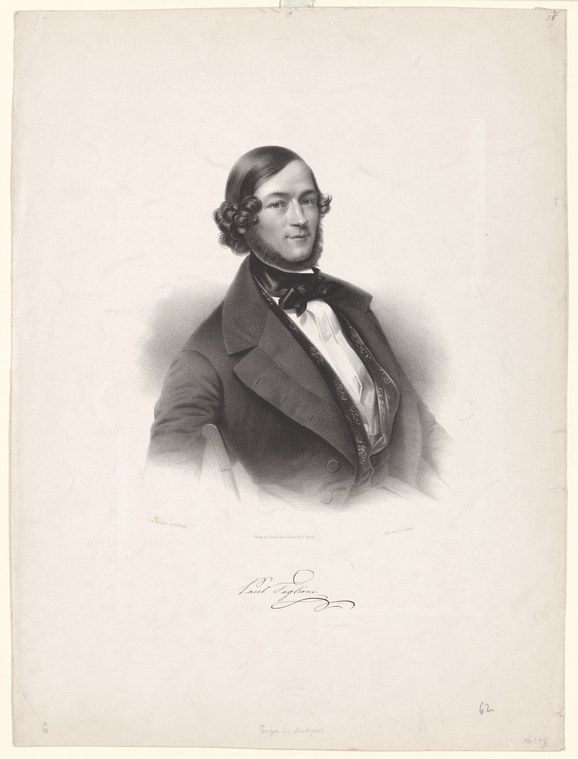
Paul Taglioni [facsimile signature]
Unknown artist
- Collection:
- Prints depicting dance
- Source:
- New York Public Library
- Rights:
- Public domain — free to use, share and adapt.
- Recorded as:
- Public Domain
Paul Taglioni was the son of Marie Taglioni and a principal dancer in the Romantic ballet repertory; he later became a major choreographer and ballet master. This lithograph documents a key figure in the genealogy of classical technique and Romantic aesthetics. For dancers and historians, the image is evidence of how the male dancer was publicly represented and valued in the 19th century—not as a spectacular body in motion, but as a named professional and cultural authority.
What you are looking at
A three-quarter-length portrait of a young man in formal 19th-century dress, facing slightly left but gazing toward the viewer. He wears a black coat with wide lapels, a white shirt front, and a black bow tie, arranged with the refined elegance of mid-19th-century formal evening wear. The figure is rendered as a bust-length engraving against a plain cream background, with skillful stippling and line-work creating volume and shadow across the face and shoulders. The man has dark, wavy hair parted and curled at the temples in the Romantic style of the 1830s–1850s. His expression is serious and dignified, the gaze direct. Below the portrait, in cursive script, appears the signature "Paul Taglioni."
The dancing
This is a portrait, not a dance scene. The single figure is posed standing, with a composed, frontal bearing typical of formal portraiture. There is no visible dance gesture, hold, or movement. The posture and dress speak to social status and professional accomplishment rather than to choreographic practice or performance.
The dance depicted
This is a portrait of Paul Taglioni, not a depiction of dance itself. Taglioni (1808–1884) was a leading male dancer and ballet master of the Romantic era, son of the celebrated Marie Taglioni. He would have performed in the classical and Romantic ballet repertory of his time—ballets such as *La Sylphide* and works created for him by his contemporaries. The portrait documents him in formal dress, the costume of the urban gentleman rather than the stage, suggesting this was made for circulation among the cultural elite and the balletic public who knew his name and reputation.
How it was made
This is a lithographic print, identifiable by its characteristic tonal gradation, the soft modeling of light and shade, and the signature's position below the image. Lithography allowed the artist to achieve the subtle volumetric effects visible in the face and to produce multiple impressions for wide distribution. The technique was ideal for celebrity portraiture and theatrical publicity in the 19th century, making works like this accessible to admirers and students of the dance.
About this work
This is a formal portrait engraving of Paul Taglioni, a principal dancer and choreographer of the Romantic ballet era, rendered in the refined lithographic style of mid-19th-century celebrity documentation. The image preserves the likeness of a man who shaped the development of classical male technique and who danced in some of the most important ballets of the age, including works created for his legendary mother. Though the portrait itself shows no dance, it is evidence of Taglioni's public prominence and of how dancers of the Romantic period were memorialized in visual culture—as named individuals worthy of formal representation, not merely as anonymous bodies in motion.
The work belongs in this collection because it documents a foundational figure in ballet history at the height of his professional standing. Taglioni's technique, teaching, and creative partnerships shaped the Romantic ballet vocabulary that later generations inherited. This portrait, through its very formality and circulation, testifies to the elevated social status and celebrity that principal dancers could command in this period.
How to look at it
This is a document of celebrity rather than a study of movement. Look at the formality of the dress and the seriousness of the gaze—the artist emphasizes Taglioni's status as a gentleman and professional master, not as a performing body. The style of his hair, the cut of his coat, and the refinement of the lithographic technique all signal that this is a portrait intended for a cultivated viewer who knew Taglioni's name and reputation. The image tells us how the Romantic male dancer wished to be seen in public: dignified, accomplished, and worthy of formal remembrance.
The artist
The artist of this lithograph is not recorded in the catalogue. The style and execution are consistent with the work of commercial theatrical portraitists and lithographers of the 1830s–1850s who specialized in celebrity images for circulation to the public and to performers themselves. The signature placement and the finish of the image suggest a professional workshop production rather than a unique work.
The period
This portrait was made during the Romantic period of ballet (circa 1830–1850), when Marie Taglioni's *La Sylphide* (1832) had established new aesthetic and technical standards for the art form. Male dancers of this era occupied an ambiguous social position: while they were essential to classical technique and partnering, they were often overshadowed by female stars. Paul Taglioni's prominence as both performer and master speaks to a particular moment when elite male dancers could achieve celebrity. The lithographic portrait was a standard medium for promoting dancers and musicians to an expanding middle-class audience interested in theatrical personalities.
Where it lives
This lithograph comes from the New York Public Library's collection of prints depicting dance. It is a commercial print, likely made for sale to the public and for distribution by the dancer himself.
Dance in this work
Questions about this work
Who was Paul Taglioni?
Paul Taglioni (1808–1884) was a principal male dancer and ballet master of the Romantic era. He was the son of the legendary Marie Taglioni and danced in major ballets of the period, including works created for him. He later became a significant choreographer and ballet master, working in Berlin and other major European cities. He was instrumental in developing and transmitting classical technique.
Why is there no dancing in this portrait?
This is a formal portrait meant for public circulation and historical record. In the 19th century, celebrated dancers were often portrayed in street dress or formal evening wear rather than in costume, emphasizing their identity as named professionals and cultural figures rather than as performers in a specific role. The portrait documents Taglioni's celebrity and standing.
What is a lithograph?
Lithography is a printing process based on the repulsion of oil and water. An image is drawn on a stone or metal plate, chemically treated, then inked and printed. The technique allowed artists to produce multiple high-quality impressions and was widely used for theatrical portraits and publicity in the 19th century.
More dance artwork





