49 works in this view — arrow keys or swipe to move between them.
Dance in Art
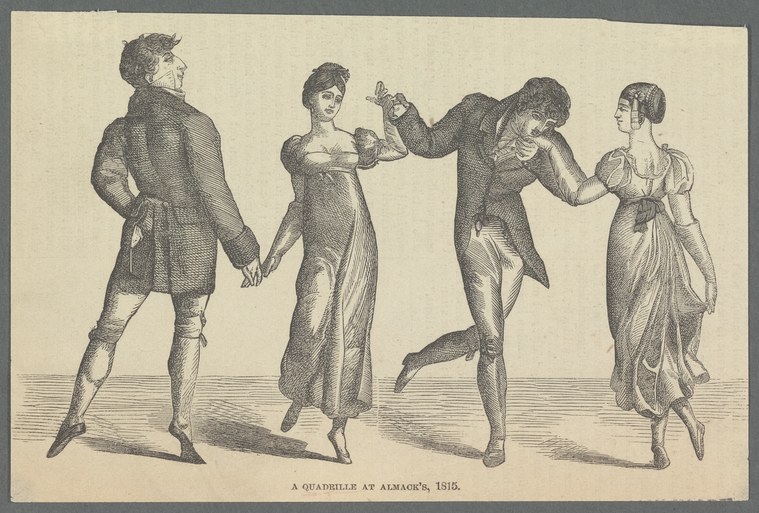
A quadrille at Almack's
Unknown artist
- Collection:
- Prints depicting dance
- Source:
- New York Public Library
- Rights:
- Public domain — free to use, share and adapt.
- Recorded as:
- Public Domain
This image is rare evidence of how the quadrille actually looked in its moment of greatest prestige, danced by the people for whom it was designed. It shows that Regency ballroom dancing was about social display and courtship choreography as much as footwork—a world away from the athletic spectacle of later 19th-century ballroom competition. For historians of fashion, social history, and dance, it documents the intersection of all three: what people wore, how they danced, and what that dance meant in a rigidly stratified society.
What you are looking at
This engraving depicts four figures in Regency-era dress arranged in a quadrille formation at Almack's, the famous London assembly rooms. The composition shows a moment of social courtship and display: the two central figures lean toward each other in animated conversation or flirtation, while the flanking pair gestures expressively. All four wear high-waisted Empire silhouettes typical of 1815. The man on the left stands in profile, his weight on one leg; the woman beside him faces forward with arms raised in a graceful, conversational pose. The two central figures create a visual nexus of attention, their bodies angled inward. The setting is spare—a neutral ground line with minimal detail—placing all emphasis on the dancers' attitudes and the social choreography of courtship. The engraving's fine parallel lines create soft modeling and suggest the elegant restraint of Regency drawing rooms.
The dancing
All four dancers maintain upright, ballroom-appropriate posture with the elongated line characteristic of Regency carriage. The leftmost man stands with one leg supporting his weight while the other is held lightly; beside him, a woman gestures with raised arms in an open, inviting frame. The two center figures lean inward, their bodies creating a closed intimate space despite the formal setting. Arms are extended with grace and control; there is no gripping or tight holds visible, consistent with the social dances of the period where couples often danced at a distance. The engraver has caught the moment not of footwork but of social address—the bodies communicate courtship and attention more than physical technique.
The dance depicted
This is a quadrille, the most fashionable group dance of the Regency period and the one most closely associated with Almack's assembly rooms. The quadrille is a French country dance adapted for formal ballrooms, danced by two couples arranged in a square. The inscription 'A quadrille at Almack's, 1815' identifies both the dance and its most prestigious venue. The image captures a moment of the figures tour—a promenade or turning movement—rather than a jump or point of maximum exertion. The quadrille was danced with restraint and elegance, emphasizing correct posture and social grace over athletic display. This engraving documents how the dance looked in practice at its height of fashion among the London nobility and gentry.
How it was made
This is a copper-plate engraving, a technique that dominated high-quality commercial print production in the early 19th century. The fine parallel hatching creates tonal modulation without color, allowing for the subtle modeling of silk fabrics and human form. Engravings were expensive to produce but relatively quick to print, making them the medium of choice for fashion and social commentary aimed at the educated middle and upper classes. The precision of the lines—particularly in the rendering of the women's high-waisted gowns—suggests this was made for publication in a periodical or as a standalone satirical or documentary print. The technique's capacity for fine detail is evident in the delineation of fabrics, posture, and the individual characterization of each figure.
About this work
This engraving documents the quadrille as it was danced at Almack's in 1815, the most fashionable assembly rooms in London and the arbiter of Regency social dancing. Almack's was a subscription club where admission depended on the patronage of its female governors; it was the place where young people of rank were launched into society and where the latest dances were performed. The quadrille itself was the newest and most prestige-bearing of group dances, imported from France and adopted by London society. This print captures not the virtuosity of the dancers but their social bearing—the elongated posture, the measured gestures, the spatial geometry of courtship. It is a documentary image, one of a genre of Regency social prints that recorded fashionable life for an audience eager to see (and emulate) the manners and dress of the town.
How to look at it
The engraver has chosen to freeze a moment of social interaction rather than a moment of maximum technical display. Look at how the two central figures lean together—this is the visual language of courtship, not the frozen peak of a jump or spin. Notice the variety of arm positions: the woman on the left gestures openly; the center pair create an intimate spatial bubble; the figure on the right is more formal and restrained. Each attitude tells a social story. The composition emphasizes the rectangular space and the balanced arrangement of four bodies; the quadrille's elegance lay in its geometry and the dancers' control of that geometry. The fine engraved lines and the absence of shadow create a sense of polish and restraint—exactly the qualities Regency society valued in ballroom dancing.
The period
The quadrille arrived in London around 1815, imported from the Paris salons where it had been danced for a decade. It supplanted the cotillion and English country dances as the dance of choice among the highest ranks. By 1815, Almack's had been the preeminent assembly rooms for over 50 years, but the quadrille's introduction marked a shift toward more formal, choreographed group dances. The Regency period (1811–1820) saw intense competition in fashion and social manners; dances were as much a subject of fashion writing and satire as dress and deportment. The engraving's date of 1815 places it at the moment when the quadrille was still new enough to warrant documentation and social commentary.
Where it lives
This engraving is held in the New York Public Library's collection of prints depicting dance. It is a print—likely a commercial publication or satirical print of the kind that circulated among London society—rather than a unique work or a fine-art painting. It represents the documentary and satirical print culture that recorded Regency social life for contemporary consumption.
Dance in this work
Questions about this work
What is Almack's and why does it matter?
Almack's assembly rooms, located on King Street in St James's, were the most exclusive social venue in Regency London. Entry depended on approval from a committee of aristocratic women known as the 'Lady Patronesses'; to be refused admission was social ruin. The rooms hosted dances every Wednesday night and functioned as the marriage market for the nobility and gentry. To dance at Almack's was the mark of social acceptance; the dances performed there were considered the gold standard of fashionable dancing.
What is a quadrille?
A quadrille is a square dance for four couples (or two couples in some versions). It consists of five figures, each with prescribed movements: figures such as the 'tour' (a promenade), the 'visites' (visits or circles), and the 'final' (finale). Unlike the English country dance, which was improvisational and social, the quadrille was choreographed and formal. It originated in France and became the dance of the highest circles of European society. It remained fashionable throughout the 19th century and is still danced today.
What does the clothing tell us?
All four figures wear the high-waisted Empire silhouette characteristic of 1811–1820, with long skirts that allow for the elongated line of the body. The men wear tailcoats and tight breeches; the women wear simple, high-waisted gowns with minimal ornamentation. The simplicity and elegance of the dress reflects Regency aesthetic ideals and the dance's emphasis on line and posture rather than color or spectacle. The women's gowns allow for the controlled, gliding footwork of the quadrille.
Is this a satirical print or a documentary one?
It is difficult to say with certainty. Regency social prints ranged from straight documentation to biting satire of fashion and manners. The engraver has rendered the figures with elegance and without obvious exaggeration or caricature, which suggests a documentary intent. However, the animated poses and the emphasis on social interaction over footwork suggest that the print may be commenting on the social choreography of courtship as much as documenting the dance itself.
More dance artwork





