49 works in this view — arrow keys or swipe to move between them.
Dance in Art
La danse du fandango
Unknown artist
- Collection:
- Prints depicting dance
- Source:
- New York Public Library
- Rights:
- Public domain — free to use, share and adapt.
- Recorded as:
- Public Domain
The fandango was one of the most famous and frequently depicted dances of the 18th century, yet it was also controversial—celebrated for its passion and condemned for its perceived licentiousness. This print is direct evidence of how the dance was visualized and circulated in European culture, and of the artist's understanding of its movement qualities. Comparing such prints with written descriptions and other visual sources reveals the gap between how dances were actually performed and how they were packaged for foreign audiences.
What you are looking at
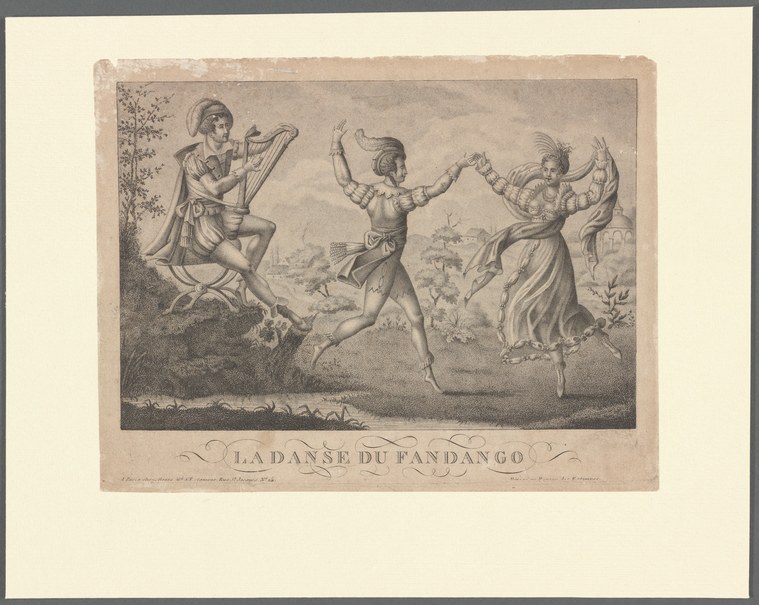
This engraving depicts a lively outdoor scene of the fandango, a Spanish dance. Four figures occupy the composition: on the left, a musician sits playing a stringed instrument (likely a guitar), while three dancers occupy the center and right. The two female dancers wear flowing dresses with full skirts caught in motion, their arms raised in animated gestures; the male dancer between them strikes a dynamic pose with one leg extended. The setting is a rural landscape with scattered vegetation and distant trees rendered in atmospheric perspective. The figures are arranged across the foreground in a diagonal composition that emphasizes movement and gaiety. Light falls evenly across the scene, typical of reproductive engraving technique, creating a clear narrative of festive social dancing rather than theatrical performance.
The dancing
The dancers occupy varied positions suggesting active, exuberant movement rather than formal partnered technique. The male figure stands centrally with weight shifted, one leg extended in a striding or kicking motion, arms raised expressively. Both women have raised arms and tilted torsos, their skirts billowing as if caught mid-turn or jump. The dancer on the right appears to be mid-leap or vigorous step. None of the figures are in closed hold or the structured frame of European ballroom dance; instead, the postures suggest the looser, more improvisational movement vocabulary of Spanish folk dance.
The dance depicted
The title explicitly identifies this as the fandango, a Spanish dance that by the 18th century had become fashionable across Europe and was frequently depicted in prints and paintings as an exotic spectacle. The image captures the fandango's characteristic vivacity and emotional expressiveness, with dancers showing the kind of freedom and individual interpretation typical of the form. The presence of a guitarist confirms the dance's musical accompaniment. The rural setting and informal grouping suggest this depicts fandango as a social dance rather than a theatrical staged version, though such prints often romanticized or theatricalized folk practices for European audiences.
How it was made
This is an engraving—a reproductive print technique involving incised lines on a metal plate, inked and pressed onto paper. The fine parallel lines (hatching) visible throughout create tonal gradation and texture, particularly in the landscape background and the figures' clothing. Engraving allowed wide circulation of images across Europe; this example, with its ornamental cartouche bearing the title, is typical of 18th-century dance imagery produced for a cultivated amateur audience. The technique's clarity and precision made it ideal for documenting fashion, gesture, and social customs.
About this work
This is an 18th-century engraving titled *La danse du fandango*, a European print documenting the Spanish fandango as it circulated through fashionable culture. The work belongs to a substantial tradition of dance prints that served multiple functions: as records of actual social and theatrical practice, as exotic or erotic spectacle for European viewers, and as fashion plates capturing contemporary dress and deportment. The fandango was among the most frequently depicted dances of this period, celebrated for its energy and emotional intensity in stark contrast to the restrained elegance of courtly minuets or contredanses.
The engraving sits at the intersection of ethnographic curiosity, artistic fashion-reporting, and theatrical exoticism that characterized European engagement with Spanish culture in the 18th century. For dancers and historians, it is valuable as evidence of how the fandango was understood and represented to a broad public, and how prints like this shaped European perception of non-courtly dance practices.
How to look at it
Observe the contrast between the figure positions: the musician is seated and still, creating a pivot point around which the three dancers rotate. Notice the asymmetry of the dancers' bodies—torsos tilted, arms at different heights, legs in different degrees of extension—which conveys spontaneity and individual expression rather than unison or synchronized movement. The artist has chosen a moment of full engagement, with all three dancers active and none at rest, suggesting the continuous, propulsive energy the fandango was known for. The flowing skirts and the way the female dancers' bodies lean away from vertical are carefully rendered details meant to capture the visual excitement of the dance.
The period
The fandango achieved peak fashionability in Europe during the mid-to-late 18th century, when Spanish culture exerted significant influence on aristocratic taste. Prints depicting the fandango proliferated from roughly 1750 onward, often paired with other 'exotic' dances from Spanish and Italian traditions. The dance itself was far older in Spain—documented at least as far back as the 16th century—but its reputation for sensuality and improvisational freedom made it both alluring and morally suspect to northern European audiences. Theatrical versions were performed in opera houses and on commercial stages, often stylized for European taste; simultaneously, the dance remained a living social practice in Spain, where it was danced in a variety of forms and regional styles. This print sits in the space between documentation and fantasy, showing recognizable elements of the dance (the guitarist, the raised arms, the skirt movement) rendered through conventions of European artistic representation.
Where it lives
The work is held in the New York Public Library's print collection, *Prints depicting dance*. It is a catalogued example of 18th-century dance imagery, one of thousands of such prints produced for the European market during the period of heightened fashion for dance documentation.
Dance in this work
Questions about this work
What is the fandango and why was it so famous?
The fandango is a Spanish dance with roots reaching back centuries, but it achieved peak fashion in Europe during the 18th century. It was celebrated for its passionate energy, rhythmic complexity (often in triple meter), and the freedom it gave individual dancers to interpret and embellish the basic steps. European audiences found it exotically appealing but also somewhat scandalous because of its sensual character and lack of the formal constraint expected in courtly dances.
Was the fandango danced exactly as shown in this print?
Almost certainly not, in the strict sense. This print was made for a European audience and represents an idealized or theatricalized version of the dance. The actual fandango, as danced in Spain and in social settings, involved many regional variations and improvisational elements. What the print captures reliably is the general energy and the basic visual vocabulary—the raised arms, the rhythmic footwork, the instrumental accompaniment—but the specific poses are an artist's interpretation, likely influenced by conventions of European figure drawing and composition.
Why was there a musician sitting in the scene?
The fandango was always danced to live music, typically guitar and often castanets. The inclusion of the musician in this image is both decorative and documentary: it anchors the dance as a musical performance and reflects the inseparability of music and movement in Spanish dance. In European concert and theatrical contexts, the fandango was sometimes performed with orchestral accompaniment instead, but the guitar remained its iconic instrument.
How do I recognize this as an engraving rather than another type of print?
Engravings are characterized by fine, parallel lines of hatching that build up tone and shadow. You can see this technique at work in the background landscape and in the shading of the figures' clothing and bodies. Engravings were labor-intensive to produce but yielded extremely clear, sharp impressions and were highly valued for fine detail. They were also more durable than etchings, allowing for larger print runs.
More dance artwork





