49 works in this view — arrow keys or swipe to move between them.
Dance in Art
Brevet de danse
Unknown artist
- Collection:
- Prints depicting dance
- Source:
- New York Public Library
- Rights:
- Public domain — free to use, share and adapt.
- Recorded as:
- Public Domain
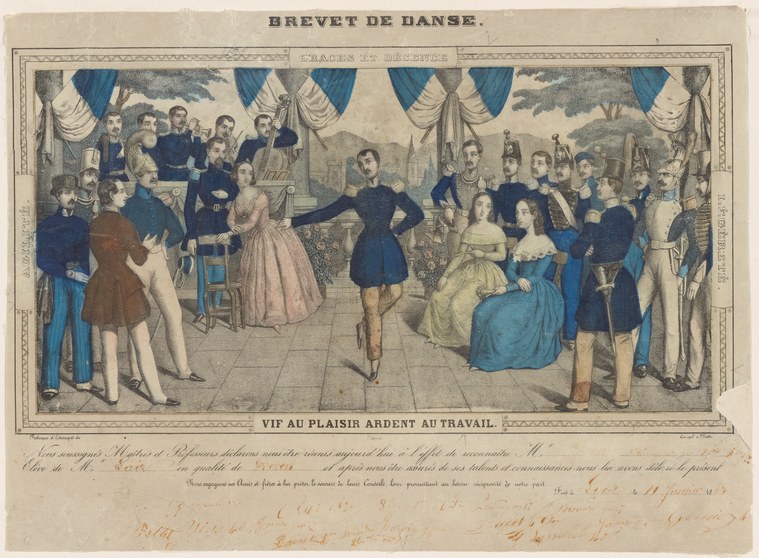
This work is rare documentary evidence of how dance was taught, examined, and certified in early-19th-century France, showing dance not as theatrical spectacle but as a disciplinary and social practice embedded in class education. It reveals that dancing was serious enough to warrant formal examination and official certification, suggesting the high status of dance in bourgeois and aristocratic life. For historians of pedagogy and social dance, this image is invaluable—it shows the apparatus of the dance master, the formality of the learning process, and the social witness that validated achievement.
What you are looking at
A formal indoor gathering, likely aristocratic or court, depicted in hand-coloured engraving. The scene is set beneath a canopy with blue and white striped drapery, suggesting official ceremony or celebration. In the foreground, a young man in military dress (dark coat, light breeches) faces a woman in a pale ball gown, their bodies angled toward each other in formal proximity. Around them stands a crowd of onlookers in 19th-century dress—women in full skirts and men in tailcoats and uniforms—arranged in loose groups, some seated, some standing. The composition creates a theatre-within-theatre: the couple at centre are framed by the watching crowd, themselves arranged as an audience. The architectural setting includes columns and distant landscape; the lighting is even and formal, characteristic of the engraving medium. The inscription below references a dance certificate ("brevet de danse"), suggesting this documents a ceremonial moment in dancing instruction or an examination.
The dancing
The central couple stand in a formal ballroom position, upright and composed, facing each other at a moderate distance. Neither is in closed hold; they appear separated, perhaps preparing for or having just completed a figure. The man's posture is erect and his arms hang naturally. The woman's posture is similarly formal and restrained; her full skirt dominates the lower half of her body, obscuring the feet. The surrounding figures are mostly static observers, seated on benches or standing in small clusters, their attention directed toward the couple. The composition suggests a demonstration or examination rather than an active dance—the stillness of the onlookers and the formal spacing imply a moment of display rather than participation.
The dance depicted
This is most likely a record of a dance examination or diploma ceremony (*brevet de danse* — a teaching certificate or evidence of proficiency in dance). The formal arrangement, the military-dressed examiner or master, and the inscribed title all point to an instructional context rather than a ballroom social dance. The style and setting suggest early to mid-19th-century French society dancing, probably a figure dance or quadrille being demonstrated as part of a formal examination. The image documents not the dance itself in motion, but the ceremonial moment of evaluation and witness—a common practice in dance pedagogy of the period, where students demonstrated mastery before assembled company.
How it was made
Hand-coloured engraving, identifiable by the fine linear hatching and the separate application of watercolour or gouache over the printed impression. The engraving technique allowed for precise delineation of costume, setting, and the formal arrangement of figures, making it ideal for documentary or commemorative purposes. The hand-colouring—visible in the blue drapery, the flesh tones, and the fabric textures—adds legibility and prestige to what would have been a significant document. This combination of print and hand-finish suggests a work made for distribution among the teaching establishment or as a keepsake for the examined student, circulating within the educated classes of early-19th-century France.
About this work
This is a documentary engraving recording a formal dance examination or diploma ceremony in early-19th-century France. The work is neither a work of fine art nor a simple illustration, but rather a professional record—part certificate, part ceremony, part social proof—issued to mark a student's achievement in ballroom dancing. It captures not a moment of dance in motion, but the formal social ritual that surrounded the teaching and certification of dance in the post-Napoleonic period, when mastery of ballroom figures was part of elite education. The image is valuable precisely because it shows dance as institutional practice: the examiner, the witnesses, the staged formality, the young woman as the focus of attention and judgment.
How to look at it
Attend to the stillness at the centre of the composition: this is not a snapshot of dance in progress, but a moment of pose and presentation. Notice the asymmetry between the couple and the framing crowd—the woman's exposed face and posture are on display, while the onlookers sit as judges. Observe the costume details: the woman's high-waisted gown and lack of jewellery suggests a student or younger woman, while the uniforms and tailcoats mark the examiners and witnesses. The architectural setting and formal drapery signal an official space set apart from ordinary ballroom life. This is dance as examination, not entertainment—read it as you would a school photograph or a diploma.
The period
The early 19th century saw the professionalization of ballroom dancing in France and Europe, following the suppression of court culture during the Revolution and Napoleonic Wars. The restoration of aristocratic and bourgeois social life under the Bourbon Restoration (1814–1848) brought renewed demand for dancing masters and systematic instruction in ballroom figures—quadrilles, cotillions, and country dances. The formality visible here reflects the period's emphasis on decorum, discipline, and the visible demonstration of educational attainment. Engraved certificates and commemorative prints were a common medium for recording such moments, particularly in professions that required skill and credentialing but left no physical artifact—dancing, fencing, or equitation. The military dress of the examiner points to the post-Napoleonic context, when military service was a badge of masculine status.
Where it lives
The work is held in the New York Public Library's collection of prints depicting dance, catalogued under the generic title "Brevet de danse." It appears to be a French print from the early-to-mid 19th century, though the specific publication, printer, and date are not recorded in the catalogue. As a hand-coloured engraving, it was likely produced in limited copies for distribution to the student and the teaching establishment.
Dance in this work
Questions about this work
What is a 'brevet de danse'?
A brevet de danse is a French diploma or certificate testifying that the holder has successfully completed instruction in ballroom dancing and demonstrated proficiency in the prescribed figures. It was issued by a dance master or academy upon completion of a formal examination, often conducted in front of witnesses, as shown in this print. The brevet functioned as social proof of elite accomplishment and was particularly valued in aristocratic and upper-middle-class circles in the 19th century.
Why is the couple shown in such a formal, static pose?
This is not a moment of active dancing, but the formal pose struck at the moment of examination or certification. The couple are positioned to be observed and judged by the assembled witnesses. The stillness and frontality are deliberate—they show the student ready for inspection, much as one would stand for a portrait. This ritual of display was central to the pedagogy of the period.
What kind of dancing did the 'brevet' certify?
The brevet typically certified mastery of ballroom figures: the quadrille, cotillion, country dances, and basic waltz. These were the social dances of respectable bourgeois and aristocratic society. The focus was on correct posture, spacing, the precise execution of figures, and the ability to move in formation with other dancers. Theatrical dancing and folk dancing were not included in the brevet syllabus.
More dance artwork





