49 works in this view — arrow keys or swipe to move between them.
Dance in Art
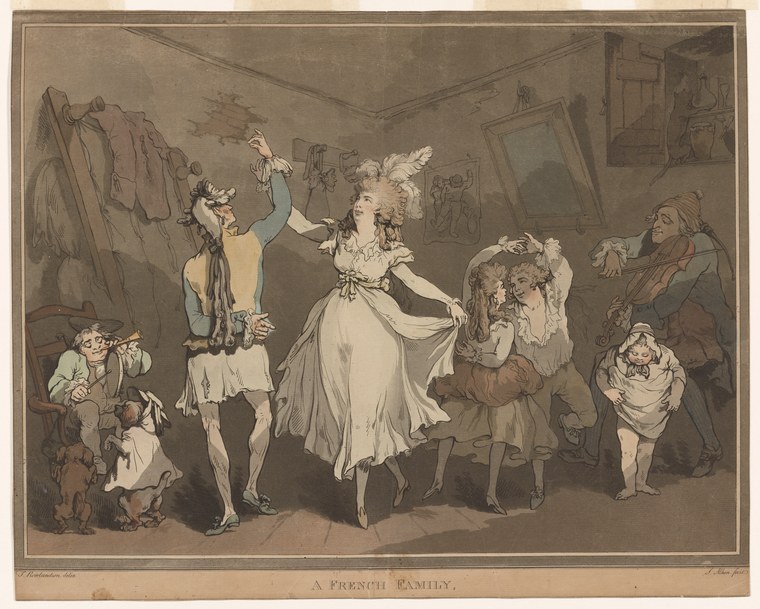
A French family
Unknown artist
- Collection:
- Prints depicting dance
- Source:
- New York Public Library
- Rights:
- Public domain — free to use, share and adapt.
- Recorded as:
- Public Domain
The work preserves a rare image of how ordinary people danced in the eighteenth century—not from dance manuals or noble commissions, but from the satirical observation of a working printmaker. It reveals the visual and social conventions the era used to distinguish folk, country, and peasant dance from the formal ballroom repertoire, and shows how that distinction was weaponized in class and national satire. For historians of popular dance, domestic sociability, and print culture, this is primary evidence of authentic movement and attitude from a period when such scenes were rarely documented.
What you are looking at
A crowded interior scene of lively social dancing, rendered in sepia wash with fine linear detail typical of late eighteenth-century satirical prints. A fashionably dressed woman in a high-waisted neoclassical gown dances center-stage with raised arms in an exuberant attitude, her body energized and her face animated. Around her stands a cast of caricatured figures: rotund gentlemen in breeches and coats, women in simpler dress or bonnets, and children—all arranged in a loose circle watching or participating in the dancing. The setting is a modest domestic interior with visible architectural elements: a low ceiling with exposed beams, framed pictures on the walls, pottery on a shelf. The composition is intentionally chaotic, with figures overlapping and at varying scales, creating the impression of crowded sociability rather than formal arrangement. The title inscription at bottom reads "A FRENCH FAMILY."
The dancing
The central female dancer carries her arms high and free, shoulders relaxed, suggesting an uninhibited folk or country dance rather than ballroom propriety. Her weight appears shifted onto one leg in an unstable or momentary pose—the artist has frozen her mid-movement. The surrounding figures are largely static observers, though some gesture animatedly. The children are small and loosely drawn; the men are broad and stolid. None of the onlookers are in closed hold or formal ballroom frame with the dancer. The overall body language is celebratory and boisterous rather than restrained.
The dance depicted
This appears to be a satirical depiction of folk or country dance as practiced in French rural or working-class domestic settings, not a formal ballroom dance. The woman's free arm position, the informal gathering, and the exaggerated caricature style all suggest the artist is lampooning popular or rustic dancing manners—possibly for the amusement of a genteel English audience unfamiliar with or dismissive of Continental folk customs. The title "A French Family" reinforces this as a genre scene of national type-character rather than a portrait of an actual family. The dance itself is likely a country reel, cotillion, or similar vernacular figure popular among the non-aristocratic classes.
How it was made
This is a hand-colored engraving or etching, executed in fine line with sepia or brown watercolor wash applied over the print. The technique allows the artist to combine sharp satirical detail (the exaggerated features and dress of each figure, the spatial crowding) with soft tonal modeling (the interior walls, the figures' flesh). The hand-coloring suggests a work intended for a relatively affluent market—engravings and etchings were expensive to produce and hand-color, marking this as a commercial print for sale to collectors rather than a mass-market broadside. The level of finish and satire indicates a London or Paris publisher producing for a print-buying middle-class audience.
About this work
This is a late eighteenth-century satirical print depicting folk or country dancing in a French domestic setting, rendered with the sharp observational humor typical of English caricature in the era of Gillray and Rowlandson. The work documents both actual dance practice among the Continental working and middle classes and English attitudes toward French manners—simultaneously mocking and fascinated. It belongs in a dance history collection as evidence of how vernacular social dancing was perceived, represented, and circulated in print culture during the Georgian period. The print captures a moment of popular diversion in which dance served as a marker of class, nationality, and gender in the late Enlightenment imagination.
How to look at it
Attend first to the central dancer's pose: her raised arms, forward-tilted torso, and the off-balance position of her feet. This is not the controlled deportment of a minuet or cotillion, but an uninhibited moment of popular dance. Notice next how the artist has caricatured the faces and bodies of the onlookers—broad noses, bulbous cheeks, exaggerated proportions—and how that caricature is withheld from the dancing woman. The composition uses the crowded, overlapping interior to suggest both intimacy and chaos—this is a genuine family gathering, not a ballroom. The title and the representation together communicate that the artist regards this scene as ethnographic or anthropological: this is how 'the French' dance, the image says, as opposed to how 'we' do.
The period
In the late eighteenth century, dance was sharply stratified by class and geography. The European aristocracy and gentry danced the minuet, cotillion, and quadrille in formal settings under prescribed rules; working and rural populations danced country reels, branles, and folk figures with looser form and greater exuberance. Satirical prints, flourishing in London from the 1770s onward, made comedy and social criticism out of these distinctions. English printmakers and caricaturists delighted in depicting Continental—especially French—manners as absurdly affected, lecherous, or uncouth. The French Revolution (1789) heightened interest in representations of French society and gave such prints additional political weight. This work likely dates to the 1780s or 1790s, in the heyday of English satirical print production.
Where it lives
Held in the New York Public Library's collection of prints depicting dance. The work is catalogued as part of a print collection and appears to have been listed with minimal descriptive metadata, suggesting it was either acquired as part of a larger lot or was considered a minor example within the collection.
Dance in this work
Questions about this work
Is this a real family or a type?
The title is generic and the rendering is satirical, suggesting the work depicts a social type—'the French family' as an object of English caricature—rather than a particular household. The exaggerated faces and the theatrical compression of the space support this reading as genre satire rather than documentary portraiture.
What dance are they doing?
The artist has not represented a named, formal dance. The raised arms, the unstable stance, and the informal gathering suggest a country reel, cotillion, or folk figure—the kind of dance a rural or working-class French family might perform at home. The loose form and exuberant gesture mark it as distinct from courtly or fashionable ballroom dance.
Why is this in a collection of dance imagery?
The print documents how people actually moved in social dancing contexts outside the ballroom, and how that movement was represented and satirized in popular print. It is evidence of eighteenth-century vernacular dance practice and of the visual and social codes used to distinguish popular from formal dance.
Who would have bought this print?
English middle-class and genteel collectors interested in Continental satire and social commentary. Hand-colored engravings were expensive; this was a luxury commodity for a print-buying public amused by mockery of French manners and curious about how 'the other half' lived and danced.
More dance artwork





