49 works in this view — arrow keys or swipe to move between them.
Dance in Art
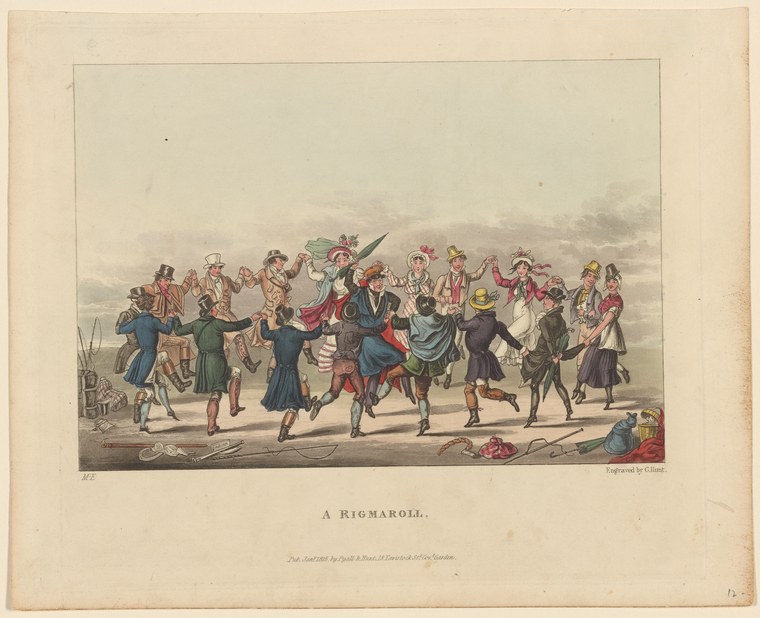
A rigmaroll
Unknown artist
- Collection:
- Prints depicting dance
- Source:
- New York Public Library
- Rights:
- Public domain — free to use, share and adapt.
- Recorded as:
- Public Domain
The rigmarole represents an alternative lineage of movement and performance—one that values chaos, satire, and social commentary over formal dance training. For historians, it shows how early 19th-century audiences and artists understood and depicted movement in public space, and how print culture preserved and circulated images of popular, ephemeral entertainment. For dancers, it offers a reminder that dance is not always about mastery: sometimes it is about play, disorder, and the body expressing critique through refusal to be orderly.
What you are looking at
A lively procession of fashionably dressed figures moves across the page in a loose, animated group. The composition spans the full width of the frame, with figures distributed across ground that suggests an outdoor setting. The participants wear early 19th-century clothing: the men sport top hats and tailcoats in navy and burgundy; the women wear high-waisted gowns with puffed sleeves and bonnets or turbans in pinks, greens, and reds. The crowd moves with exaggerated, almost chaotic energy—bodies lean forward, arms gesture freely, some figures appear to be skipping or bounding rather than walking. A few props scatter the ground: fallen flowers or ribbons, and what may be a lost shoe. The scene has the character of a theatrical or carnivalesque parade, captured mid-motion, with the foreground figures rendered in brighter watercolour tints and those toward the back paler and more sketched. The engraver has used fine hatching to suggest depth and shadow, giving the figures volume despite their spirited poses.
The dancing
The dancers move in no fixed formation; some are paired or grouped, others stand alone. Arms are raised, extended, or held high; bodies twist and turn with loose, uninhibited gestures. The women's long skirts swirl and catch the implied motion, creating visual momentum. A few figures appear to be linking arms or taking hands in a line or chain, but the overall impression is of spontaneous, uncoordinated merrymaking rather than a rehearsed pattern. The energy is in the tilt of the torso, the height of the leap, the flailing of the arms—this is not a formal dance in a fixed hold, but rather a tumbling, processional revelry where bodies express abandon rather than precision.
The dance depicted
A rigmarole was a mock-ceremonial procession or chaotic parade, often comic or carnivalesque in character, popular in 18th and 19th-century satire and popular prints. The term itself refers to a long, complicated, and often nonsensical procedure or speech, and the visual tradition shows it as a theatrical or street spectacle in which participants—often in exaggerated dress or costume—moved in deliberate disorder. The figures here are not executing a recognized dance form but rather participating in a tumultuous, joyful processional movement with elements of satire, masquerade, and social commentary. The absence of musical notation, formal positions, or a clear leading couple suggests this is social theatre or street spectacle rather than ballroom or stage dance. The print documents a performance genre associated with satire, caricature, and public entertainment.
How it was made
This is a hand-coloured engraving, likely early 19th century, executed with fine parallel lines and cross-hatching to model form and shadow. The delicate stippling and linear work suggest steel or copper-plate engraving rather than a coarser method. The hand colouring—applied in watercolour or gouache over the monochrome print—is selective and bright, drawing the eye to the costumes and central figures. The technique allowed for multiple impressions, suggesting this was a popular or commercial print intended for a broad audience. The fineness of the line work and the control of the compositions indicate a skilled printmaker, likely working from a design or original artwork.
About this work
This hand-coloured engraving depicts a rigmarole—a satirical, chaotic processional spectacle performed by fashionably dressed participants in the early 19th century. The work captures not a codified dance form but a genre of social theatre and public merrymaking, in which participants moved in deliberate, exaggerated disorder to comic effect. The print is a document of popular entertainment and visual satire, recording a performance tradition that sat outside the ballroom and concert hall, closer to street carnival and comic theatre. It belongs in a gallery about dance because it preserves evidence of a real performance tradition—one rooted in play, mockery, and the pleasure of embodied absurdity rather than in technique or narrative.
How to look at it
Attend first to the absence of symmetry and control. There is no clear line, no partnered couples in a recognizable hold, no progression or figure—only the impression of forward motion and abandon. Notice how the printmaker has used scale, overlap, and colour to create depth and direct the eye. The exaggerated costume detail—the hats, bonnets, the high waistlines and puffed sleeves—dates the scene precisely and speaks to the social character of the participants. The scattered props and the tumbled, skipping poses of the bodies are the visual heart of the work: this is an image of bodies refusing order, refusing the ballroom, refusing the stage. The energy is in the gesture, not the formation.
The period
In the early 19th century, hand-coloured satirical and comic prints were a major vehicle for social commentary and entertainment in Britain and Europe. Artists and printmakers documented contemporary life, fashion, and manners through exaggerated, caricatural imagery. The rigmarole as a performance tradition appears to have peaked in visibility during this period, often depicted in prints as a subject of social satire. The loose, energetic line work and bright costume detail reflect the conventions of Regency and early Victorian print culture. The rigmarole itself may derive from earlier carnival and masquerade traditions, updated and circulated through the new technology of mass-produced, coloured engravings.
Where it lives
Part of the Prints depicting dance collection at the New York Public Library. The work is housed as a historical print document, part of the broader archive of early 19th-century satirical and entertainment prints that NYPL maintains. The hand colouring and fine engraving technique suggest this was a commercial print, likely circulated among a middle-class or educated audience interested in satire and fashion.
Dance in this work
Questions about this work
What is a rigmarole?
A rigmarole is a chaotic, often comedic procession or spectacle, popular in 18th and 19th-century satire and street entertainment. The term originally meant a long, complicated, or absurd procedure or speech, and the visual tradition shows it as a theatrical or public event in which participants moved in exaggerated disorder for comic or satirical effect. It represents a form of social theatre distinct from formal ballroom or stage dance.
Is this a real dance or a satirical invention?
The rigmarole was a real performance tradition, but it was theatrical and satirical by design. It was not a codified dance form with set steps or patterns, but rather a social spectacle in which the deliberate disorder and exaggeration were the point. Prints like this one document an actual genre of public entertainment and body-play that existed outside the ballroom and concert hall.
Why was this printed and coloured by hand?
Hand-coloured satirical prints were a major medium for entertainment and social commentary in early 19th-century Britain and Europe. Colouring by hand made each print unique and allowed for brighter, more striking visuals. This technique was labour-intensive but produced high-quality images for a middle-class market interested in fashion, manners, and satire.
How does this relate to other dances of the period?
Unlike the formal quadrilles, waltzes, and country dances of the Regency ballroom, the rigmarole represented a counter-tradition of disorder and play. While ballroom dances emphasized control, precision, and social hierarchy, the rigmarole celebrated chaos, mockery, and the body's capacity to refuse order. Both traditions coexisted in early 19th-century culture, speaking to different values and audiences.
More dance artwork





