49 works in this view — arrow keys or swipe to move between them.
Dance in Art
Costume de bal
Unknown artist
- Collection:
- Prints depicting dance
- Source:
- New York Public Library
- Rights:
- Public domain — free to use, share and adapt.
- Recorded as:
- Public Domain
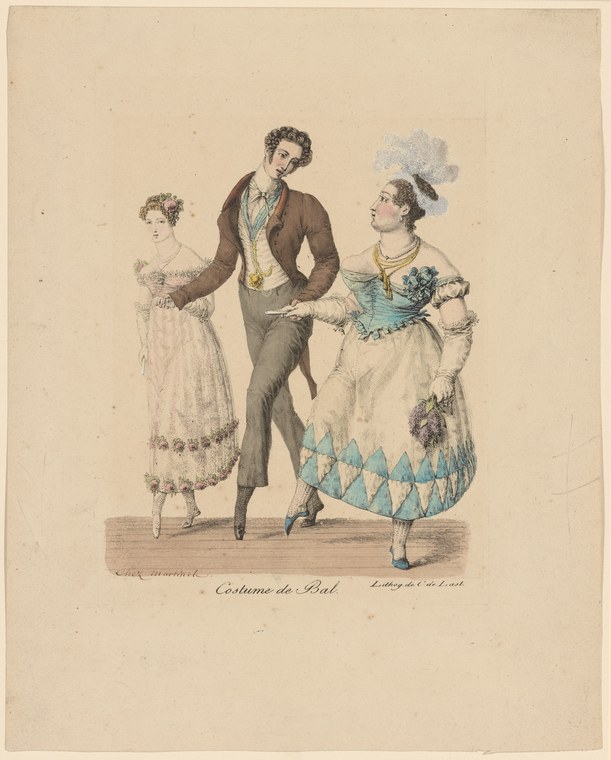
This print is evidence of how the ballroom was understood—and documented—not primarily as a space of movement and technique, but as a space of fashion display and social performance. It shows the visual codes of Regency elite sociability: the upright carriage, the carefully constructed costume, the scripted moment of greeting or promenade. For historians of dance, it demonstrates the degree to which early 19th-century dance documentation conflated the ballroom with fashion, and captured posed social bearing rather than the kinetic reality of the dances themselves.
What you are looking at
Three figures in Regency-era dress are shown in a moment of social interaction at a ball. A man in dark coat and light waistcoat stands centrally, his body angled between two women. The woman on the left wears a high-waisted white gown with delicate hem embroidery; the woman on the right is dressed in a pale blue bodice with a white skirt decorated with triangular blue patterns and topped by an elaborate white feathered headdress. The man's posture suggests he is engaging both women simultaneously—his right hand extended toward the left woman, his body turned slightly rightward. The composition is frontal and theatrical, set against a plain background that emphasizes the figures' dress and gesture. The hand-colored print technique has rendered the fabrics with careful attention to texture: the men's tailoring, the women's muslin and silk, and the ornamental details that mark this as fashionable dress of the 1810s–1820s. The title "Costume de bal" (Ball Costume) and an artist's signature indicate this is a fashion or social documentation print, not a narrative scene.
The dancing
The three figures stand in an upright, posed arrangement rather than an active dance configuration. The man's arms are extended in a gesture of engagement—not a dance hold but a social address. Both women stand with weight distributed evenly, their arms relaxed at their sides or gently held, their posture conveying the upright carriage required by Regency fashion. The spacing and angles suggest a moment of promenade or introduction rather than active partnered movement; none of the figures display the flexed knees, inclination of the body, or close positioning characteristic of the ballroom dances of the period. The artist's focus is on displaying the costume—the cut of the coat, the drape of the muslin, the decoration of the gown—rather than on capturing a specific dance hold or step.
The dance depicted
This print documents Regency ball costume rather than depicting a specific dance in motion. The figures are dressed for the cotillion, quadrille, country dances, or other formal ballroom dances of the era, but they are posed in a moment of social greeting or promenade rather than executing any recognizable step or figure. The upright posture, the leisurely spacing, and the frontal presentation all indicate that the primary purpose is sartorial documentation: to show how the fashionable attended a formal ball. The print belongs to the genre of fashion plates and social documentation rather than to dance depiction per se, though it records the dress code and bearing expected of dancers at a formal event.
How it was made
This is a hand-colored engraving or lithograph, typical of Regency-era fashion plate production. The line work is fine and precise, suggesting engraving; the hand-coloring in watercolor or hand-tinted pigment is evident in the careful rendering of the fabrics and the subtle gradations in the women's clothing. The technique allowed for mass production and circulation among fashionable society—these prints were often published in fashion journals or sold separately to document the latest styles in dress and deportment. The artist's signature and the notation "Costume de bal" indicate this is a professional fashion documentation, likely intended for a journal, private collection, or serial publication.
About this work
A hand-colored Regency-era fashion plate showing three figures in ball dress: two women and a man posed in a moment of social interaction at a formal dance. The print documents the costume, posture, and social manner expected of attendees at a fashionable ball rather than depicting the execution of a specific dance. It belongs to a large body of Regency fashion and social documentation, where the ballroom served as the primary stage for displaying elite dress and demeanor. The work records not dance technique but the visual culture of the ballroom as a space of fashion, courtship, and social performance.
How to look at it
Look at the posture and spacing of the three figures: none is in an active dance frame, and their arrangement is suited to greeting or conversation rather than to the execution of a dance step. Observe the care lavished on the costume details—the pattern of the woman's skirt, the texture of the feathered headdress, the cut of the man's coat—which reveals the true purpose of the print: sartorial documentation. The theatrical, frontal pose and the plain background are conventions of the fashion plate, designed to isolate and display the figures' dress without distraction. This is a record of how one should look at a ball, not of how the dance itself was performed.
The artist
The artist is not recorded in the catalogue. The signature on the print is present but not clearly legible in the reproduced image. The style and execution are consistent with professional Regency fashion plate production, likely from a London publisher or journal. The hand-coloring and the care of the rendering suggest a commercial workshop rather than a fine artist; these prints were produced in quantity for subscribers to fashion journals or as individual sheets for collectors.
The period
This print was made during or immediately after the Regency era (c. 1811–1820), when the ballroom had become the central site of fashionable social life and courtship in elite British society. The formal dances of the period—cotillion, quadrille, country dances, and the cotillon—were highly structured and regulated by etiquette. Fashion plates of this era were proliferating, driven by elite demand for guidance on dress and deportment. Dance itself was documented primarily through the formal notation of dance treatises and instruction books; fashion plates focused instead on the dress, the bearing, and the social moment. This work sits at the intersection of fashion history and dance history, recording the costume and manner rather than the movement itself.
Where it lives
The print is held in the New York Public Library's collection of prints depicting dance. It is catalogued with minimal information: title only, no date, artist, or medium recorded, and no existing written description. This reflects the status of fashion plates in library collections—often acquired in large lots and catalogued summarily as social or fashion documentation rather than as individual artistic works.
Dance in this work
Questions about this work
Is this print showing a specific dance?
No. The figures are posed in a moment of social interaction—a greeting or promenade—rather than executing a recognizable dance step or hold. The print is documentation of ball costume and social bearing, not a record of dance movement. It shows how to dress and deport oneself at a ball, but not how to dance.
What dances would these people have danced at a Regency ball?
The formal dances of the Regency era included the cotillion, quadrille, country dances (such as the cotillon), and occasionally the minuet. These were structured, partner-based dances with prescribed figures and steps. A full evening of dancing would involve several of these in succession. But this print does not show any of them in progress.
What is the date of this print?
The catalogue record does not provide a date. From the style of the dress—the high waistline, the muslin gowns, the men's tailoring—the print can be placed in the Regency era, approximately 1810–1825. A more precise date would require consultation with a specialist in Regency fashion or a search of fashion journal archives.
Why is the artist unknown?
The signature on the print is not clearly legible in the reproduced image, and the catalogue record does not record the artist's name. Regency fashion plates were often produced by commercial workshops and published anonymously or with signatures that are difficult to read in later reproductions. Identifying the artist would require examining the original print or consulting specialized sources on Regency fashion plate production.
More dance artwork





