49 works in this view — arrow keys or swipe to move between them.
Dance in Art
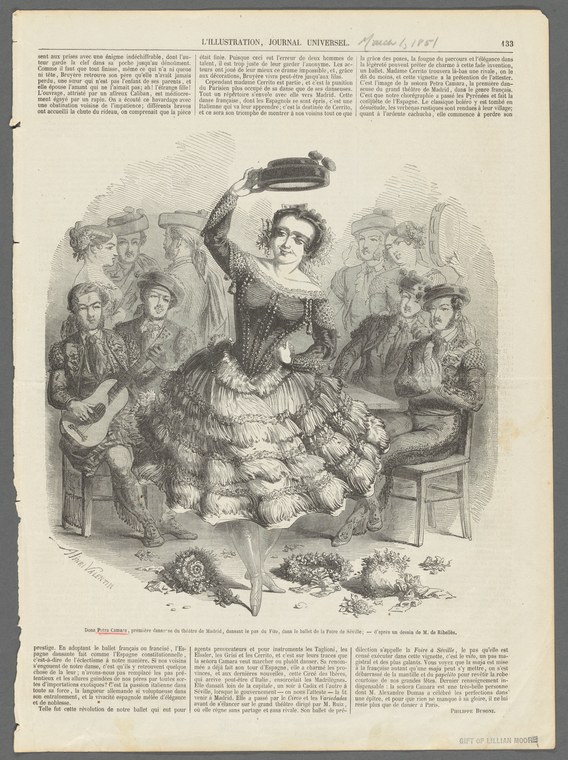
Dona Petra Camara, première danseuse du théâtre de Madrid, dansant le pas du Vito, dans le ballet de la Foire de Séville
Unknown artist
- Collection:
- Prints depicting dance
- Source:
- New York Public Library
- Rights:
- Public domain — free to use, share and adapt.
- Recorded as:
- Public Domain
This work documents the actual repertoire and performance practice of a major nineteenth-century theatre—not an idealized ballet narrative but a specific dancer's specific performance. It shows how classical ballet stages incorporated Spanish and regional dance material, and how female performers of this era moved between different vocabularies. For historians of both ballet and Spanish dance, this is a primary document of theatrical practice and circulation.
What you are looking at
A woman in an elaborate mid-nineteenth-century ball gown dominates the center of this engraving, captured mid-movement with one arm raised high, holding what appears to be a fan or small object aloft. Her dress is voluminous—a wide skirt with multiple layers of ruffles or flounces—and she wears the fitted bodice typical of the 1850s. Around her stand at least six other figures in period dress: men in tailcoats and top hats, women in bonnets and day wear, all observing or participating in the scene with animated gestures. The setting appears to be indoors, possibly a ballroom or theatrical space, rendered in the fine cross-hatching technique characteristic of mid-century wood or steel engraving. The composition radiates outward from the central dancer, with the surrounding figures arranged to frame and emphasize her movement. At the bottom of the engraving lies a small pile of what may be scattered objects or debris—details that suggest either a comedic or dramatic moment frozen in time.
The dancing
The central figure has raised her right arm overhead in an exultant or expressive gesture while her body twists slightly, suggesting a moment of dynamic rotation or elevation. Her posture suggests upright carriage and a lifted torso—the mark of trained theatrical movement. The surrounding figures display varied stances: some lean forward with interest, others gesture with hands, and at least two seated figures (visible at left and right) appear to be musicians or accompanists. The relative scale and positioning suggest this is a solo performance or demonstration rather than a partnered dance, with the other figures as audience or musicians rather than co-dancers.
The dance depicted
The title identifies the central figure as Doña Petra Cámara, prima ballerina of the Teatro de Madrid, dancing the 'pas del Vito' from the ballet *La Feria de Sevilla* (The Seville Fair). The Vito was a Spanish regional dance associated with Andalusia, characterized by intricate footwork and expressive upper-body movement—quite distinct from the formal vocabulary of classical ballet. That a prima ballerina of a major theatre would perform a Spanish folk or regional form suggests the theatrical blending of European ballet technique with Spanish vernacular dance that characterized mid-nineteenth-century theatrical practice. The raised-arm, twisted-torso pose captures what may be the characteristic arm styling of this form.
How it was made
This is a finely detailed engraving, likely wood or steel, executed with the precise cross-hatching and line-work typical of mid-nineteenth-century reproductive prints. The technique allowed for sharp definition of costume detail, facial expressions, and theatrical atmosphere—all legible even at small scale. Such engravings were the primary means of circulating images of celebrated performers and theatrical moments before photography became widespread for publication. This work's presence in the collection of *L'Illustration*, a major illustrated weekly, indicates it was intended for a broad middle-class European audience interested in theatrical news and celebrity.
About this work
This engraving documents a specific performance by a celebrated Spanish-born dancer of the mid-nineteenth century—Doña Petra Cámara—executing a Spanish regional dance within a classical ballet context. It captures a moment of theatrical hybridity: a prima ballerina trained in European technique performing vernacular Spanish material on the stage of a major European theatre. The work is both a portrait of a celebrated performer and evidence of how the ballet stage of this period was beginning to absorb and theatricalize non-European and folk dance forms. The engraving's precision and theatrical framing indicate it was intended as a record of a notable performance, circulated through a major illustrated periodical to an audience invested in following theatrical fashion and celebrity.
How to look at it
Attend to the costume detail: the precise rendering of the ball gown's construction, the men's formal dress, the hats and bonnets that mark social rank and context. Notice how the engraver has positioned the central figure in a moment of vertical lift and twisting rotation—not a static pose but an instant of movement. The surrounding figures' varied gazes and gestures frame this moment as significant and observed. The scattered objects at the bottom may be a comedic detail or may indicate the energetic physical vigor of the performance.
The artist
The engraving is uncredited in the catalogue, which was common for reproductive theatrical prints of this period. Such works were typically executed by specialist theatre and fashion illustrators working for major periodicals like *L'Illustration* (founded 1843), which employed teams of draughtsmen and engravers to capture performances and social events from life or description. The print's high technical quality and theatrical sophistication suggest it was made by an experienced theatrical illustrator working for a major publication.
The period
Mid-nineteenth-century European theatre was increasingly documenting itself through illustrated periodicals. Photography existed but was still relatively slow and difficult for theatrical reproduction. At the same time, classical ballet was evolving from Romantic-era narrative spectacle toward a more cosmopolitan repertoire that incorporated Spanish, Oriental, and folk material—Delibes' *La Source* (1866) and later works exemplify this trend. Cámara was active during the 1850s–60s, a period when Spanish dance was gaining visibility in European theatrical contexts, partly through performers like her. The *Feria de Sevilla* ballet represents the fashion for Spanish-themed spectacle that flourished in mid-century European opera houses.
Where it lives
This engraving comes from the New York Public Library's collection of prints depicting dance. It was published in *L'Illustration, Journal Universel*, a major French illustrated weekly founded in 1843 and circulated across Europe and to educated readers internationally. Such publications were the primary means of distributing images of celebrated performances to a broad audience before photographic reproduction became standard.
Dance in this work
Questions about this work
Who was Doña Petra Cámara?
Cámara was a Spanish-born dancer active in the mid-nineteenth century, performing at major European theatres including the Teatro de Madrid. She was celebrated for her technical skill and for her ability to perform both classical ballet and Spanish regional dances. She represents the cosmopolitan theatrical culture of the 1850s–60s, when European opera houses increasingly incorporated Spanish and folk material into their repertoires.
What is the 'pas del Vito'?
The Vito is a Spanish regional dance from Andalusia, characterized by intricate footwork, rhythmic complexity, and expressive arm and upper-body movement. When performed on the theatrical stage by a classical ballerina like Cámara, it represented a blending of European ballet technique with Spanish vernacular idiom. It was the kind of regional specialty that mid-nineteenth-century ballet companies incorporated into their programs to offer variety and local color.
What is *L'Illustration*?
*L'Illustration* was one of the first and most successful illustrated weekly periodicals, founded in Paris in 1843. It published detailed engravings of contemporary events, including theatrical performances, and circulated across Europe and internationally. For performers and theatregoers, *L'Illustration* was the primary source of images and news about celebrated performances and notable dancers of the day.
More dance artwork





