49 works in this view — arrow keys or swipe to move between them.
Dance in Art
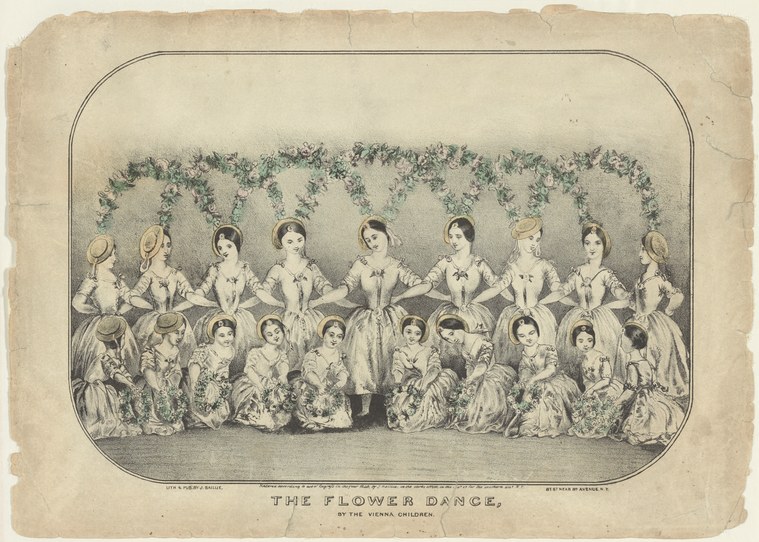
The Flower dance, by the Vienna children
Unknown artist
- Collection:
- Prints depicting dance
- Source:
- New York Public Library
- Rights:
- Public domain — free to use, share and adapt.
- Recorded as:
- Public Domain
This print documents a specific subset of nineteenth-century theatrical dance practice: the display ensemble number for children, which was distinct from ballet technique but occupied the same theatrical space. It also reveals how dance was advertised, consumed, and remembered before film—as printed image, where pose and costume could be studied long after the performance ended.
What you are looking at
A large group of young dancers, arranged in two tiers with a decorative garland of flowers and foliage forming an arch above them, poses for the camera in a formal theatrical composition. The back row stands, while the front row sits or kneels. All wear white or pale muslin dresses trimmed with flowers, and most carry fans or wear flower wreaths in their hair. The lighting is even and studierly—characteristic of mid-nineteenth-century theatrical photography—and casts minimal shadow. The border of the print is rounded at the corners, a common framing device of the period. The composition is symmetrical and ceremonial, emphasizing the collectivity of the ensemble rather than individual virtuosity.
The dancing
The dancers stand and sit in relaxed, undemanding poses—upright but not turned out, arms naturally placed, weight distributed easily. The holds are social rather than balletic: no partner supports, no lifts, no extension of the leg. The faces are visible and serene, directed toward the camera. The distribution suggests rehearsed positioning for the photograph rather than a captured moment of movement. There is no visible footwork and no indication of active weight transfer or elevation.
The dance depicted
This is almost certainly a posed ensemble tableau, not a documentation of active dancing. The title 'The Flower Dance' suggests a pantomime or theatrical children's number, popular in the mid-nineteenth century. Such pieces were display vehicles for groups of young performers (often from Vienna's ballet schools, as the credit states) and prioritized visual spectacle—flowers, costume, symmetry—over technical facility. The 'dance' here is likely processional or static, organized for visual appeal rather than choreographic complexity.
How it was made
This is a hand-coloured engraving or lithograph, printed and then tinted by hand—evidenced by the even application of pale watercolour and the crisp linear definition of the border and figures. The technique allowed for cheap, reproducible theatrical publicity and souvenir images, circulated to audiences and collectors of theatrical prints. The colour work is modest and uniform, suggesting commercial production for a broad market rather than a unique or precious object.
About this work
A nineteenth-century theatrical print documenting a children's flower-themed dance spectacle performed by the Vienna Children's ballet ensemble. The image is a posed compositional study rather than a dynamic action shot, emphasizing costume, symmetry, and the collective presence of the young performers over individual technique or movement. It belongs to a rich tradition of theatrical prints that served as publicity and souvenir material, and records a now-lost mode of entertainment—the ornamental, processional children's ensemble piece—that occupied a significant place in nineteenth-century theatre programming alongside ballet proper.
How to look at it
Attend to the almost perfect symmetry of the composition: the arch of flowers, the placement of standing and seated figures, the matching dresses. This is deliberate. The photographer or print-maker chose to emphasize order, beauty, and group harmony over any sense of movement or dance action. The lack of dynamic posture—no lunges, no elevation, no tension—is itself informative: this is theatre as tableau, as living picture, not as kinetic performance. The flowers are as much the subject as the dancers.
The artist
The artist is not recorded in the catalogue. The print credit indicates only that it was issued as a theatrical souvenir, likely by a Vienna-based publisher. The hand-colouring and composition suggest commercial theatrical printing of the mid-nineteenth century, a competitive market in which image-makers synthesized photography, engraving, and watercolour to create appealing records of celebrated performers and pieces.
The period
The 1840s–1860s saw the flowering of theatrical souvenir prints in Europe, particularly in Vienna, where the ballet was a prestigious public institution. Children's dance numbers were a staple of mixed bills, combining the sentimentality of Victorian youth culture with the visual spectacle of costume and flowers. At the same time, early photography was emerging as a medium for theatre documentation; this print likely dates to the transition between hand-drawn theatrical imagery and photographic realism—it may be hand-coloured from a photograph, or a lithographic copy of a photograph.
Where it lives
Part of the New York Public Library's collection of prints depicting dance. It is one of numerous such theatrical prints acquired in the nineteenth and early twentieth centuries, many uncredited and unattributed, that document popular entertainments now known only through such images.
Dance in this work
Questions about this work
Is this an actual dance, or just a posed picture?
It is almost certainly a posed picture made for publicity or as a souvenir. The title refers to a theatrical piece, but what we see here is a formal group portrait, not a captured moment of performance. The relaxed postures, the symmetrical arrangement, and the studio lighting all point to a deliberately composed photograph or engraving, not candid documentation of movement.
Were children really dancers in nineteenth-century theatre?
Yes, extensively. Children appeared in ballet companies, in ensemble numbers, and in pantomimes. A group called 'the Vienna Children' or similar was a known touring attraction. This print is publicity for such a group, showing their costume and scale rather than their technique.
Why so many flowers?
Flowers were a standard element of feminine and juvenile spectacle in nineteenth-century theatre. They signified beauty, innocence, and innocuousness. A 'flower dance' was a visual genre—dancers surrounded by, wearing, or carrying flowers—that appealed to mixed audiences and required no narrative or technical sophistication.
Who made this print?
The artist and publisher are not recorded. It was likely produced by a Viennese firm specializing in theatrical prints, hand-coloured and sold as a souvenir to audiences and collectors. Many such prints circulated anonymously.
More dance artwork





