49 works in this view — arrow keys or swipe to move between them.
Dance in Art
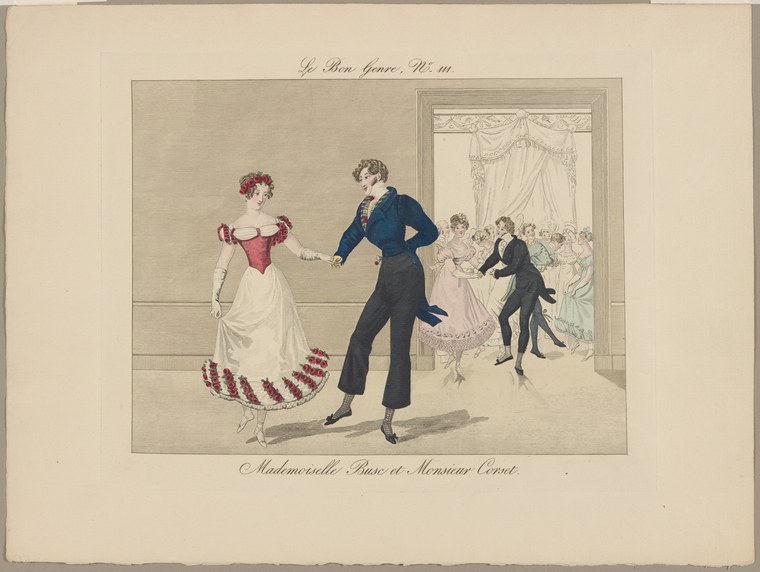
Mademoiselle Busc et Monsieur Corset
Unknown artist
- Collection:
- Prints depicting dance
- Source:
- New York Public Library
- Rights:
- Public domain — free to use, share and adapt.
- Recorded as:
- Public Domain
The work documents not only a specific historical dance form but also the transformation of social dance into theatrical performance and public spectacle during the Romantic era—a moment when dances like the cotillion and quadrille moved from drawing rooms into theaters and the press. The named performers and printed record suggest a professional dance world and an audience interested enough in fashionable entertainment to purchase prints depicting specific dancers and styles.
What you are looking at
A ballroom or salon scene in which a fashionably dressed couple dominates the foreground while a group of onlookers gathers in the background beneath a draped canopy. The woman wears a striking red velvet bodice with white sleeves and skirt, the skirt trimmed with red and white horizontal stripes along its hem—a vivid, almost caricatural costume that reads as theatrical or satirical dress rather than conventional evening wear. The man stands beside her in dark tailcoat and trousers, his posture open and slightly turned toward her, gesturing as if in conversation or instruction. The setting is a formal interior with pale walls and a classical mantelpiece; the background figures, rendered in lighter outline, suggest an audience of fashionable spectators. The composition is staged and deliberate, the couple presented as objects of attention rather than lost in private movement. The hand-coloring gives the work the character of a popular theatrical or satirical print.
The dancing
The woman stands with weight balanced, one arm extended outward in a gesture of display or acknowledgment, the other at her side; her skirt's voluminous cut and the position of her body suggest she is either pausing mid-turn or presenting herself to view. The man's stance is relaxed and upright, his body angled to address both the woman and the watching room, his arm raised in a gesture of introduction or direction. There is no intimate closed hold or typical partner contact; instead, they occupy a shared stage space with a visible distance between them, as if performing for the crowd rather than dancing alone together. The relationship is presentational.
The dance depicted
The work appears to depict a social dance of the early-to-mid 19th century, most likely a cotillion, quadrille, or figure dance—forms in which couples demonstrate steps and poses for an assembled group. The title, which names both dancers as performers (Mademoiselle Busc and Monsieur Corset), suggests these were known dancers or entertainers, not merely anonymous socialites. The theatrical costume, the watchful audience, and the demonstrative stance of both figures point to a professional or semi-professional entertainment rather than a ballroom social. The style and composition are consistent with printed theatrical ephemera recording fashionable dances of the Romantic era, when such dances were increasingly performed as spectacles for paying audiences as well as social participation.
How it was made
This is a hand-colored print—the outline appears to be engraved or lithographed and then colored by hand with watercolor or gouache, as evidenced by the bold, flat colors (especially the red and white of the woman's costume), the fine linear detailing of the faces and clothing, and the sketchy rendering of background figures. The technique allowed rapid production and distribution of popular images of contemporary fashionable life and entertainment. The hand-coloring varies in precision and may indicate production for a mass market rather than a single commission, consistent with the genre of theatrical and satirical prints that documented public performances and social trends for a wide audience.
About this work
This is a theatrical or satirical print of the Romantic era recording a performance or demonstration of fashionable dance by two named dancers, Mademoiselle Busc and Monsieur Corset. The work documents both the dance itself—likely a cotillion or quadrille—and the social spectacle surrounding it: the audience, the formal setting, the costume, and the presentational bearing of the performers. The composition emphasizes the dance as public entertainment and display rather than private social interaction, and the bright, unusual costume of the woman suggests either theatrical convention, satirical exaggeration, or both. The print format and hand-coloring place it within the tradition of popular prints recording fashionable society, theater, and entertainment in early-19th-century France or a French-speaking region.
How to look at it
Notice the theatrical framing and the division between performers and audience—this is not a snapshot of social dancing but a deliberate staging for view. Observe the woman's costume: the red velvet and white striped hem are far too striking and unusual for typical ballroom dress, suggesting either exaggerated theatrical costume or satirical commentary on fashion and pretension. The open posture and gestures of both dancers, and the careful arrangement of watching figures in the background, indicate a moment of display or instruction rather than the actual execution of steps. The precision of the hand-coloring and the careful composition suggest this is a commercial print made to capture and sell the novelty of a fashionable dance performance.
The period
This print dates to the early or mid-19th century, a period of rapid transformation in European dance culture. The cotillion, quadrille, and other figure dances had become the dominant social dances of ballrooms and were simultaneously being professionalized, performed on stage, and documented in prints, caricatures, and satirical imagery. The Romantic era saw keen interest in fashionable dress, behavior, and entertainment, reflected in the proliferation of colored prints and theatrical satires. The named performers and theatrical treatment suggest a moment when certain dancers or dance teachers had become recognizable public figures, their performances and styles the subject of popular imagery.
Where it lives
The work is held in the New York Public Library's collection of prints depicting dance, a collection that documents the history of dance through visual media across cultures and periods. The print's origin and original purpose—whether it recorded an actual performance, a fashionable new dance, or a satirical commentary on dance culture—cannot be determined from the record, but its format and style place it within the tradition of 19th-century theatrical and satirical prints.
Dance in this work
Questions about this work
Who were Mademoiselle Busc and Monsieur Corset?
The catalogue record does not identify these dancers beyond their names in the title. The names suggest they were known performers of the period, but whether they were professional dancers, society entertainers, or characters in a satirical print is not clear from the record. Their inclusion by name in the printed title suggests they had enough visibility that audiences would recognize them.
What dance is being shown?
The specific dance form cannot be determined with certainty from the image alone, but the style, period costume, and composition are consistent with a cotillion, quadrille, or similar figure dance of the early-to-mid 19th century—dances in which couples performed set steps and formations for an assembled group.
Is this a real ballroom scene or a stage performance?
The theatrical costume, the watching audience visible in the background, the formal staging, and the overall composition suggest this records or depicts a staged performance or entertainment rather than a routine social dance. The woman's striking red and white costume in particular is too theatrical for typical ballroom wear.
What technique was used to make this print?
This is a hand-colored print, most likely engraved or lithographed in outline and then colored by hand with watercolor or gouache. This technique was standard for popular theatrical and satirical prints of the 19th century, allowing relatively rapid and inexpensive production for a broad audience.
More dance artwork





