49 works in this view — arrow keys or swipe to move between them.
Dance in Art
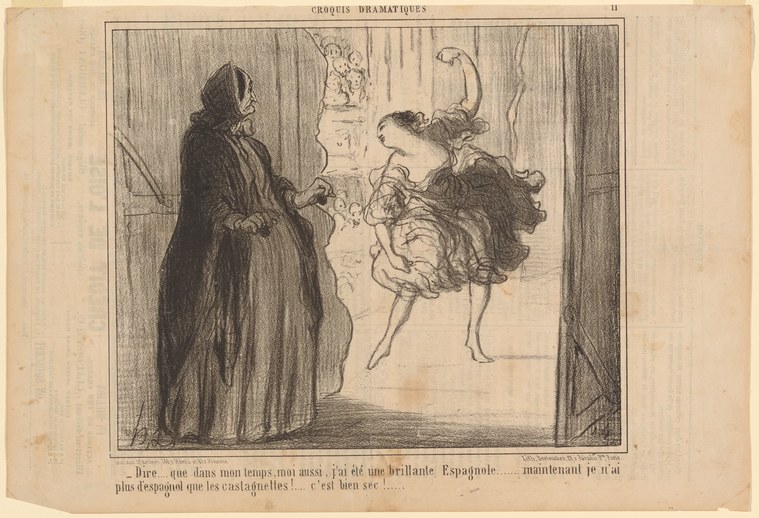
Dire-- que dans mon temps, moi aussi, j'ai été une brillante Espagnole-- maintenant je n'ai plus d'espagnol que les castagnettes!-- c'est bien sec!
Unknown artist
- Collection:
- Prints depicting dance
- Source:
- New York Public Library
- Rights:
- Public domain — free to use, share and adapt.
- Recorded as:
- Public Domain
This print documents the presence and prestige of Spanish dance in nineteenth-century European theatrical and salon culture, while also revealing how that dance was consumed, satirized, and gendered in the period. For dance historians, it is evidence of both the technique and the cultural anxiety around aging female performers, a tension that persists in dance.
What you are looking at
A woman in dark traveling clothes—a heavy coat or cloak and bonnet—stands at left facing a figure emerging from or positioned within an ornate doorway or architectural frame at right. The second figure is rendered in a much lighter, more ethereal manner: a woman in elaborate dress with voluminous skirts caught mid-motion, her body twisted and limbs akimbo in an exuberant pose. Her hair or headdress is swept upward, emphasizing the dynamism of the moment. The contrast between the solid, earthbound figure on the left and the weightless, energized dancer on the right is acute and intentional. The setting is interior, suggested by vertical hatching that represents drapery or walls. The inscription below speaks to the passage of time and the loss of the Spanish dancer's art.
The dancing
The standing woman on the left is static and observational, her weight settled, her posture formal and reserved. The dancer at right is captured in a moment of explosive energy: her body is arched, her legs are splayed or scissored, her arms are raised with the characteristic hand position of Spanish dance (likely with castanets, referenced in the text). The weight is on the balls of the feet or fully airborne. The two figures occupy entirely different registers of motion and deportment—a deliberate visual commentary on the contrast between former vitality and present restraint.
The dance depicted
This depicts Spanish dance, almost certainly Flamenco or a related Spanish theatrical form. The woman's reference to being 'une brillante Espagnole' (a brilliant Spanish woman) and the lament that now she has 'plus d'espagnol que les castagnettes' (nothing Spanish left but the castanets) places this in the nineteenth-century salon or theatrical world where Spanish dance was performed for European audiences. The pose—the arched back, raised arms, high leg work, and visible castanets—is consistent with Flamenco or Spanish bolero of the period. The inscription frames this as satire: a former Spanish dancer, now elderly and earthbound, remembers her days of brilliant performance.
How it was made
This is an engraving or etching, recognizable from the fine hatching that builds tone and the characteristic line-work of the medium. The delicate parallel lines create the drapery and architectural elements, while bolder lines define the figures. The contrast between dense hatching and open white space is crucial to the composition's effect. The technique allows for rapid circulation as a print and targets a literate, urban audience—the kind who would recognize the social satire in the inscription and appreciate the visual wit of the comparison.
About this work
This is a social satire in print form, likely from the mid-to-late nineteenth century, that uses the figure of the Spanish dancer to comment on aging, lost youth, and the fading of artistic brilliance. The print belongs to a tradition of French satirical prints (possibly from a series like *Croquis Dramatiques*) that lampooned theatrical life and Parisian society. The work is as much about the passage of time and the melancholy of age as it is about dance itself—but it documents a real performance tradition (Spanish theatrical dance) and the way it was perceived and caricatured in Europe. The exuberance frozen in the dancer's pose is the visual argument: that is who she was; this is who she is now.
How to look at it
Pay attention to the compositional split: the left side is static, heavily clothed, dark; the right side is motion, gossamer, light. The artist has frozen the dancer at the apex of a movement—high and weightless—to maximize the contrast with her present, earthbound self. The castanets in her hand link the two figures and anchor the satire: they are all that remains of her art. The inscription is not decoration but essential to meaning; read it aloud to feel the pathos the image conveys.
The artist
The artist is not recorded. The work is part of a holding listed as 'Croquis Dramatiques' (Dramatic Sketches), suggesting it belongs to a series of theatrical satires, likely French, possibly from the 1850s–1880s. The style and technique suggest a professional print workshop, but the specific hand remains unattributed.
The period
The nineteenth century saw European fascination with Spanish culture, especially Spanish dance, as exotic, passionate, and feminized. This coincided with the rise of the female theatrical dancer as a public figure and with anxieties about her age, retirement, and sexual status. Flamenco and bolero were performed in Paris and other European capitals, often by Spanish or Spanish-trained dancers, and became subjects of printmaking, caricature, and theatrical commentary. The satire here—the contrast between past and present—reflects broader nineteenth-century preoccupations with modernity, nostalgia, and the female body in performance.
Where it lives
The work is held in the New York Public Library's collection of prints depicting dance, catalogued as part of a series titled *Croquis Dramatiques*. It is a loose print, likely one of many in a bound volume or portfolio of theatrical satires.
Dance in this work
Questions about this work
What dance is being shown?
Spanish dance, most likely Flamenco or Spanish bolero, as performed in nineteenth-century European theaters and salons. The raised arms, arched back, high footwork, and visible castanets are characteristic of these forms. The inscription identifies the figure as a 'brilliant Spanish woman,' confirming the style.
Why is the woman in two places at once?
She is not in two places: the image shows the past and present superimposed. The ethereal, energized figure at right is the dancer as she was in her youth; the heavy, dark figure at left is her in age. This is a visual metaphor for memory and loss, common in nineteenth-century satirical prints.
Is this making fun of Spanish dancers?
Partly, yes—but more subtly, it is making fun of aging and obsolescence. The satire is tinged with melancholy. The inscription's tone is not cruel but wistful: it mourns the passing of the dancer's brilliance, even as it mocks her present state. The print reflects real anxieties about female aging in performance.
What are castanets doing in this image?
Castanets are the percussive instrument essential to Spanish dance, held in the dancer's hands and clicked rhythmically to accompany the movement. The inscription puns on them: she has nothing left of her Spanish identity except the castanets—they survive her youth. They link the two figures and drive the satire home.
More dance artwork





