49 works in this view — arrow keys or swipe to move between them.
Dance in Art
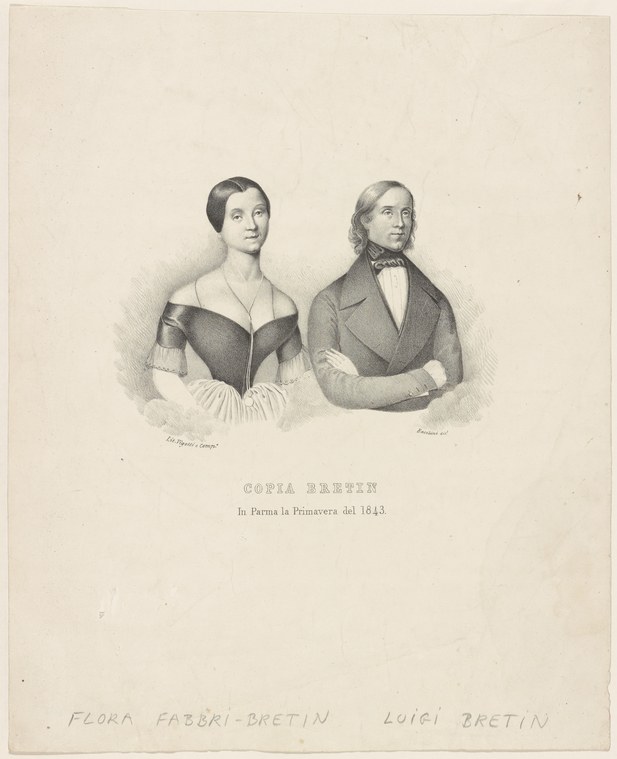
Copia Bretin in Parma la primavera del 1843
Unknown artist
- Collection:
- Prints depicting dance
- Source:
- New York Public Library
- Rights:
- Public domain — free to use, share and adapt.
- Recorded as:
- Public Domain
This work documents two named performers and their location at a specific moment in dance history—essential information for reconstructing European Romantic-era dance practice and the international circulation of dancers and companies. It also preserves the visual record of how celebrated dancers of this period presented themselves in public image: formal, dignified, and displayed as individual celebrities rather than members of an ensemble.
What you are looking at
Two figures occupy the composition in bust-length format against a plain cream background, rendered as a lithograph in soft gray tones. On the left, a woman wearing a dark off-shoulder bodice with short sleeves and light-colored long gloves gazes thoughtfully to her right; her dark hair is smoothly arranged and her pose is composed and dignified. On the right, a man in formal dress—dark jacket, white shirt, and bow tie—turns slightly toward the viewer, his longer hair swept back from his face. The pairing and their formal presentation suggests this is a portrait of two dancers, likely the principal dancers of the famous Bretin company. The inscription below names them as Flora Fabri-Bretin and Luigi Bretin, and dates the work to spring 1843 in Parma.
The dancing
Both figures are shown from the shoulders up in a formal portrait convention; neither is in active dance pose. The woman's posture is upright and serene, her gaze averted in the manner of Romantic-era female portraiture. The man holds a more animated expression and forward-facing orientation. Their presentation emphasizes their status as performers rather than capturing them mid-movement; the lithography allows for soft modeling of faces and careful attention to the texture of fabric and the quality of their grooming.
The dance depicted
This is a portrait of celebrated dancers Flora Fabri-Bretin and Luigi Bretin, documented here by name and location during their appearance in Parma in spring 1843. The lack of active dance pose or theatrical costume makes the specific repertory impossible to determine from the image alone. However, the formal presentation and the prominence of their names suggest they were major figures in European theatrical dance of the early 19th century. The Bretin company was known for Romantic ballet, and the date places this during the period when that style dominated European stages.
How it was made
This is a lithograph, identifiable from its characteristic soft gray tones, the subtle gradation of shading, and the slight irregularity of the drawn line. Lithography allowed for relatively rapid production and distribution of performer portraits, making it an economical way to circulate images of celebrated dancers to theaters, patrons, and the press across Europe. The technique supports the fine modeling of facial features and fabrics visible here, and the work shows the care of a practiced hand—likely a professional theater portraitist working in the tradition of early-19th-century celebrity culture.
About this work
This is a lithographed portrait of two principal dancers of the Bretin company, documented by name during their spring 1843 season in Parma. It belongs to a substantial European tradition of theater portraiture in which lithography served as the standard medium for circulating images of celebrated performers. The work records not a moment of dance itself but the professional and social status of these dancers as named public figures—a different but crucial kind of dance documentation. It tells us that Flora Fabri-Bretin and Luigi Bretin were important enough to merit individual portrayal and publication, and that their appearance in Parma was noteworthy enough to commemorate.
How to look at it
Attend to the difference between portraiture and dance imagery: neither figure is in motion or costume, yet the work is no less a document of dance history for that. The soft lithographic technique allows the artist to capture the texture of fabric, the arrangement of hair, and the character of the face—details that convey social status and professional identity. The side-by-side pairing, the male figure more energetic and the female more serene, follows a convention of Romantic-era male-female partnerships in dance portraiture, where complementary qualities (his vigor, her grace) define the ideal couple.
The period
In the 1840s, lithography was the dominant medium for theater portraiture in Europe, driven by the celebrity culture of Romantic ballet. Dancers like Marie Taglioni and Fanny Essler were circulated across Europe through prints and engravings, and the Bretin company was part of that international star system. Parma maintained a significant opera and ballet culture through the 19th century, and the documentation of visiting companies through such prints was standard practice. The formal, idealized presentation of both dancers reflects conventions of Romantic-era portraiture: dignity, refinement, and a carefully curated public image.
Where it lives
This lithograph is held in the New York Public Library's collection of prints depicting dance, catalogued as part of their broader theater collection. It is one of many similar works documenting European theater and dance in the 19th century.
Dance in this work
Questions about this work
What dance form did the Bretin company perform?
The image alone does not specify their repertory. However, they were active in 1843 in Parma during the height of Romantic ballet in Europe, and the formal presentation and European context strongly suggest their primary work was theatrical ballet. The company name and period are consistent with Italian and European ballet practice of that era.
Why is this a portrait rather than a dance scene?
This is a celebrity portrait in the tradition of 19th-century theater documentation. Such works circulated the likenesses of celebrated dancers to patrons, other theaters, and the public. It served the function of promotional imagery and artistic documentation simultaneously—a record of who these dancers were, not what they danced.
How do I find other images of these dancers?
Search for "Flora Fabri-Bretin" and "Luigi Bretin" in museum collections, theater archives, and digitized print databases, particularly those specializing in 19th-century European theater. The NYPL's holding suggests other contemporary prints may exist. Check also for records of the Bretin company's tours in European theater archives.
More dance artwork





