49 works in this view — arrow keys or swipe to move between them.
Dance in Art
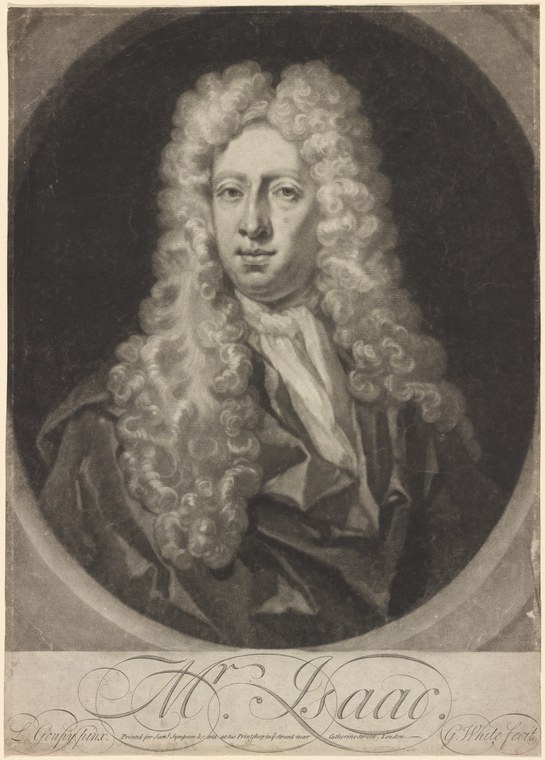
Mr. Isaac
Unknown artist
- Collection:
- Prints depicting dance
- Source:
- New York Public Library
- Rights:
- Public domain — free to use, share and adapt.
- Recorded as:
- Public Domain
Isaac was one of the most influential choreographers and dance masters of his era, shaping the development of Baroque stage and court dance across Europe. This portrait is one of the few surviving images that anchors his historical identity and documents the status accorded to leading dance professionals in the period. For historians and dancers, it is visual evidence of who the art form's canonical figures were and how they were publicly commemorated.
What you are looking at
A bust-length portrait of a man in three-quarter view, rendered in mezzotint or stippled engraving against a dark background, likely 18th century. He wears a full, voluminous curled periwig that falls past his shoulders in the fashion of the late 1600s to early 1700s, dressed in a coat with visible white collar or jabot. The face is modeled with careful attention to light and shadow, giving it sculptural definition. Below the portrait is an inscribed nameplate reading 'Mr Isaac' in an elegant script hand, with additional text that is partially legible at the base of the image. The oval framing and presentation suggests this is a commemorative or celebratory print, possibly published during or shortly after the subject's lifetime.
The dancing
A single figure, presented in formal, frontal repose—not mid-movement. The subject gazes directly outward with an expression of calm authority. The posture is upright and dignified, the shoulders squared. There is no depiction of dance position or movement; this is a portrait of a named individual, not a scene of dancing action. The curled periwig and formal coat are the dominant visual elements.
The dance depicted
This is a portrait of Mr. Isaac, almost certainly the renowned dancing master and choreographer Isaac (also known as Monsieur Isaac or Jean-Georges Noverre's predecessor). He was a dominant figure in European court dance in the late 17th and early 18th centuries, particularly known for his work in the theater and at court. The image does not depict him dancing, but rather commemorates him as a named practitioner and master of the art. The print's formal presentation suggests he held significant professional status and reputation. Without additional inscription details, we cannot establish the exact date or occasion of the portrait from the image alone.
How it was made
The work is an engraving, almost certainly a mezzotint or mixed-method engraving typical of 18th-century printmaking. The soft modeling of light and shade, particularly across the face and periwig, is characteristic of mezzotint's tonal range. The technique allowed for wide circulation of the image as a commemorative print, reaching a educated or court-connected audience who would recognize the subject's name. Such prints served as portable records of notable practitioners and were collected as evidence of professional achievement and celebrity.
About this work
This is a commemorative engraved portrait of Mr. Isaac, a celebrated dancing master of the late 17th and early 18th century. It belongs in a dance collection not because it shows dance in action, but because it documents one of the period's most significant dance practitioners through the format of a formal celebrity print. The work exemplifies how dance masters—who were high-status professionals in court and theatrical contexts—were recorded and celebrated in visual culture. This particular genre of print (the named portrait of a named dance master) is historically important as evidence of dance's cultural prominence and the individual fame of its practitioners.
How to look at it
Attend to the formal, dignified presentation and the prominence given to the periwig, which was the status marker of a gentleman and a fashionable figure. The direct gaze and controlled posture communicate authority and professional distinction. The inscription naming the subject is as important as the portrait itself—this is an image designed to be known by the name written below it. The quality of the engraving and the care taken to model the face suggest this was a print of some expense and circulation, intended for a discerning audience.
The artist
The artist of the engraving is not recorded in the catalogue. The style and execution are consistent with professional portrait engraving in England or France of the early 18th century, when such commemorative prints of musicians, actors, and dancers were a standard form of celebrity documentation. The engraver's identity would help establish the print's place of origin and intended circulation.
The period
By the early 18th century, dancing masters had achieved considerable professional status and fame in European courts and theaters. They were often immigrants or cosmopolitan figures who moved between courts, teaching noble patrons and choreographing theatrical spectacles. The formal engraved portrait was the primary visual technology for commemorating and circulating the images of celebrated professionals—actors, musicians, and dancers alike. Prints such as this were collected, distributed, and displayed as markers of cultural celebrity and professional achievement. Isaac himself was part of a cohort of French and French-trained dance masters who dominated European theatrical and court dance in the Baroque period.
Where it lives
The work is held in the New York Public Library's Prints collection, which concentrates on depicting dance. It is a print within that collection, part of a larger archive of visual records of dance practitioners and performances from various periods.
Dance in this work
Questions about this work
Who was Mr. Isaac?
Isaac (various spellings, including Jean-Georges Noverre's mentor) was one of the most celebrated dancing masters of the late 17th and early 18th centuries. He was renowned across European courts and theaters for his choreography and teaching. He is part of the documented lineage of Baroque dance masters who shaped European theatrical and social dance before the Romantic era.
Why is a portrait of a non-dancing figure in a dance collection?
This portrait documents a major figure in dance history. Dance collections preserve not only images of dancing, but also records of the artists, teachers, and practitioners who shaped the art form. Named portraits of dance masters are historical evidence of who the field's canonical figures were and how they were publicly recognized.
When was this print made?
The catalogue record does not provide a specific date, and the style is consistent with early 18th-century engraving. The periwig and clothing fashions suggest a date no later than the early 1700s, possibly later 1600s. A closer reading of the inscribed text (which is partially obscured in this image) might reveal a publication date.
More dance artwork





