49 works in this view — arrow keys or swipe to move between them.
Dance in Art
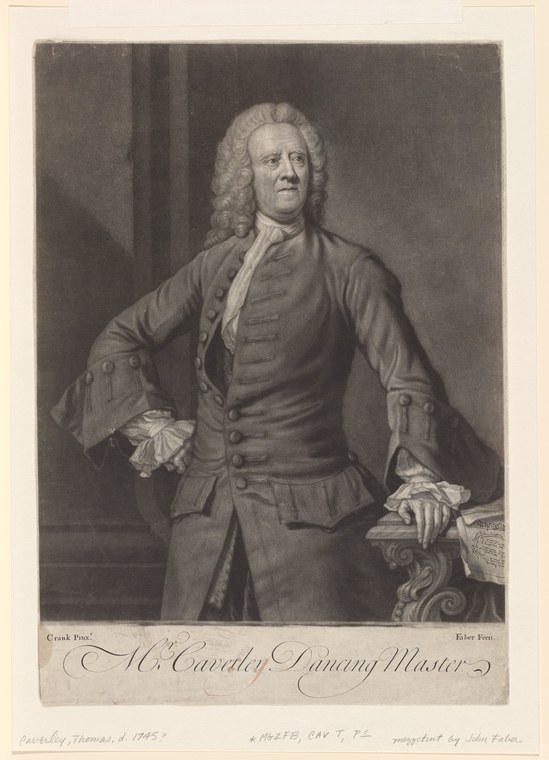
Mr. Caverle[y] dancing master
Unknown artist
- Collection:
- Prints depicting dance
- Source:
- New York Public Library
- Rights:
- Public domain — free to use, share and adapt.
- Recorded as:
- Public Domain
Dancing masters were architects of 18th-century social order, and their methods and authority shaped how bodies moved in ballrooms across Europe for generations. This portrait preserves the image of a named practitioner whose individual students are unknown to us but whose influence on ballroom culture was real and lasting. For historians of dance pedagogy, dance portraiture, and the professionalization of the dancing profession, this is a rare documentary record of how the art was transmitted and understood.
What you are looking at
A three-quarter-length portrait of a man in mid-18th-century dress, identified in the inscription as a dancing master. He stands in a formal pose against a dark background, his weight distributed in the characteristic stance of a person demonstrating movement or posture. He wears a dark coat with buttons down the front, a lighter waistcoat visible beneath, and white linen at wrists and neck—formal dress of the period but suitable for active demonstration. His right arm extends outward at about shoulder height, palm open, as if gesturing to a student or indicating a position in dance. His left arm hangs more naturally. His head turns slightly to one side, regarding the viewer with an alert, instructional gaze. A draped fabric or cloak hangs from his left shoulder. The print shows fine control of light and shadow, with careful modeling of the face and hands—the tools of his profession.
The dancing
A single standing figure demonstrates an open, instructional posture rather than executing a dance step. The extended right arm and engaged stance suggest he is teaching or demonstrating form rather than performing. The body is upright and controlled, with weight evenly distributed in a stance suited to explanation and correction of others. The position of the feet is not clearly visible, but the overall frame—shoulders back, head alert, hands expressively placed—is that of an instructor prepared to show and correct his pupils.
The dance depicted
The subject is explicitly identified as a dancing master, a professional teacher of social dance in the 18th century. The pose captures the pedagogical rather than performative moment—he demonstrates a position or frame for his students rather than executing a complete dance movement. The formal, controlled stance and the open gestures are consistent with the teaching methods of the period, when dancing masters were central figures in the refinement of aristocratic youth and the standardization of ballroom technique. The exact dance style taught is not specified, but the period and context strongly suggest ballroom and court dances such as the minuet, which was central to dancing masters' curricula in the 1700s.
How it was made
This is a mezzotint or engraving, a printmaking technique well-suited to rendering the subtle modeling of flesh, fabric, and light that characterize portraiture. The inscription is engraved into the lower margin. The technique allowed for wide circulation in a time before photography; a portrait of a celebrated dancing master could be distributed to patrons, students, and other practitioners across Europe. The quality of the print—the careful hatching, the tonal control, the formal presentation—indicates this was a professional commission intended for public distribution and likely for display.
About this work
This print documents a dancing master of the 18th century at the moment of instruction. The subject is presented not as a performer but as an educator and arbiter of taste, a professional of standing whose knowledge and deportment were valuable enough to be preserved in a formal portrait. Dancing masters occupied a crucial role in 18th-century society: they trained aristocratic children in the bodily discipline and social grace that marked gentility, and they were instrumental in codifying and spreading the ballroom dances that dominated elite social life. This image captures the pedagogical moment—the demonstration, the correction, the transmission of technique—rather than the display of virtuosity. It belongs in a gallery of dance art because it shows us not performance but teaching, not spectacle but the everyday work of making dancers.
How to look at it
Observe the carefully controlled posture and the deliberate placement of the hands—this is not a candid moment but a posed demonstration. The extended right arm and the slight turn of the head are not accidental; they are the teaching gesture itself, the moment when the master shows the student what is required. Notice also the formal dress and the composure of the face: this is a man of authority and refinement, presenting himself as a model of genteel comportment. The print's careful attention to the rendering of fabric and the play of light on skin underscores that physical grace and appearance were central to the profession.
The period
In the 18th century, ballroom dancing—particularly the minuet—was a cornerstone of aristocratic education and social ritual. Dancing masters were respected professionals, often with established schools and a stable of wealthy pupils; some achieved celebrity status and published treatises on technique and dance notation. The portrait genre itself was undergoing change, with prints allowing for the distribution of images far beyond the reach of painted portraits. This formal, dignified presentation of a dancing master reflects the elevated status of the profession during its golden age, before the social upheavals of the late 18th century would begin to reshape dance culture.
Where it lives
This print is held in the New York Public Library's collection of prints depicting dance. The inscription attributes it to 'Mr Caverley' (or Caverley), a dancing master whose dates and full biography are not established in the current record. The print appears to be an 18th-century engraving, likely created for distribution to patrons or for display in a dancing master's studio.
Dance in this work
Questions about this work
What was a dancing master and why were they important?
A dancing master was a professional instructor in social dance, particularly valuable in aristocratic circles where mastery of ballroom dances like the minuet was a marker of refinement and breeding. They were often celebrated figures who trained the children of nobility and gentry, published treatises on dance technique and notation, and helped standardize dance practice across Europe. In the 18th century, their social and cultural authority was substantial.
What dance style is shown here?
The image does not depict the execution of a specific dance, but rather a teaching moment. The formal dress, period, and the explicit identification of the subject as a dancing master suggest his repertoire would have centered on ballroom dances of the 18th century, most notably the minuet, which was the primary focus of dancing master training and society dancing of the era.
Why is this a portrait and not a performance image?
The pose captures a moment of instruction and demonstration rather than the execution of a complete dance phrase. This reflects the double status of the dancing master: both a teacher and a model of physical grace. The portrait format emphasizes his professional identity and elevated standing, presenting him as worthy of being recorded and studied, not merely entertained by.
More dance artwork





