49 works in this view — arrow keys or swipe to move between them.
Dance in Art
Parisian dancers, no. 2 - l'Horatia
Unknown artist
- Collection:
- Prints depicting dance
- Source:
- New York Public Library
- Rights:
- Public domain — free to use, share and adapt.
- Recorded as:
- Public Domain
For historians of Regency dance, this print is valuable evidence of the formal presentation conventions and costume vocabulary of the period—the silhouettes, headdresses, and positioning that framed actual dance movement. For costume specialists, it provides a dated example of high-end Parisian dress circa 1800–1815. For dance historians, it documents the visual culture surrounding dance even when depicting stillness, offering insight into how bodies were formally arranged for public view.
What you are looking at
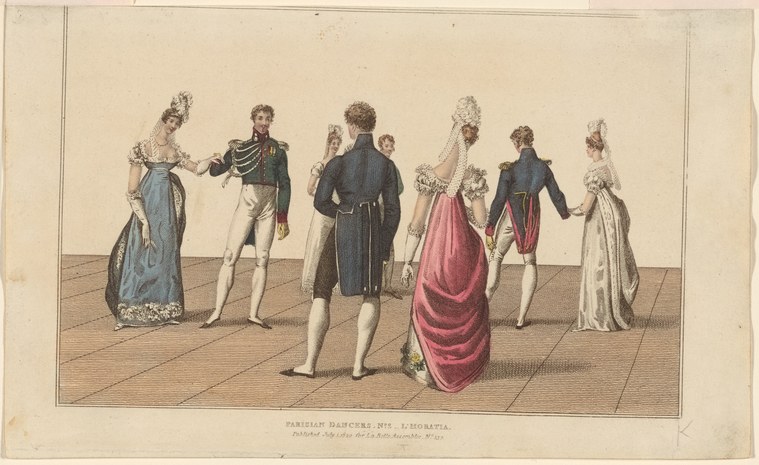
Six figures in Regency-era dress are arranged in a formal line on a wooden floor against a plain background. The composition reads left to right: a woman in a high-waisted pale gown with blonde ringlets and a headdress, a young man in a dark military coat with gold trim and close-fitting white breeches, a second man in a dark coat viewed from behind, a woman in an empire-waist gown with a dramatic pink silk train and blonde curled hair, a second young man in dark coat and breeches, and a woman on the right in a pale neoclassical gown. All figures stand upright with formal posture. The floor is rendered with perspective lines receding into space. The overall effect is of a presentation or formal social gathering rather than an active dance in progress—the figures are positioned as if for inspection or introduction.
The dancing
The six figures maintain vertical alignment and forward-facing orientation with minimal dynamic movement. Their arms hang at their sides or are gently positioned; only the leftmost woman shows an arm extended toward the young man beside her in a gesture of acknowledgment. The poses suggest standing presentation rather than coupled dancing—there is no closed hold, no deep frame, and no visible weight transfer or stepping action. The spacing is even and formal, more suggestive of a promenade or formal introduction than active dance steps.
The dance depicted
The image most likely depicts a formal Regency-era social gathering or presentation, possibly a quadrille or cotillion formation, though no active dance steps are frozen in the moment. The standing poses and formal arrangement are consistent with the opening positions of such dances or with a promenade between figures during a ball. The title reference to 'l'Horatia'—likely a specific named dance or theatrical performance—suggests this may illustrate a particular ballroom composition rather than a general social scene, but the static quality of the figures prevents identification of specific steps or movement vocabulary.
How it was made
This is a hand-colored engraving or aquatint, evidenced by the precise linear perspective, the fine parallel lines forming the floor, and the deliberate application of watercolor or gouache over an engraved base. The technique was economical and allowed wide circulation of fashion and social-scene prints in the early 19th century. The coloring—pale blues, pinks, and flesh tones—is typical of commercial prints aimed at the middle and upper classes documenting current fashions and social customs. The delicate line work and careful rendering of costume details indicate a skilled commercial printmaker rather than a fine artist.
About this work
This is a Regency-era social-scene print documenting the formal dress and presentation conventions of Parisian ballroom culture in the early 1800s. Whether it depicts a specific named dance, a theatrical representation, or a generalized ballroom moment, the print captures the aesthetic of Regency high society: the architectural verticality of the figures, the precision of their dress, and the formal spatial geometry of social exchange. The work belongs in a dance gallery not as evidence of active choreography but as visual documentation of how bodies were positioned, dressed, and presented in the moment before or between danced figures during the Regency ball season. It shows dance culture at rest, staged for public view.
The print format and hand coloring indicate this was a commercial work, likely sold individually or in series to fashionable audiences in Paris and across Europe. It functioned as both a fashion plate and a social document, recording the material and spatial culture of Regency dancing.
How to look at it
Attend to the rendering of fabric and posture: the high waists, narrow sleeves, and pale silks are not incidental to the dance—they dictated the possible range of arm and torso movement and the visual effect of figures in motion. Note how the artist has arranged the six figures in a line rather than showing interaction: this reflects the formation logic of Regency dances, where couples or groups processed and reformed in prescribed sequences. The stillness is intentional and informative. The perspective floor receding into space suggests a real ballroom and emphasizes the formal architectural quality of early-19th-century dance.
The period
This print dates to the Regency era (approximately 1811–1820, with some dating conventions extending to 1830), a period of intense formalization of ballroom dancing and codification of social choreography. The quadrille was gaining ground on the contredanse; the cotillion was reaching its peak popularity. Fashion prints and social-scene engravings proliferated in Paris and London, documenting the material life of the ball season. The Napoleonic Wars had ended; society was consolidating around rigid codes of conduct, and ballroom dancing was central to both romantic courtship and social hierarchy. Prints like this one served as how-to guides and aspiration images for the rising middle classes. The reference to 'l'Horatia' in the title suggests either a specific choreographed figure or a theatrical dance that had entered ballroom repertory.
Where it lives
The work is held in the New York Public Library's collection of prints depicting dance. It is catalogued as part of a series titled 'Parisian dancers' with the subtitle 'no. 2 - l'Horatia,' indicating it was one of a numbered set of similar images, likely a commercial series sold to collectors of fashion and social scenes.
Dance in this work
Questions about this work
Is this a depiction of an actual dance or a posed fashion scene?
The distinction is not clear from the image alone. The formal postures and presentation suggest this may be a fashion plate—a record of current dress standards—that happens to use ballroom figures as its vehicle. However, the specific title 'l'Horatia' and the formal six-figure arrangement suggest it may also document an actual named dance or cotillion figure. The print records both fashion and social choreography at once.
What dance is being shown?
The title indicates 'l'Horatia,' which may refer to a specific named dance figure or set, though this is not verified from the print itself. The formal standing arrangement is consistent with the opening, closing, or presentation positions of Regency-era quadrilles or cotillions, but no active steps are visible. The print shows the staging and costume of the ballroom rather than the kinetic detail of dance movement.
What does the clothing tell us about the dance?
The high-waisted, narrow-sleeved gowns with long trains and the men's close-fitting breeches and tailored coats restricted large arm movements and emphasized vertical posture, controlled stepping, and formal partnering. The elaborate headdresses and carefully arranged hair would have caught light and motion, making even small head turns visible from a distance. The costume itself was part of the visual design of Regency dance.
Who were these people?
They are not identified, and likely represent generic types or fashionable society figures—the kind of people for whom this print was made as a record of current social and sartorial standards. The print documents the class and aspirational culture of Regency Paris rather than specific individuals.
More dance artwork





