49 works in this view — arrow keys or swipe to move between them.
Dance in Art
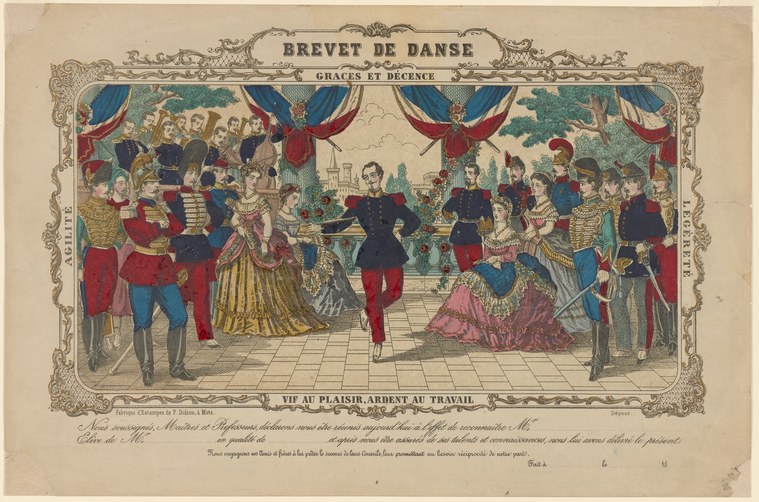
Brevet de danse
Unknown artist
- Collection:
- Prints depicting dance
- Source:
- New York Public Library
- Rights:
- Public domain — free to use, share and adapt.
- Recorded as:
- Public Domain
It is one of the few surviving visual documents of how baroque court dance was understood and taught in its own time—not as an abstract ideal but as a social and physical practice embedded in costume, architecture, and ceremony. The inscription and formal framing suggest this was made as an educational or commemorative object, giving it particular value as a source for understanding what courtiers needed to know and what they valued about their dancing.
What you are looking at
A formal indoor ball or court entertainment, rendered in hand-colored engraving. A large gathering of nobility and courtiers occupies a columned hall draped with blue and crimson fabric. In the foreground, a couple executes a dance at the center of the floor while musicians play from a gallery above; surrounding figures in rich dress—silks, velvets, hose, and jewels—watch or await their turn. The composition is symmetrical and hierarchical: the dancers occupy the axis of attention, while onlookers frame the scene on both sides. The floor is a geometric pattern of tiles. Overhead, a painted ceiling and heraldic ornament confirm the aristocratic setting. The print's title, *Brevet de danse* (a diploma or certificate of dance), appears in an ornate cartouche at top, with a Latin or French inscription below the image.
The dancing
The central couple dances in a formal embrace: the man in dark coat and hose holds the woman, who wears a full-skirted gown with pale silk and gold brocade. Both figures are upright and composed, with arms positioned in a closed social frame. The surrounding courtiers stand in relaxed attitudes, some in conversation, others observing; there is no sense of frenetic movement or virtuosity, but rather the measured decorum of aristocratic display. The relative stillness and restraint of all bodies suggests a processional or stately couple-dance rather than a vigorous solo performance.
The dance depicted
This is almost certainly a minuet or other baroque court dance of the 17th or early 18th century—the formal dress, the enclosed hall, the musician gallery, and the ceremonial framing all point to the aristocratic dance culture of the French or European court. The title *Brevet de danse* (literally 'dance diploma') may suggest this is a teaching image or a record of a formal ball where the couple's execution demonstrates courtly propriety. The closed couple-hold and upright posture are consistent with minuet technique of the period, though the image does not preserve enough detail of footwork to confirm the specific step-pattern.
How it was made
This is a hand-colored engraving—recognizable from the fine parallel hatching used for shading, the crisp line work, and the separate application of watercolor or gouache for the blue, crimson, gold, and flesh tones. Engraving was the dominant print medium for didactic and commemorative images in the 17th and 18th centuries, permitting wide circulation among the literate and wealthy. The ornate cartouche framing the title and the inscription below are typical of formal prints intended for framing or inclusion in bound collections. The technique allowed for fine detail in costume and setting, making such prints valuable as historical records of dress and decorum.
About this work
A formal engraving documenting aristocratic dance in the baroque court, likely from the 17th or early 18th century. The print serves as both a visual record of minuet or court-dance practice and a celebration of the refinement expected of nobility. The title's reference to a 'diploma' suggests this may have been a teaching tool or a commemorative record of a specific ball, positioned between the practical instruction manuals and the allegorical tributes to dance that circulated in elite circles. The work belongs in a dance history collection as evidence of how the aristocratic world visualized and legitimized social dancing.
How to look at it
Notice the absolute stillness and symmetry of the composition: the artist has chosen not a moment of maximum movement or virtuosity, but rather the formal presentation of the couple at the center of attention, watched by a motionless court. This reflects the baroque ideal of dance as a demonstration of control and grace rather than athleticism. Observe also the precision of the costume detail—every ribbon, every jewel—and how the print uses the architecture and drapery to frame and elevate the dancing figures, suggesting that this moment of dancing is itself a kind of ceremony or ritual display.
The period
This engraving dates from the era of Louis XIV's court (or its imitators elsewhere in Europe), when the minuet was becoming the defining social dance of the aristocracy and when dancing-master manuals were flourishing. The baroque period saw dance codified into a system of named steps and rules—the five positions, the menuet, the saraband—with printed instruction manuals beginning to circulate widely in France and Italy. At the same time, formal prints celebrating dance and courtly behavior served as propaganda for the absolute monarchy, presenting dance as an expression of order, beauty, and virtue.
Where it lives
Held by the New York Public Library in its collection of prints depicting dance. The record offers no accession number, publication information, or date, suggesting it arrived as part of a larger donation or collection of dance prints.
Dance in this work
Questions about this work
What is a 'brevet de danse'?
Literally a 'dance diploma' or 'dance certificate.' The title suggests this print may have commemorated a formal ball, served as a teaching tool, or certified the holder's knowledge of courtly dance. Such prints were sometimes used in dance instruction or gifted to mark a student's proficiency.
Is this a minuet?
Almost certainly a minuet or related baroque court dance, based on the formal dress, the closed couple-hold, the architectural setting, and the ceremonial framing. However, the print does not show enough detail of footwork to be absolutely certain which specific dance is depicted.
Who danced these dances?
Members of the aristocracy and court nobility. Minuets and other formal court dances were essential accomplishments for anyone seeking favor at court and were taught by specialized dancing masters from childhood.
Why is everyone standing still?
The artist has frozen a moment of formal presentation rather than captured peak movement. In baroque court dance, stillness and control were prized over spectacular energy; the dancer's task was to demonstrate grace, propriety, and refined movement within strict rules.
More dance artwork





