49 works in this view — arrow keys or swipe to move between them.
Dance in Art
Dancers' accidents
Unknown artist
- Collection:
- Prints depicting dance
- Source:
- New York Public Library
- Rights:
- Public domain — free to use, share and adapt.
- Recorded as:
- Public Domain
This print is valuable evidence of how theatrical dance accidents were understood and consumed as entertainment in the 19th century. It reveals cultural anxieties about bodily control and the fragility of refined performance, suggesting that the gap between disciplined technique and human fallibility was a source of humor and fascination for the public.
What you are looking at
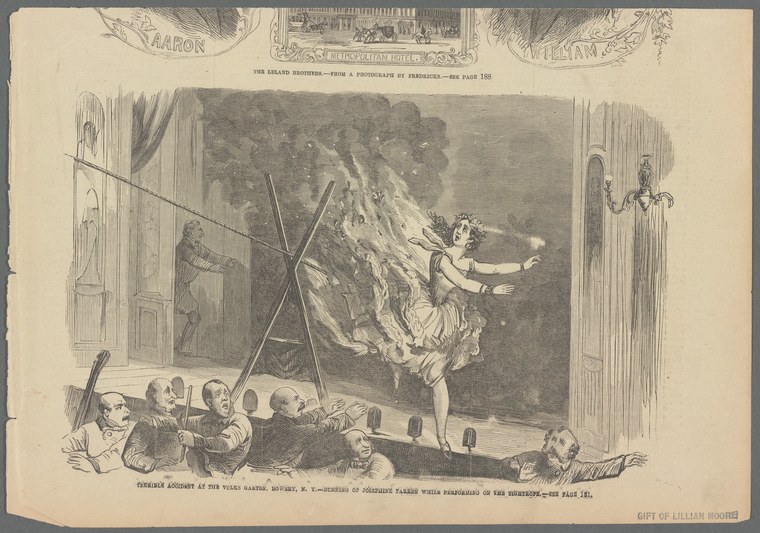
A theatrical scene depicts a moment of comic mishap during a performance. A female dancer in a pale, flowing classical costume stands center-stage on a raised platform, her body twisted in an exaggerated gesture of alarm or distress, one arm extended outward. Below and to either side, several figures—appearing to be musicians or orchestra members—are caught in disarray: two men in the lower left have fallen or are sprawling backward, their instruments scattered. A cello or similar large stringed instrument lies diagonally across the lower foreground. The setting is a grand interior with tall doorways flanked by classical pilasters and wall sconces. Heavy curtains frame the scene. The composition suggests a backstage or performance-space incident, capturing the chaos of what appears to be a dancer's fall or collision with the orchestra pit.
The dancing
The central dancer is depicted in a moment of instability: her weight is off-balance, her limbs loosely extended in alarm rather than controlled form. Her pose shows no technical facility—the gesture is one of surprise and loss of control. The musicians below are rendered in collapsed, tangled attitudes, their bodies sprawled at angles that emphasize helplessness. The contrast between the elevated, isolated dancer and the grounded, scattered musicians below creates a visual hierarchy of calamity.
The dance depicted
This appears to document a theatrical accident rather than depict any recognizable dance style or technique. The work is satirical or comic in intent: it captures the moment a dancer has lost control or collided with the orchestra during a classical performance. No balletic vocabulary is evident—the pose is deliberately ungainly. The image functions as a visual gag about the perils of live performance, playing on the tension between the refinement expected of theatrical dance and the bodily mishaps that can interrupt it.
How it was made
This is an engraving or etching, executed with fine cross-hatching and line work characteristic of 19th-century printmaking. The technique allows rapid circulation and reproduction—this image was intended for a broad audience, likely as part of a periodical or satirical publication. The print medium and style of rendering suggest this was a topical or journalistic image, capturing a moment of entertainment or scandal for public consumption. The fine detail and tonal modulation achieved through line indicate a skilled practitioner of the engraving tradition.
About this work
This is a satirical print documenting a theatrical accident—the collision or fall of a dancer during a classical performance. It captures the moment of chaos that ensues when a performer loses control and disrupts the orchestra below. The work belongs in a dance history collection not because it documents a dance technique or style, but because it reveals how performance mishaps were perceived and circulated in popular culture. It shows that even in an era of formal classical training, the body could betray expectation in ways that were considered comic or scandalous enough to warrant public documentation and distribution.
How to look at it
Attend to the contrast between the centered, elevated dancer and the chaos of the orchestra below: the print's composition emphasizes the isolation of the performer and the ripple effect of her loss of control. Notice the rendering of the musician's bodies—they are drawn with the exaggeration typical of comic or satirical prints, their sprawl and tangle amplifying the sense of disruption. The artist has chosen the precise moment of maximum disorder, freezing the instant after the initial impact but before any recovery or resolution.
The artist
The artist is not recorded. The style and execution suggest a professional engraver working for a periodical or satirical press in the 19th century. The composition and narrative intent indicate familiarity with theatrical life and access to material worth engraving—possibly a known incident, or a composite representation of common theater disasters.
The period
This print dates to an era when classical ballet was the dominant theatrical dance form in Europe, but when live performance remained unpredictable and accidents were neither rare nor necessarily hidden from public view. In the 19th century, satirical prints documenting stage catastrophes, romantic entanglements, and the eccentric behavior of performers were popular entertainment in their own right. The tension between the idealization of the classical dancer (ethereal, controlled, refined) and the reality of the performing body (vulnerable, mortal, capable of spectacular failure) was a rich subject for visual humor.
Where it lives
The work is held in the New York Public Library as part of its collection of prints depicting dance. It appears to have been catalogued with minimal documentation, typical of satirical or journalistic prints of the period, which were often treated as ephemeral material.
Dance in this work
Questions about this work
What is actually happening in this picture?
A female dancer has apparently fallen or collided with the orchestra during a classical performance. Musicians and their instruments are scattered below her in disarray. The print captures the moment of maximum chaos and confusion, presenting the incident as comic spectacle.
Is this documenting a real event?
It may be based on an actual incident, or it may be a composite or invented scenario typical of satirical prints. Without further documentation, we cannot determine whether this represents a specific known accident or a generalized comment on the perils of live performance.
What kind of dance is being performed?
The costume and setting suggest classical ballet, the dominant theatrical dance form of the 19th century. However, the point of the print is not to document technique but to capture the moment it breaks down entirely.
Who is the artist?
The artist is unknown. The print's style, technique, and publication suggest a professional engraver working for a satirical or theatrical press, but no signature or attribution survives.
More dance artwork





