49 works in this view — arrow keys or swipe to move between them.
Dance in Art
Vestris [Armand Vestris]
Unknown artist
- Collection:
- Prints depicting dance
- Source:
- New York Public Library
- Rights:
- Public domain — free to use, share and adapt.
- Recorded as:
- Public Domain
The Vestris family shaped the development of ballet technique and aesthetics in Europe; Armand was part of that legacy. This print is direct visual evidence of how male dancers of the ancien régime dressed, held themselves, and were publicly commemorated—information not always available from written sources. It represents the intersection of fine art, performance celebrity, and print culture in the 18th century.
What you are looking at
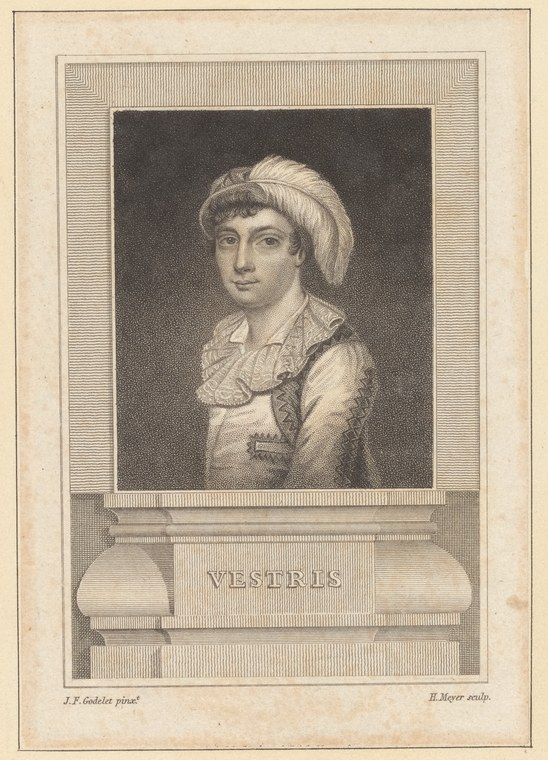
This is a portrait engraving of a single figure shown from the waist up, turned slightly to one side. The subject wears the costume of an 18th-century male dancer: a fitted, ornately embroidered coat with a decorative collar, pale breeches, and a draped fabric—likely a turban or headwrap—wound around the hair. The background is dark and uniform, throwing the figure into relief. Below the portrait sits a classical pedestal inscribed with the name "VESTRIS" in capital letters. The engraving is executed in fine parallel lines typical of reproductive engravings from the late 18th century, with cross-hatching used to model the face and fabric. The artist has signed the lower left corner "J.F. Caldesi pinxt." and the lower right "H. Moser sculpt," indicating this is an engraving after a painting by Caldesi, cut by the engraver Moser.
The dancing
The figure is rendered in a static, three-quarter pose typical of formal portraiture rather than active dance representation. The body is upright and composed, with the head held high and turned slightly away from profile. The hands are not visible in the frame, and there is no indication of movement, weight shift, or the dynamic posture associated with active performance. This is a portrait of a dancer as a distinguished person rather than a depiction of dancing.
The dance depicted
The inscription identifies this as Armand Vestris, a member of the celebrated Vestris family of dancers who dominated European ballet in the late 18th century. Armand (c. 1753–1808) was the nephew of Gaetano Vestris and son of Auguste Vestris, both legendary figures in French ballet. The costume shown here—the embroidered coat, fitted silhouette, and wrapped headpiece—is consistent with the formal dress worn by male dancers of the French ballet tradition during the 1770s–1790s. However, the portrait itself does not depict Vestris dancing; it is a formal character portrait meant to commemorate his status as a celebrated performer.
How it was made
This is a reproductive engraving—a print made from a painted or drawn original by a professional engraver. The signature indicates a two-stage process: Caldesi created the original painted or drawn design, and Moser translated it into an engraved plate using the burin, the standard tool for line engraving. The fine parallel hatching and controlled tonal modeling are hallmarks of skilled 18th-century reproductive engraving, a technique that allowed multiple impressions to be made and distributed widely. This print format was the standard means of circulating images of celebrated performers to theaters, wealthy patrons, and print collectors across Europe.
About this work
This is a formal portrait engraving of Armand Vestris, a principal male dancer of the French ballet tradition in the late 18th century. The work documents both his celebrity status—commemorated through the classical pedestal and formal composition—and the aesthetic conventions of elite male dance dress of the period. The engraving belongs to a large body of reproductive prints made to celebrate and circulate the likenesses of celebrated performers, functioning as a form of promotional and historical documentation. Though the portrait itself shows no movement, it is a primary visual record of how a celebrated dancer of the Romantic era presented himself and was presented to the public.
How to look at it
Attend to the costume: the cut, embroidery, and fit of the coat speak to the formal aesthetic of elite 18th-century male dance dress. Note the wrapped headpiece, which was standard for male dancers of the period and distinct from the fashion of the street. The classical pedestal is not decoration—it is a deliberate choice to frame this performer as a figure of cultural importance. The absence of dynamic pose or indication of movement is itself significant; this is not a dancer in the act of dancing, but a dancer as a celebrity and historical figure being formally recorded.
The artist
J. F. Caldesi appears in this record as a painter; H. Moser is identified as the engraver. Both were working professionals in the 18th-century print trade, where reproductive engravings after paintings were a major commercial form. Moser in particular may be identifiable with a known engraver of that period, though the record provides no further detail. These prints served theater patrons, collectors, and the performers themselves, who often owned and distributed them.
The period
This engraving dates to the latter part of the 18th century, when the Vestris family dominated European ballet and helped establish the technique and vocabulary of Romantic ballet. Male dancers of this era wore fitted embroidered coats, silk breeches, and heeled shoes, often with exotic headwear. The formal portrait as a vehicle for celebrating dancers was a well-established practice; engravings of celebrated performers were collected and exhibited much as photographs of stars are today. The inscription on the classical pedestal reflects Enlightenment-era aesthetics, treating the dancer as a figure worthy of the same commemorative treatment as a statesman or philosopher.
Where it lives
This work is held in the Prints depicting dance collection at the New York Public Library. It is a reproductive engraving in the institutional collection's holdings of dance-related printmaking from the 18th and 19th centuries.
Dance in this work
Questions about this work
Who was Armand Vestris?
Armand Vestris (c. 1753–1808) was a leading male dancer in the French ballet tradition and a member of the celebrated Vestris family. He was the nephew of Gaetano Vestris and son of Auguste Vestris, both legendary figures in the development of ballet technique. Armand danced in Paris and across Europe during the late 18th century and was celebrated for his elevation and technical skill.
What does the engraving technique tell us?
Reproductive engravings like this one were made by translating a painting or drawing into fine lines cut into a metal plate. This allowed multiple high-quality prints to be made and sold to theaters, wealthy patrons, and collectors. The technique was labor-intensive but economical at scale, making it the standard way to circulate images of celebrities before photography.
Why is the dancer wearing that outfit?
The embroidered coat, silk breeches, and wrapped headpiece are the formal dress of an 18th-century male ballet dancer. The coat was often richly decorated with embroidery or metallic trim, and the breeches were fitted to show the line of the leg and the dancer's musculature. The exotic headpiece was a convention of the era, adding grandeur and distinguishing theatrical dress from street fashion.
Is this showing a dance or just a portrait?
This is a formal portrait, not a depiction of dancing. Armand is shown standing in a composed, static pose. However, it is a portrait of a dancer in his stage costume, so it documents how celebrated performers of the era dressed and presented themselves to the public.
More dance artwork





