49 works in this view — arrow keys or swipe to move between them.
Dance in Art
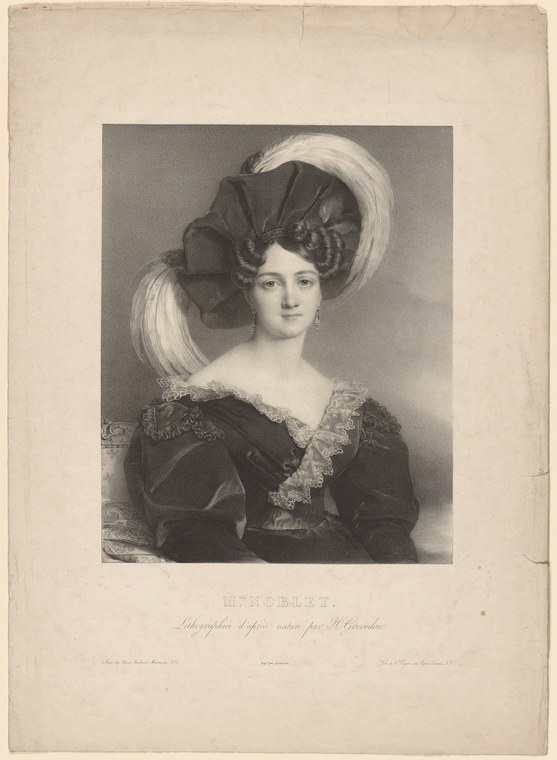
Melle. Noblet
Unknown artist
- Collection:
- Prints depicting dance
- Source:
- New York Public Library
- Rights:
- Public domain — free to use, share and adapt.
- Recorded as:
- Public Domain
This portrait is essential evidence of how Romantic ballet dancers were celebrated and commodified as public figures in the early 19th century, and how engraved reproductive prints circulated images of theatrical stars across Europe. For researchers of Romantic ballet, ballet history, and the rise of the theatrical star system, it illustrates the visual culture surrounding one of the period's most prominent dancers and the conventions of theatrical portraiture that shaped how audiences imagined their favourite performers.
What you are looking at
A three-quarter-length portrait of a woman in early 19th-century dress, shown against a neutral background. She wears a dark velvet dress with elaborate lace trim at the shoulders and décolletage, and a striking headdress of white plumes arranged in a dramatic upright composition. Her dark hair is styled in the fashionable Regency manner, with ringlets framing her face. The image is rendered as a black and white engraving or stipple print, which softens the forms and creates a luminous quality across the white plumes and pale skin. The figure is presented as a theatrical or performance portrait, suggesting this is a dancer or performer of some renown. The composition emphasizes elegance and the fashionable luxury of her costume rather than movement or the body in action.
The dancing
The figure stands in a poised, frontal three-quarter view with a graceful, upright posture befitting Regency deportment. Her shoulders are back, her neck extended, and her gaze directed neutrally outward—all conventions of formal portraiture rather than dance documentation. There is no visible evidence of a dance hold, footwork, or the dynamic weight-shift characteristic of movement capture. The body is presented as a still, presentable form rather than one caught mid-action, which is typical of theatrical portraiture of the period celebrating the dancer as an icon of elegance rather than as a moving performer.
The dance depicted
The subject is identified in the print as 'Melle. Noblet,' almost certainly referring to Lise Noblet, a prominent French dancer of the early 19th century who performed at the Opéra in Paris. Noblet was a leading exponent of Romantic ballet in its nascent phase, and this portrait dates to the height of her fame in the 1820s–1830s. However, the portrait itself does not document a dance or a specific performance. Rather, it presents Noblet as a fashionable stage personality, emphasizing her costume and bearing as a star of the theatre. The theatrical dress—the velvet and lace gown—appears to be performance costume or an idealized version of it, suggesting her status as a celebrated performer, but the static, presentational pose is typical of celebrity portraiture rather than a depiction of dancing itself.
How it was made
This is a black and white engraving or stipple engraving, a reproductive print technique that allowed wide circulation of theatrical celebrity portraits to a broad public audience. The technique employs fine dots and short strokes to build tone and model form, creating a soft, flattering surface particularly suited to the rendering of skin, fabric, and the luminous quality of the white plumes. The print would have been sold individually or in bound collections and reached theatregoers, fans, and collectors across Europe and beyond. The technical quality and formal presentation suggest this was a commercial theatrical portrait of significant production value, elevating the subject and implying her status as a major star.
About this work
This is a theatrical celebrity portrait of Lise Noblet, a leading French ballet dancer of the Romantic era, rendered as a formal engraved print. It belongs to the broader tradition of theatrical portraiture—a genre distinct from dance documentation—that celebrated performers as fashionable icons rather than capturing them in the act of dancing. The work is significant for the history of ballet celebrity and the dissemination of images of famous dancers to a growing public audience in the early 19th century. It documents not how Noblet danced, but how she was presented to the world as a glamorous stage personality, and it reveals the status of ballet dancers as celebrities comparable to other entertainment stars of the period.
How to look at it
Observe the composition as a statement of elegance and status rather than a record of movement. Note how the headdress dominates the composition—the white plumes create height and drama, extending the silhouette and drawing the eye upward in a way that emphasizes the performer's theatricality and glamour. The dress and pose follow the conventions of fashionable society portraiture, adapted for the stage: the upright bearing, the carefully arranged hair, and the direct gaze all present the subject as a composed and presentable icon. Look at how the engraving technique softens and flatters the form, particularly in the rendering of the plumes and skin, creating an image intended to appeal to admirers and cement the subject's status as a desirable theatrical personality.
The artist
The artist and engraver are not recorded in the catalogue. The technical quality and finish suggest work by a professional theatrical portraiture workshop, likely Parisian, operating in the 1820s–1830s. The style is consistent with the output of commercial printmaking houses that specialized in theatrical and celebrity portraiture, such as those working after paintings by portraitists of the period. The print likely derives from an oil portrait or drawing, now untraced.
The period
The 1820s–1830s were the formative years of Romantic ballet. Lise Noblet performed during the reign of Romantic ballet's emergence from the classical tradition of the late 18th century, a period when ballet was becoming an increasingly popular public entertainment and dancers were emerging as celebrated celebrities in their own right. Engraved and lithographed portraits of dancers, singers, and actors were among the most widely circulated images of the period, collected in albums and sold as individual prints to theatre audiences. This portrait is one among hundreds of such prints documenting the celebrity culture of Romantic-era performance.
Where it lives
The print is held in the New York Public Library's collection of prints depicting dance. It is a reproductive engraving, one of a large body of similar theatrical celebrity portraits that were produced, collected, and circulated in the early 19th century as commercial prints for the theatre-going public.
Dance in this work
Questions about this work
Who was Lise Noblet?
Lise Noblet was a prominent French ballet dancer who performed at the Paris Opéra from the 1820s through the 1840s. She was a leading figure in the transition from classical to Romantic ballet, a period of major innovation in the art form. She was celebrated for her technique, grace, and stage presence, and her fame was disseminated through prints and other theatrical ephemera such as this one.
Is this portrait showing a dance, or just a costume?
This is a formal theatrical portrait, not a depiction of dance in progress. It presents Noblet as a fashionable stage personality and celebrity, emphasizing her costume and bearing rather than capturing her in movement. Such portraits were designed to celebrate the star and appeal to fans, not to document how she actually danced.
What is the headdress, and was it part of her actual costume?
The white plumes are a stylized theatrical headdress typical of Romantic-era ballet costume, often worn in classical and mythological roles. Whether this exact arrangement was worn in performance is uncertain; the portrait may present an idealized or exaggerated version of her stage costume designed to create maximum visual impact and elegance in the finished print.
How were these prints made and distributed?
This is an engraved print, likely produced in Paris by a commercial printmaking workshop. Such prints were sold individually or in collected albums to theatre audiences and circulated widely across Europe. They were an important form of celebrity merchandise, allowing fans to own an image of their favourite performers and helping to build and maintain the public profile of stage stars.
More dance artwork





