49 works in this view — arrow keys or swipe to move between them.
Dance in Art
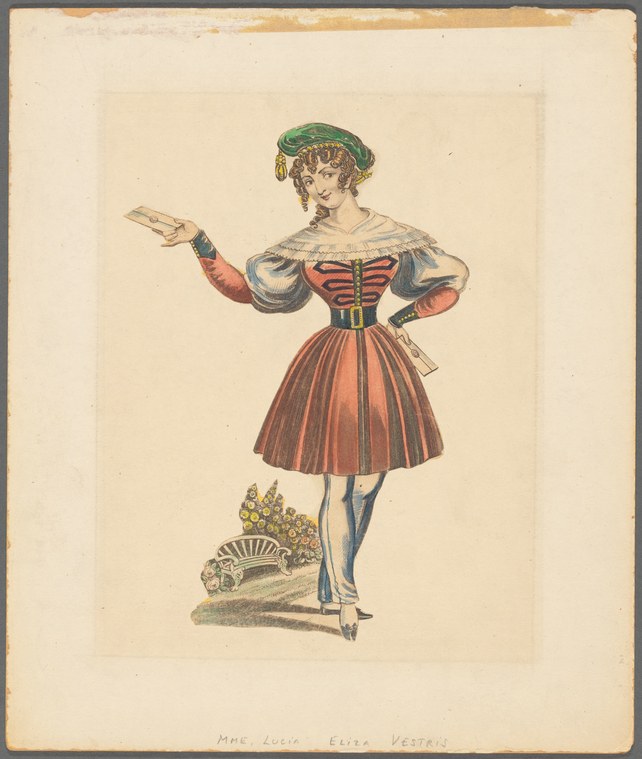
[Mme. Lucia Eliza Vestris, penciled notation].
Unknown artist
- Collection:
- Prints depicting dance
- Source:
- New York Public Library
- Rights:
- Public domain — free to use, share and adapt.
- Recorded as:
- Public Domain
Vestris was a prominent figure in early-to-mid 19th-century theatre, and this portrait documents the elaborate costume and theatrical persona that defined her performance. The work is valuable as evidence of how performers were commercially branded and circulated in this period, and of the centrality of costume and visual presentation to theatrical appeal.
What you are looking at
A single female figure stands in three-quarter view against a plain cream background, posed in a moment of theatrical presentation. She wears a striking red pleated skirt with a black corset-style bodice trimmed in red, and puffed sleeves in a contrasting fabric that appears tan or beige. A green decorative hat or headdress sits atop her curled hair, and she wears dark stockings and heeled shoes. Her left arm extends outward holding what appears to be a fan or piece of fabric, while her right arm rests at her side with hand on hip. At her feet sits an ornamental object—possibly a decorative fan or theatrical prop with gold detail. The pose is confident and frontal, the body arranged for display rather than captured mid-motion. The figure fills the composition centrally, with careful attention to the geometry of the silhouette and the crisp lines of the costume.
The dancing
The single dancer stands with weight evenly distributed, shoulders back, creating an upright theatrical posture. The left arm extends in a presenting gesture, a classic position for displaying costume and commanding audience attention. The right hand placement on the hip suggests confidence and stage presence. There is no sense of dynamic movement—the figure is posed for display, a convention of theatrical portraiture that prioritizes the costume and persona over choreographic action.
The dance depicted
This appears to be a theatrical character portrait rather than a representation of dance in motion. The inscription identifying the subject as 'Mme. Lucia Eliza Vestris' places this in the context of 19th-century theatre rather than concert dance. Vestris was a celebrated performer, and the image documents a stage costume and character presentation, likely from a popular theatrical or operatic role. The work celebrates a performer and her costume rather than depicting a specific dance or choreography.
How it was made
This is a hand-colored print or engraving on laid paper, executed with pencil notation (as indicated by the inscribed title). The technique allows fine detail in the costume rendering and precise delineation of the silhouette. The hand coloring—applied to the skirt, bodice, sleeves, and accessories—was likely done after the primary print, a common and economical method for theatrical portraits of the period. The quality of the paper and the care of the execution suggest this was a commercial theatrical print, likely distributed to audiences or collectors of theatre memorabilia.
About this work
This is a theatrical character portrait of a celebrated 19th-century performer, Lucia Elizaveta Vestris, rendered as a hand-colored engraving or print. The work documents a moment of theatrical presentation rather than choreographic action—the figure is posed in a conventional stance that displays costume, presence, and character. It belongs in a gallery of dance in art as a record of theatrical performance culture and the visual presentation of the performer's body as a primary spectacle. The image shows how theatrical performers of the period were documented, celebrated, and circulated through popular prints.
How to look at it
Attend to the deliberate arrangement of the figure: the outward-facing pose, the extended arm, and the carefully composed silhouette are all conventions of theatrical portraiture designed to celebrate the performer and her costume rather than to suggest movement or choreography. The viewer is positioned as an admirer confronting the performer's persona directly. Notice how the costume details—the pleating of the skirt, the trim of the bodice, the texture of the sleeves—are rendered with precision, indicating that the costume itself is as much the subject as the performer wearing it.
The artist
The artist is not recorded. The work bears only a penciled inscription of the subject's name, a common practice for theatrical prints of this period. Such portraits were often produced by commercial printmakers whose names were not consistently recorded, especially when hand-colored by workshop staff rather than the primary artist.
The period
This work dates to the 19th century, a period of explosive growth in theatrical entertainment and celebrity culture. The development of lithography and improved printing techniques made theatrical portraits widely available to audiences. Lucia Elizaveta Vestris was a star of European theatre in this era, and her image would have been recognized and sought by theatre-goers. The style and costume conventions visible here are consistent with mid-to-late 19th-century theatrical practice.
Where it lives
The work is held in the New York Public Library's collection of prints depicting dance. The penciled inscription suggests this may be an archival or cataloguing note rather than an artist's signature. The work is a commercial theatrical print, likely one of many produced and distributed during its subject's career.
Dance in this work
Questions about this work
Who was Lucia Elizaveta Vestris?
Vestris was a celebrated performer of the 19th-century European theatre, known for her starring roles in popular theatrical and operatic productions. She was a major celebrity of her time, and her image was widely circulated through theatrical prints like this one. The details of her specific roles and career achievements would require historical research beyond what the image alone conveys.
Is this a dance image?
This is a theatrical portrait of a performer, not a depiction of dance or choreography in motion. It documents the costume and stage presence associated with a theatrical role, and belongs in a dance collection because it shows how performers' bodies were presented and circulated in theatrical culture. It is evidence of performance rather than a record of actual choreography.
What technique was used to make this print?
The work appears to be an engraving or lithographic print that was hand-colored after printing. Hand-coloring allowed printmakers to produce affordable colored prints quickly, making theatrical portraits accessible to theatre-goers. This was a standard commercial method for theatrical memorabilia of the period.
More dance artwork





