49 works in this view — arrow keys or swipe to move between them.
Dance in Art
Il ballo
Unknown artist
- Collection:
- Prints depicting dance
- Source:
- New York Public Library
- Rights:
- Public domain — free to use, share and adapt.
- Recorded as:
- Public Domain
The image preserves a specific moment in dance history when trained solo performance by women became a central feature of aristocratic social life and entertainment. It shows us not just what was danced, but how it was watched and valued—as a spectacle to be admired from a distance rather than as a participatory social form.
What you are looking at
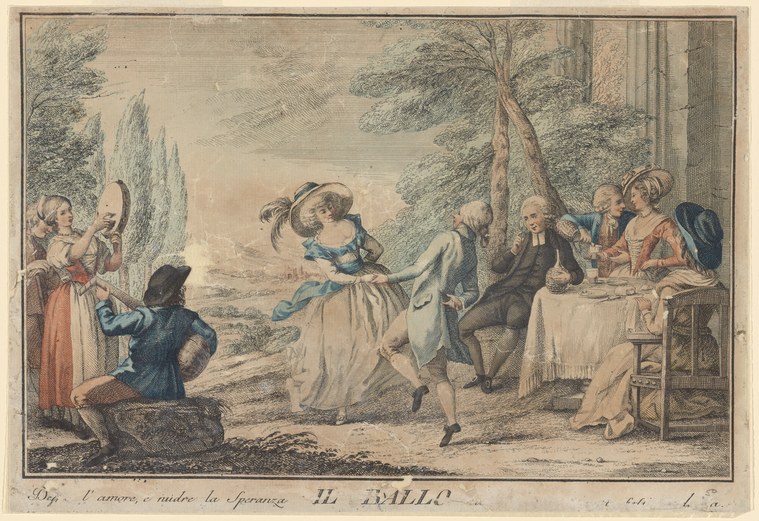
A garden party in progress, set among tall trees with classical architecture visible on the right. A woman in white muslin with a blue sash dances alone in the center, her body caught mid-movement in a graceful pose. Around her, seated and standing figures in 18th-century dress watch from tables and chairs arranged informally: men in dark coats, women in colored gowns and elaborate coiffures. The lighting is soft and diffused, suggesting daylight filtered through foliage. The composition draws the eye to the solitary dancer, who occupies the dramatic center of the scene, while the spectators form a loose semicircle of attention.
The dancing
The central dancer stands with her weight lifted, one leg extended or about to extend, arms gracefully positioned in a balletic port de bras. Her posture is upright and controlled, suggesting trained movement rather than folk or social dance. She performs alone, separated from the company by space and by her elevated energy. The watching figures are seated or standing at ease, leaning forward slightly with interest, suggesting this is a moment of entertainment within a social gathering rather than a participatory group dance.
The dance depicted
This appears to depict a solo performance within a courtly or aristocratic garden setting, most likely a minuet or gavotte—the kind of danced entertainment that formed part of elite social life in the 18th century. The solitary female dancer, the formal dress, the watchful audience, and the garden setting all point to this as a display piece: a woman dancing for the assembled company rather than with them. The controlled, upright carriage and the balletic quality of the pose suggest training in the courtly dances of the period.
How it was made
This is a hand-colored engraving or etching, recognizable from the fine line work, the precise hatching used to create shadow and volume, and the selective application of watercolor or gouache to key elements—the woman's blue sash and white dress, the flesh tones, the landscape greens. The technique allowed for wide circulation through printing, making this a work intended for a relatively broad audience of educated people interested in fashionable society and its entertainments. The careful composition and refined execution suggest a commercial print of some standing, produced for the art market rather than as a unique work.
About this work
This engraving captures a moment from 18th-century aristocratic leisure: a young woman performing a courtly dance for the entertainment of her assembled company in an idealized garden setting. The work documents both the dance itself—a trained, solo performance in the refined style of the period—and the social context in which such dances were presented. It is a record of how dance functioned in elite society: as display, as social accomplishment, as a form of beautiful entertainment that demonstrated both the dancer's training and the host's cultivation.
How to look at it
Watch the dancer's posture and the isolation created by space and attention. The artist has frozen her at a moment of grace and control—poised rather than in rapid motion—which is typical of how 18th-century dance was depicted: not as spectacle or vigor, but as refined, restrained beauty. Notice how every eye in the garden turns toward her: this is a convention of the period, where the depicted audience's attention signals to us what we should admire. The garden setting, too, is a convention—it elevates leisure and pleasure as worthy subjects while suggesting that this is an idealized, timeless moment of civilization and taste.
The period
This work dates stylistically to the mid-18th century, when the minuet and gavotte dominated aristocratic dancing and garden entertainments had become fashionable settings for social display. The engraving itself is a commercial product of the period's lively market in prints depicting manners, costume, and social life. In France and Italy especially, prints of this kind circulated widely among people of leisure, documenting the idealized world of aristocratic culture and serving as visual records of contemporary fashion and conduct.
Where it lives
The work is held in the New York Public Library's collection of prints depicting dance. It is a commercial engraving, one of many such prints produced in the 18th century to document and circulate images of fashionable life.
Dance in this work
Questions about this work
What dance is this?
Almost certainly a minuet or gavotte. The solitary female dancer, the balletic posture, the garden setting, and the watchful audience are all typical of how 18th-century courtly dances were presented and depicted. Without an inscription or title, we cannot be certain, but the form and context are unmistakable.
Why is she dancing alone?
In 18th-century aristocratic culture, a trained dancer often performed solo for the entertainment and admiration of the assembled company. This was a form of display: a demonstration of grace, training, and refinement. Solo performances by women became increasingly fashionable during the Enlightenment as a form of cultivated leisure.
Is this a real event or a fantasy?
It is almost certainly idealized rather than documentary. These prints depicted aspirational versions of aristocratic life, often following established conventions of composition and setting. The garden, the attentive audience, the perfect moment of grace—all are elements of a polished, imagined vision of society rather than a record of an actual occasion.
What can we learn from this about how women were viewed?
The image shows women as trained performers whose bodies and accomplishments were objects of aesthetic admiration. The isolated dancer is the focus of every gaze, but she is also separated from the social group—admired for her training and beauty, but placed at a distance. It reflects a world where women's education in dance was valued, but primarily as a form of ornamental display.
More dance artwork





