49 works in this view — arrow keys or swipe to move between them.
Dance in Art
Wanda polka mazurka, composed by Adrien Talexy
Unknown artist
- Collection:
- Prints depicting dance
- Source:
- New York Public Library
- Rights:
- Public domain — free to use, share and adapt.
- Recorded as:
- Public Domain
Dance cards and promotional prints like this one are among the few surviving visual records of how ballroom dances were actually performed and presented to the public in this period. They show the social ritual and formal etiquette surrounding dance just as much as the movement itself, and they document the commercial infrastructure—the composers, publishers, dancers, and ballrooms—that sustained ballroom culture. For historians of social dance, gender performance, and Victorian leisure, such prints are primary evidence.
What you are looking at
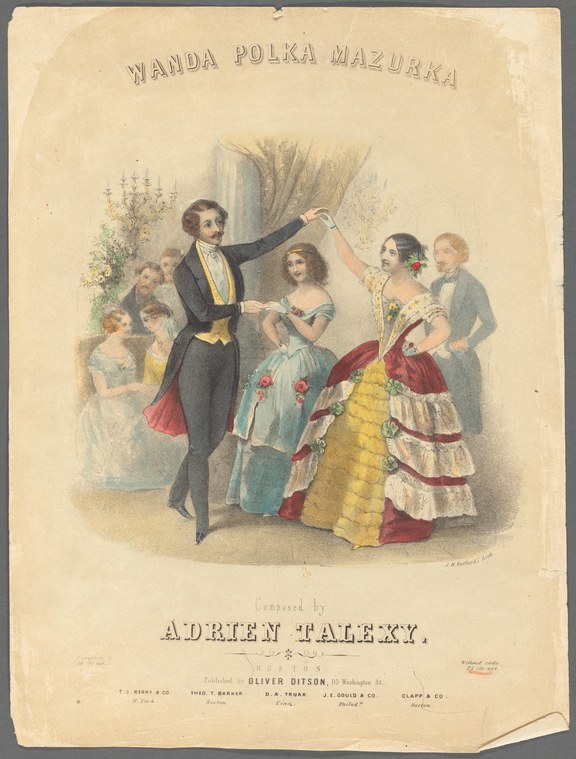
A ballroom scene in the mid-nineteenth century, with a young couple at its center taking the floor before an assembled company of fashionably dressed onlookers. The man, in formal black tailcoat with yellow waistcoat, reaches toward the woman's raised hand in a gesture of invitation or encouragement; the woman wears a pale blue dress with red underskirts visible beneath the hem, and her posture suggests she is about to begin or is being drawn into the dance. Behind them stands a small orchestra or musicians (visible at left), and the background is crowded with other couples and spectators in evening dress—women in layered skirts of yellow, red, and white, men in dark coats—arrayed as if witnessing the opening of a formal dance. The setting is indoors, lit by soft gaslight or candlelight that gives the scene warmth and definition. The moment captured is one of social ceremony: the beginning of a dance number at an assembly or ball.
The dancing
The central couple are in an open or preparatory position rather than a closed ballroom hold; the man's arm is extended and raised, his body turned toward the woman in a posture of formal address or invitation. The woman faces him with her arm raised to meet his, her weight balanced and her body erect. Neither figure shows the weight-sharing or body contact of a dance already underway; instead, the gesture reads as the prelude to dance—a moment of social negotiation. The surrounding figures are stationary observers, their poses formal and attentive.
The dance depicted
This is a polka-mazurka, a hybrid social dance that combined the bouncing rhythms and folk character of the polka with the turning, three-step pattern of the Polish mazurka. The title credits the composition to Adrien Talexy, and the print itself is a dance card cover or advertisement for a fashionable ballroom number—one of hundreds produced in Europe in the 1850s and 1860s to promote specific dances and their composers. The polka-mazurka was a couples' dance performed in closed position with a characteristic hop-and-turn motion, lighter and more playful than the mazurka proper. The image shows the social context—a formal ball—rather than the dance in motion, emphasizing the ceremonial opening moment when the male partner invites the female to dance.
How it was made
This is a hand-colored lithographic print, as evidenced by the soft chromatic washes, the delicate gradations of tone, and the characteristic crayon-worked textures visible in the background and figures. The image is printed in pale tints—greens, blues, yellows, pinks—with hand coloring applied afterward, a common technique for popular dance prints of the mid-1800s. The medium allowed rapid and inexpensive reproduction, making such prints widely accessible to ballroom dancers, music teachers, and middle-class households. The style and finish indicate this was a commercial product designed for circulation among dancers and musicians.
About this work
This is a mid-nineteenth-century ballroom print advertising a specific dance composition—the polka-mazurka—rendered as a fashionable ballroom scene. It documents both the music and the social context in which such dances were performed: the formal assembly, the gendered etiquette of invitation, the orchestra, the watching company. The work is part of a large tradition of dance-card covers and promotional lithographs that proliferated during the heyday of the polka and its variants in the 1850s–1860s. Such prints served as both commercial advertisements for composers and publishers, and as instructional or aspirational images for people who danced or wished to dance in fashionable society. The Wanda polka-mazurka was one of many such pieces, and this print its visual accompaniment—a window into how social dancing was marketed and imagined in the Victorian ballroom.
How to look at it
Observe the moment chosen: not the dance itself in motion, but the formal instant of invitation and acceptance that precedes it. The artist has frozen the social choreography—the raised hands, the turned bodies, the attending crowd—rather than the stepping choreography. Note also the extreme formality of the dress and setting, and the careful attention to the hierarchy of the ballroom: the couple elevated and central, the musicians at left, the spectators arranged around the perimeter. This was how the dance was framed for public consumption—as spectacle and as aspiration, not as physical instruction.
The artist
The artist is not recorded on the print. The work credits the musical composition to Adrien Talexy and was published by Oliver Ditson of Boston, a major music publisher of the era. The actual lithographer or illustrator remains unidentified, which is typical of commercial dance-card covers of the period; such prints were usually made by in-house artists or regional workshops and attributed only to the publisher and composer.
The period
The polka arrived in Europe from Bohemia in the 1830s and became the dominant ballroom dance of the 1840s–1860s, eclipsing the older waltz in popularity. Composers and publishers rapidly produced countless polka variants—mazurka-polkas, schottische-polkas, redowa-polkas—to sustain novelty and fashion. The printed dance card served as both advertisement and instruction, circulated among dancers and often bundled with sheet music. In America, this practice was particularly vigorous; Boston and New York publishers like Oliver Ditson issued hundreds of such prints. At the same time, lithography was undergoing rapid improvement and becoming more affordable, enabling the mass circulation of colored images. This print sits at the intersection of these trends: the commercialization of ballroom dance, the rise of lithographic printing, and the mid-Victorian enthusiasm for fashionable social ritual.
Where it lives
This print is held in the New York Public Library's collection of prints depicting dance. It is a commercial lithograph from a music publisher, typical of the thousands of dance-card covers produced in America and Europe in the mid-nineteenth century.
Dance in this work
Questions about this work
What is a polka-mazurka?
A polka-mazurka was a ballroom dance that combined the energetic hopping rhythm of the polka with the three-step turning pattern of the Polish mazurka. It was popular in the 1850s–1860s as one of many polka variants that composers produced to sustain novelty in fashionable society. Couples danced it in closed position with a characteristic bouncing, turning motion.
What is a dance-card cover?
A dance card was a small printed booklet that listed all the dances to be performed at a ball, with spaces for gentlemen to write their names next to their chosen dances as a way of reserving partners. The cover of such a card often featured an illustration of a fashionable couple dancing, and served as an advertisement for the composer and publisher of the music inside.
Who was Adrien Talexy?
Adrien Talexy is identified only as the composer of this polka-mazurka; biographical information about him does not survive in standard references. He was one of many mid-nineteenth-century composers who specialized in ballroom dances for the commercial market, producing pieces that were quickly published and circulated through prints like this one.
Why was this print hand-colored?
Hand-coloring was more economical than chromolithography (color printing) for small runs or for customized work. The base image was printed in black or pale tints, then finished by hand with watercolor or gouache. This method allowed publishers to offer colored prints without the expense of separate color lithographic stones.
More dance artwork





