49 works in this view — arrow keys or swipe to move between them.
Dance in Art
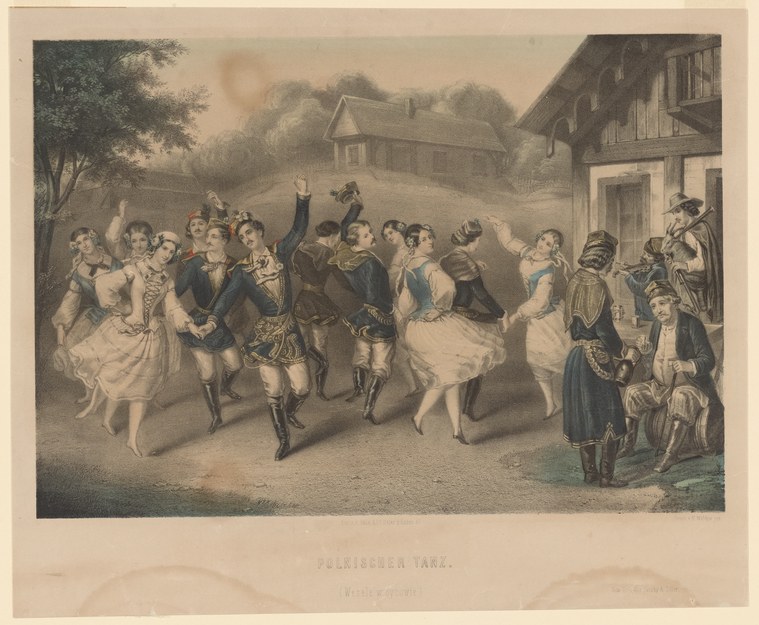
Polnischer Tanz: (Wesele w oycowie)
Unknown artist
- Collection:
- Prints depicting dance
- Source:
- New York Public Library
- Rights:
- Public domain — free to use, share and adapt.
- Recorded as:
- Public Domain
This image documents a living folk tradition at a moment when such traditions were beginning to be recorded, preserved, and distributed through print culture. It shows Polish wedding dance not as a museum specimen but as a social practice involving the whole village, and it reveals how non-specialist artists represented folk movement—emphasizing gesture, energy, and community participation over technical precision. For historians of dance and of print culture, it is evidence of how regional and ethnic identity was visualized and circulated in 19th-century Europe.
What you are looking at
A country wedding celebration unfolds in a village courtyard, with a large stone house and church visible in the background under hazy light. The scene captures a moment of energetic communal dance: a group of figures in the center of the composition move together in formation, their bodies angled and gesturing outward with visible animation. The women wear white or pale dresses with full skirts; the men are in dark jackets and trousers, some in military or formal dress uniform. Spectators line the edges—women in dark clothing on the right, children and onlookers positioned around the perimeter. The composition emphasizes the circular or linear arrangement typical of folk celebration, with the dancers forming a loose group rather than pairs, and the setting suggesting a moment of collective participation rather than formal performance.
The dancing
The central dancers move in what appears to be a line or circle formation without rigid paired holds. Their gestures are expansive—arms raised or extended, bodies leaning forward with energy, legs in active motion suggesting continuous movement or the moment just before a turn. The dancers' posture suggests folk dance rather than ballroom hold: upright torsos, separated bodies, and gestures that include the arms and shoulders rather than the contained frame of social dancing. The mix of uniformed and civilian dress suggests this is a community event where diverse participants joined the dance.
The dance depicted
The title *Polnischer Tanz (Wesele w oycowie)* identifies this as a Polish wedding dance, specifically a *wesele*, the traditional Polish wedding celebration featuring collective folk dances. The composition and formation suggest the *mazurka* or *oberek*—vigorous folk dances performed by multiple couples or a group in open formation with characteristic stamping and turning. The animated gestures, upright posture, and communal arrangement are consistent with 19th-century Polish folk dance as opposed to the closed ballroom dances of the same period. The village setting and mixed social composition reinforce that this documents a genuine folk tradition rather than a stylized stage version.
How it was made
This is a hand-colored engraving or steel engraving, evidenced by the fine parallel lines visible in the shading, the linear definition of forms, and the overall compositional clarity characteristic of reproductive printmaking. The technique allowed for wide circulation of the image—prints like this were produced in multiple copies and distributed as popular prints, making it a vehicle for documenting and distributing knowledge of regional dance practices to audiences beyond Poland. The hand-coloring in watercolor or gouache adds specificity to dress and setting that an uncolored engraving would lack.
About this work
This is a printed document of Polish folk dance at a moment when European printmakers were recording regional traditions, often with ethnographic or picturesque intent. The *wesele* was a central cultural institution in Polish village life, and this image captures not the dance itself in technical detail but its social meaning: a moment when the entire community participated in celebration, when formal dress and uniforms mingled with everyday clothing, and when the boundaries between performer and spectator dissolved. For dance historians, it is valuable evidence of how these dances were understood and represented in the 19th century—not as codified steps but as collective, energetic, and communal expression.
How to look at it
Notice how the artist has chosen not a moment of still formation but a moment of movement—bodies leaning, arms raised, weight shifting. The composition is deliberately inclusive, showing not just the dancers but the watchers, emphasizing that this is a communal event rather than a performance. The detail of uniform dress among some male dancers suggests the social mix of the village, including military or official figures. The background architecture—the substantial house and church—anchors this in a specific place and suggests the peasant village rather than nobility or town.
The period
This print belongs to the 19th-century tradition of ethnographic and picturesque printmaking, when European artists and publishers developed a keen interest in documenting regional folk practices. The Romantic movement's celebration of folk culture, national identity, and peasant life drove demand for images of folk dances, costumes, and celebrations. Poland, under partition and politically fragmented during the 19th century, saw its folk traditions recorded and celebrated in print as a form of cultural preservation and nationalist assertion. The engraving medium allowed these images to circulate widely, making folk dance visible to urban, educated audiences who might never witness an actual *wesele*.
Where it lives
This work is held in the New York Public Library's prints collection, part of a larger body of prints documenting dance and social life. The collection designation *Prints depicting dance* indicates it was catalogued as documentary or ethnographic material rather than fine art.
Dance in this work
Questions about this work
What is a Polish wesele?
A *wesele* is a traditional Polish wedding celebration that typically lasts multiple days and features collective dancing, feasting, and games. Unlike formal ballroom celebrations, the *wesele* is participatory: community members, not professional dancers, perform the dances. The dances performed include the mazurka, oberek, and other vigorous folk forms done in groups or lines rather than pairs.
How do we know this is a Polish dance and not another Central European tradition?
The title explicitly identifies it as a Polish dance (*Polnischer Tanz*) and gives the Polish name for a wedding celebration (*Wesele w oycowie*). The formation, gestures, and costuming are consistent with documented 19th-century Polish folk dance, though the artist may have worked from description or other images rather than direct observation.
Why are some of the men in uniform?
Military or official dress was common at 19th-century village celebrations, particularly in partitioned Poland where Russian, Prussian, or Austrian officials were present. It also suggests that men of various social standings participated in the dance, and that the artist wanted to convey the social composition of the event.
Is this a reliable document of how the dance was actually performed?
As a printed image created for a broad audience, it prioritizes visual interest and clarity over technical accuracy. The artist has captured the energy and communal nature of the dance and the general formation, but the precise steps, rhythm, and footwork cannot be determined from a single frozen moment. It is better understood as evidence of how European audiences understood and imagined Polish folk dance in the 19th century.
More dance artwork





