49 works in this view — arrow keys or swipe to move between them.
Dance in Art
Dance on music covers
Unknown artist
- Collection:
- Prints depicting dance
- Source:
- New York Public Library
- Rights:
- Public domain — free to use, share and adapt.
- Recorded as:
- Public Domain
This image captures the Polka at the moment of its mass cultural presence—not in the ballroom itself but in the commercial representation that shaped public understanding of the dance. The comic exaggeration and the theatrical framing show how a dance form was adapted and satirized for popular consumption, revealing attitudes toward dance, gender, and social propriety in the Victorian era. For historians of social dance and popular culture, it documents the intersection of music publishing, dance instruction, and entertainment.
What you are looking at
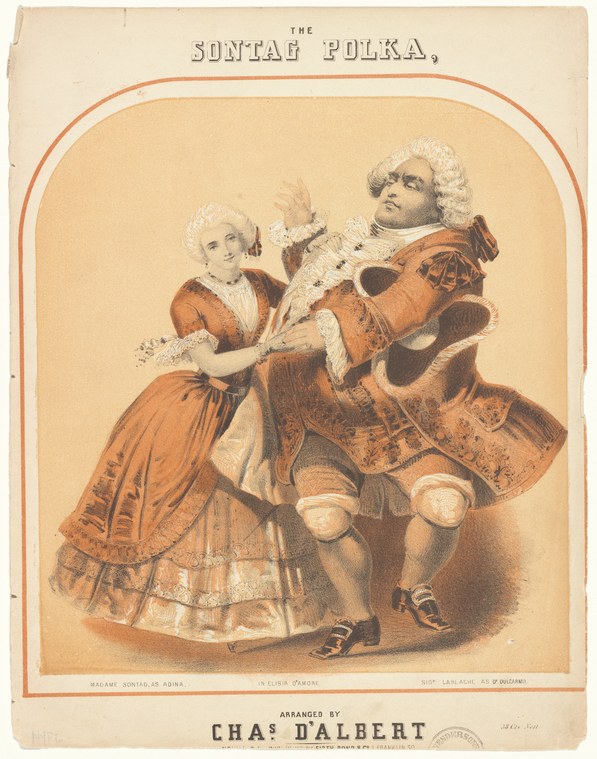
A man and woman in eighteenth-century dress perform a lively dance together. The man, dressed in a rust-colored coat with ornate embroidery, breeches, and stockings, holds a child aloft in one arm while executing an energetic movement with the other. His posture is dynamic and off-balance, leaning backward. The woman, in a matching rust-colored dress with layered skirts and white fichu, reaches toward him with extended arm and animated expression. The figures occupy the center of the composition against a plain cream background. The print is framed by a double-line border, with the title "THE SONATA POLKA" printed above in decorative capitals. Below the image, credit lines indicate the arrangement by "CHAS DALBERT" and publication details. The composition captures a moment of theatrical buoyancy and playful interaction between the adult dancers.
The dancing
The man and woman are in close spatial relationship but not in a closed ballroom hold. His free arm is raised and bent; her arm extends toward him at shoulder height. Both figures are captured mid-movement with pronounced forward momentum and lifted posture. The child, held horizontally by the man's left arm, is rendered in lighter tones and appears almost as a prop or extension of his dancing. The woman's weight appears to be on a forward leg, her torso inclined, suggesting she is either advancing or about to turn.
The dance depicted
This is a Polka, as stated in the title. The Polka was a Czech folk dance that became an international ballroom craze in the mid-nineteenth century, spreading rapidly through Europe and North America from the 1840s onward. The energetic, bouncing character visible in the figures' posture—the lifted carriage, the dynamic arm work, the forward propulsion—aligns with the Polka's characteristic hop-step rhythm and lively tempo. The presence of the child and the theatrical exaggeration of the pose suggest this is not a strict ballroom demonstration but rather a comic or novelty version, possibly from a music hall or theatrical context. The title references the musical form (Sonata-Polka), indicating this was sheet music cover art.
How it was made
This is a hand-colored lithograph, a reproductive technique well-suited to the mass production of sheet music covers in the nineteenth century. The use of warm ochres and terra-cottas, with delicate shading in the faces and careful cross-hatching for texture in the fabrics, demonstrates skilled draftsmanship. Lithography allowed for broad distribution to amateur musicians and dancing masters, making this a document of popular taste and commercial music culture. The quality of the color registration and the refinement of the line work suggest a reputable publisher's output, consistent with mid-to-late nineteenth-century music publishing standards.
About this work
This is a lithographed cover for a published musical composition titled "The Sonata Polka," arranged by Charles Dalbert. It depicts the Polka in its heyday as a fashionable ballroom dance, captured not in formal instruction but in a comic or theatrical moment—the addition of a child held aloft by the male dancer transforms a standard dance representation into comic entertainment. The work belongs to the vast archive of nineteenth-century sheet music covers, which are vital documents of dance history precisely because they show how dances were understood by the public, how they were marketed, and what kind of bodies and moments the commercial imagination chose to circulate. The Polka's explosive popularity across Europe and the Americas is visible in prints like this; it was not elite ballet but a social dance that penetrated all levels of society and became a subject for graphic satire and novelty.
How to look at it
Attend to the moment the artist chose to freeze: not the neat, instructional alignment of a dance manual, but an exuberant, mid-movement instant with bodies off-balance and in dynamic contact. The woman's extended arm and forward lean, the man's backward tilt and lifted child, the asymmetry of their poses—these are the visual language of vivacity and comedy, not formal ballroom decorum. The costume detail (the ornate coat, the layered skirts) confirms the Polka's status as fashionable ballroom wear. The theatrical framing and the addition of the child signal that this is a novelty or performance variant, not strict social dancing, which tells us something about how the dance was understood in popular imagination.
The artist
Charles Dalbert is credited as the arranger of the musical composition. The lithographer and illustrator are not identified in the visible text. Dalbert's name suggests a European, likely French or German, musician working in the nineteenth-century music publishing trade. Without further research into publishing records, little can be confidently stated; the work represents the typical output of mid-century commercial music publishers who employed anonymous or credited illustrators to create appealing covers that would sell sheet music to the growing market of amateur musicians and dancers.
The period
The Polka emerged in Bohemia in the 1830s and spread across Europe with remarkable speed, reaching London and Paris by the early 1840s and becoming a defining dance of the Victorian era. By the 1860s-1880s (the likely date of this print, based on lithographic style and dress), the Polka was no longer exotic but thoroughly domesticated—a standard ballroom dance taught to children and featured in public balls. This print belongs to the period when the Polka was being absorbed into popular and comic culture; the exaggeration and the novelty of the child-carrying variant suggest audiences were already somewhat familiar with the basic form and could enjoy humorous variations. In visual art, the period saw explosion in chromolithographic sheet music covers as a commercial art form, with dance scenes proving particularly popular subjects.
Where it lives
The print comes from the New York Public Library's collection of prints depicting dance. It is a sheet music cover, a category of object that was produced in vast numbers in the nineteenth century for commercial distribution and is now a rich but often uncatalogued archive of dance history.
Dance in this work
Questions about this work
What is a Sonata Polka?
A Sonata Polka is a musical composition that combines the formal structure of a sonata with the rhythmic and melodic character of a polka. It is more sophisticated than a simple polka melody and would be played by accomplished amateur musicians on piano. This cover advertises such a piece, arranged (adapted for performance) by Dalbert.
Why is the child in the picture?
The child is almost certainly included for comic effect and novelty. Including a child in a dance (or pretending to) was a familiar trick for creating humor and appeal on sheet music covers. It may also reference a specific novelty dance or a theatrical skit, though without additional documentation, the specific reference cannot be confirmed.
Is this what the Polka actually looked like?
Not exactly. This is a theatrical or comic exaggeration. A real Polka in a ballroom would feature a closed or semi-closed hold, more compact footwork, and a bouncing rhythm synchronized to music. This print shows the Polka as understood by a mass audience—energetic, exuberant, and slightly absurd—rather than as demonstrated in a dance instruction manual.
How do we know this is a lithograph?
The technique is evident from the quality of the line work, the characteristic soft gradations in the color, the way the stone was used to create texture, and the chromatic registration. This is consistent with mid-nineteenth-century sheet music covers, which were almost always produced by lithography because the technique allowed for economical, high-quality color reproduction at scale.
More dance artwork





