49 works in this view — arrow keys or swipe to move between them.
Dance in Art
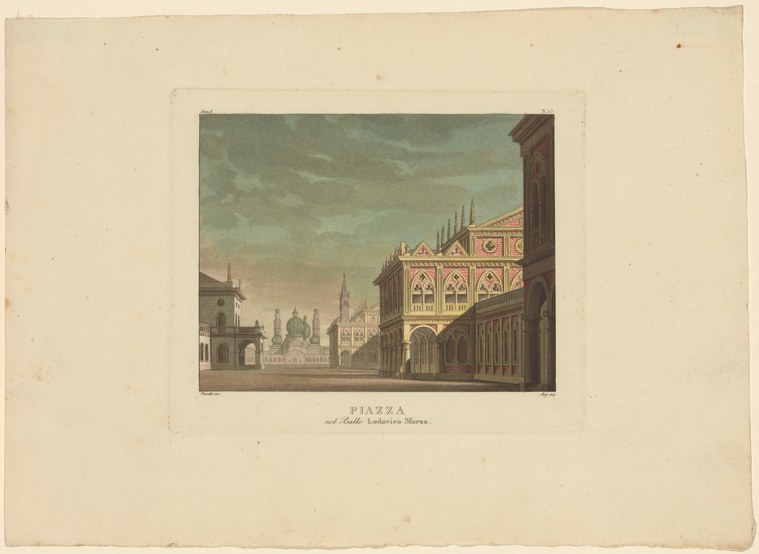
Piazza nel ballo Lodovico Sforza
Unknown artist
- Collection:
- Prints depicting dance
- Source:
- New York Public Library
- Rights:
- Public domain — free to use, share and adapt.
- Recorded as:
- Public Domain
This is one of the few visual documents of the ballo in its original architectural context—not a book illustration or a later reconstruction, but a print evidently made to record the actual ceremonial space and practice of Milanese court dance. It shows how the Renaissance court understood dance not as an isolated spectacle but as an integral part of the designed environment and the performance of nobility.
What you are looking at
A veduta of the Piazza in Milan during a formal court dance. The composition is a staged view of architectural grandeur: in the foreground right, the ornate palazzo façade with its distinctive Gothic-Renaissance details—pointed arch windows and decorated stonework—frames the scene. The piazza stretches back in perspective toward a cityscape of domes and spires under a pale sky. In the center and left foreground, figures in Renaissance court dress move through the space. The figures are small and carefully distributed; they do not dominate the composition but rather animate the urban stage. The light is even and cool, the colors muted—pale greens, ochres, and terracottas—characteristic of hand-colored engraving or print work. The mood is formal and ceremonial, the architecture the true subject, the dancers subordinate to it.
The dancing
The dancers are rendered at a distance and in profile or three-quarter view, making precise reading of hold and footwork difficult. What is visible suggests upright carriage and measured, formal bearing. The figures appear to be in pairs or small groups, distributed across the piazza rather than concentrated. The women's skirts are full and voluminous, consistent with mid-to-late Renaissance fashion. The scale and spacing suggest a slow, processional or courtly movement rather than energetic or rapid motion. No clear record of the mechanics of the dance is evident from the bodies themselves.
The dance depicted
This image documents a court dance—most likely a ballo or a pavan given the formal Renaissance setting and the title's reference to Ludovico Sforza, the Duke of Milan (r. 1494–1508). The ballo was the principal courtly dance of the Italian Renaissance, a slow, stately form performed in the presence of nobility and in architectural or ceremonial settings such as this. The image is not a naturalistic record but an architectural print that uses dance as a marker of courtly ceremony. The dance itself cannot be identified from the figures' movement; it is known primarily from the context and the period's conventions.
How it was made
This is a hand-colored engraving or etching, established from the linear style, the fine detail in the architectural rendering, and the characteristic coloring in flat or nearly flat tones. The technique allowed for precise architectural documentation while introducing human figures at a legible but subordinate scale. The hand coloring—applied after printing—adds atmospheric perspective and defines the social space. Such prints were circulation documents: evidence of ducal magnificence, court life, and artistic patronage, distributed among collectors and courts across Europe.
About this work
A veduta-style print depicting a formal court dance in the Piazza of Milan under Ludovico Sforza, likely dating to the late 15th or early 16th century or to a later antiquarian work reproducing such a scene. The composition is primarily architectural—the palace and cityscape dominate—but the carefully placed figures in Renaissance dress signal that the image documents courtly ceremony and the performance of the ballo, the principal social dance of the Italian Renaissance court. The work belongs to the tradition of veduta prints and courtly documentation, where dance is one element of a larger performance of power and magnificence.
How to look at it
Attend first to the architecture: the palazzo and the ordered perspective define the social hierarchy and formality of the occasion. Then locate the figures—small, distributed, upright. The artist has chosen to freeze the moment not at a peak of movement but in a ceremonial state of processional order. The distance of the view, and the subordination of the dancers to the setting, tells you that the point of the image is not the dance itself but the court, the city, and the authority they represent. The hand coloring adds depth and atmosphere, making the space feel inhabited and real.
The period
The image dates to or depicts the court of Ludovico Sforza (the 'il Moro'), one of the most important patrons of the Renaissance. Milan in the late 15th century was a center of courtly culture: music, dance, and theatrical spectacle were central to the duke's self-representation. The ballo was the dominant dance form, taught to noblemen and women and performed at banquets, diplomatic occasions, and celebrations. Italian dance manuals from this period (Domenico da Piacenza, Guglielmo Ebreo, Antonio Cornazano) document the technique and etiquette of the ballo. The print tradition of vedute—topographic or ceremonial views—flourished in Italy in the 16th and later centuries, often used to document courtly life and architectural achievement.
Where it lives
The work is held in the Prints collection at the New York Public Library. It is catalogued as an eighteenth- or nineteenth-century print, likely a later reproduction or antiquarian document rather than a contemporary Milanese print, though the subject and composition may reference earlier court records or artistic traditions.
Dance in this work
Questions about this work
What is a ballo?
A ballo (plural: balli) was the principal courtly dance of the Italian Renaissance. It was a slow, processional dance often performed in couples or small groups, marked by measured steps, formal bearing, and allegorical or narrative content. It was taught to noblemen and women as essential to courtly accomplishment, and it was performed at state occasions, banquets, and celebrations. Italian dance masters of the 15th century such as Domenico da Piacenza documented its technique in treatises.
Who was Ludovico Sforza?
Ludovico Sforza (1452–1508), known as 'il Moro,' was Duke of Milan from 1494 to 1508. He was one of the most powerful Italian princes of his time and a major patron of the arts, music, and dance. His court was famous for its spectacle and ceremony, and he commissioned many works documenting courtly life. He was also a patron of Leonardo da Vinci.
Is this a historical document or an artistic fantasy?
It is likely both. The image may be based on actual court records or ceremonies, but the print itself was created as an artistic and documentary work—a veduta that celebrates Milan's architectural grandeur and courtly sophistication. Whether it depicts a specific recorded event or a generalized ideal of Milanese court life cannot be determined from the image alone. It belongs to the tradition of courtly documentation and architectural celebration rather than to eyewitness reportage.
More dance artwork





