49 works in this view — arrow keys or swipe to move between them.
Dance in Art
Greenwich Fair
Unknown artist
- Collection:
- Prints depicting dance
- Source:
- New York Public Library
- Rights:
- Public domain — free to use, share and adapt.
- Recorded as:
- Public Domain
This work documents the lived dance culture of ordinary people at a moment when printed images of dance were dominated by theatrical and aristocratic subjects. It shows how social dance functioned outside the ballroom—as public, commercial entertainment where mixed crowds could move freely and without strict choreographic form, making it invaluable evidence for understanding 19th-century popular culture and the social freedom dance could enable.
What you are looking at
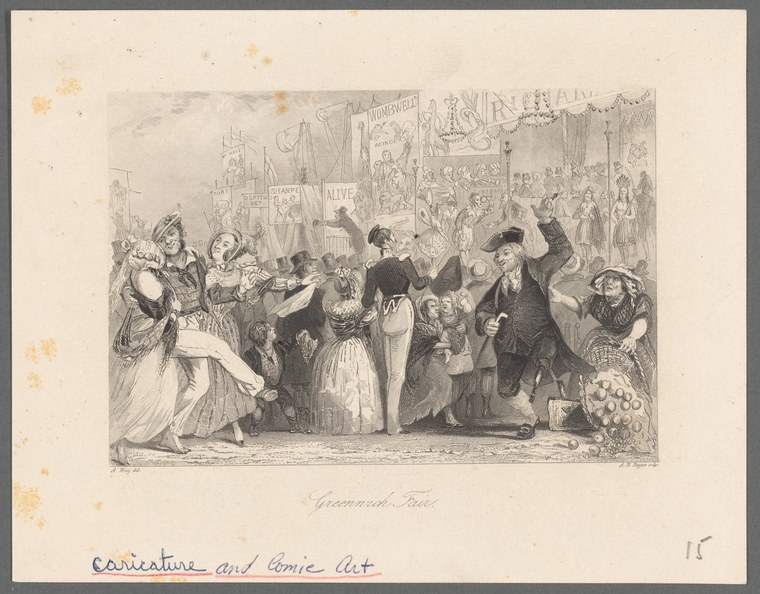
A crowded fair ground in full festive swing, with fairground attractions and striped tents visible in the background. In the foreground, a mixed crowd of fashionably dressed people—men in tailcoats and top hats, women in long skirts and bonnets—are engaged in lively social dancing and revelry. The composition is dense and chaotic, capturing the energy of a public carnival or street fair. Musicians with instruments visible on the left play for the dancers. The scene has the character of a popular Vauxhall-style pleasure garden or Greenwich Fair itself, a famous 18th–19th century English fair known for its music, dancing, and crowds. The print is rendered in fine detail with strong contrasts between light and shadow, typical of satirical or observational social prints of the period.
The dancing
The dancers occupy a shallow middle ground, with bodies arranged in informal clusters rather than strict pairs. Some figures are in closed holds (man and woman facing), others stand apart or gesture expansively toward companions. The poses suggest spontaneous social interaction rather than formal choreography—raised arms, turned heads, animated gestures. Weight is typically upright and frontal, with skirts and coats creating broad silhouettes. The figures in the immediate foreground are more detailed; those receding toward the fair attractions become smaller and sketchier, increasing the sense of crowded public space.
The dance depicted
This depicts social dancing at a public fair, most likely in the Regency or early Victorian era. The setting, dress, and mixed-gender socializing point to country dances, quadrilles, cotillions, or other popular social forms of the 1820s–1840s. The informal arrangement and lack of rigid geometric patterns rule out the structured formations of the most formal ballroom dances; this is popular, open-air social dancing. The print captures the democratic, pleasure-seeking character of 19th-century public fairs, where all classes mingled. No specific dance step or hold is sufficiently resolved to identify the dance more precisely, but the energy and informality are unmistakable.
How it was made
This is a hand-colored engraving or etching on paper. The fine line work, cross-hatching for shadow, and capacity for minute figure detail are consistent with engraving; the subject matter—social satire and observational humor—was a staple of English print production for middle-class circulation. The hand coloring is selective and relatively flat, typical of prints sold for a modest price. The technique allowed multiple impressions to reach a wide audience, making this likely a published work with commercial intent, not a unique drawing. The print medium was ideal for social commentary and documentary observation of contemporary life.
About this work
This is a lively social document in print form, recording the public dancing and merriment of an English fair, most likely Greenwich Fair itself—a famous and rowdy gathering of working people, servants, and others seeking amusement outside the formal ballroom. The work combines careful observation of costume and manners with the energy of the moment, capturing both individual dancers and the festive crowd. It belongs in a dance archive as evidence of how social dancing functioned in public, unregulated spaces: informal, mixed, energetic, and central to popular entertainment in the 19th century.
The print records a world of public pleasure and social freedom that formal ballroom culture did not encompass. It shows us not courtship dances conducted under supervision but rather the joyful, abandoned, often satirized dancing of the fair-going public.
How to look at it
Look first at the density and informality of the groupings: no clear couples in fixed formation, no obvious leader, just clusters of people turning, gesturing, and moving. Notice the raised arms and turned bodies, which suggest active improvisation rather than set figures. The print's point of view is sympathetic but also gently mocking—we are invited to see the fair-goers' pleasure in their vigor and exuberance, but also to smile at their lack of restraint. Pay attention to how the print maker uses detail in the foreground and sketchiness in the distance to pull us into the crowd, making us feel the press and energy of the fair itself.
The period
Greenwich Fair was a real annual fair held in Greenwich, London, particularly famous during the 18th and early 19th centuries. It was a site of working-class leisure, music, dancing, and often rowdy behavior—frequently satirized in prints and literature of the period. The Regency and early Victorian eras saw a flourishing of satirical and observational prints documenting contemporary manners, of which this is an example. Social dancing at public fairs was distinct from ballroom culture: less formal, more exuberant, and more socially mixed. The print medium was the dominant way such scenes reached a public audience, and these images shaped how the middle and upper classes understood—and judged—popular leisure.
Where it lives
Held by the New York Public Library, this work is part of a prints collection focused on dance. It is catalogued as a dance image but lacks detailed attribution or date information in the record, suggesting it is one of many similar satirical or observational prints of 19th-century public life that circulated widely.
Dance in this work
Questions about this work
Is this a famous artist's work?
The attribution is unknown from the record provided. The style and subject suggest a professional print made for commercial circulation, not a unique artwork or signed original. Many such prints were produced by printers and publishers rather than individually named artists, and records for them are often sparse.
What is Greenwich Fair?
Greenwich Fair was an annual public fair held in Greenwich, London, during the 18th and early 19th centuries. It was a major site of working-class leisure, music, dancing, and socializing, often satirized in literature and prints as rowdy and chaotic. It became symbolic of plebeian joy and freedom, though also of the disorder middle-class moralists feared from unsupervised public gatherings.
How do we know this is about dancing and not just a crowd scene?
The organized groupings of men and women in close contact, the raised arms and turned bodies, the presence of musicians on the left, and the overall energy and dynamism all mark this as a dancing scene. The title 'Greenwich Fair' further confirms the setting. The composition prioritizes the human figures and their movement, not the architecture or commerce of the fair.
What style of dance is this?
The informality and mixed arrangement suggest social dances current in the early–mid 19th century—country dances, quadrilles, or cotillions—but the lack of formal positioning and the exuberant, spontaneous quality indicate this is popular fair dancing, not the refined ballroom versions of the same dances. The specific steps are not legible in the print.
More dance artwork





