49 works in this view — arrow keys or swipe to move between them.
Dance in Art
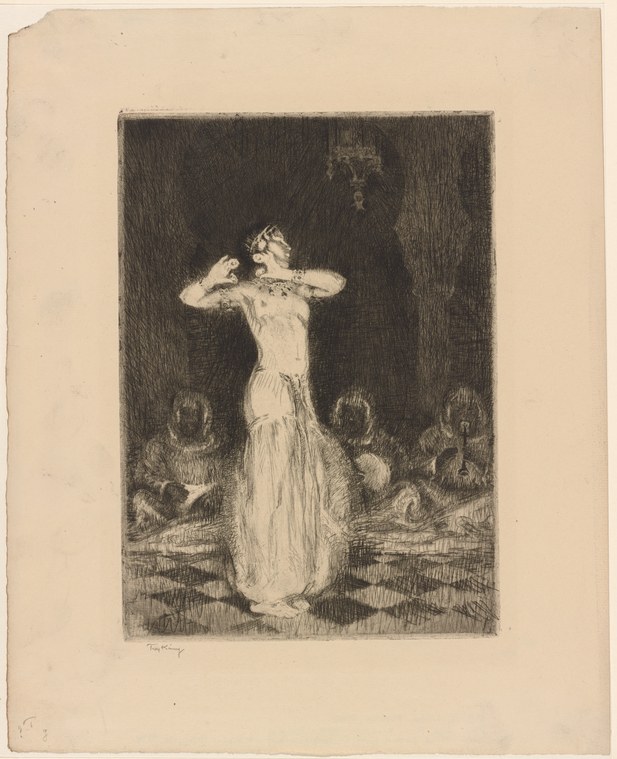
Doris Niles at Radio City
Unknown artist
- Collection:
- Prints depicting dance
- Source:
- New York Public Library
- Rights:
- Public domain — free to use, share and adapt.
- Recorded as:
- Public Domain
For dance historians, this image documents the visual and physical language of early modern concert dance—the codes by which expressiveness was conveyed in the body and by which dancers represented interiority. For art historians, it shows how dance became a subject worthy of serious graphic representation at the moment modernism was reimagining the stage. The catalogue lists this as Doris Niles at Radio City, which would date it to the 1930s, the era of American theatrical modernism; if correctly attributed, it is evidence of how dance in America was being visually documented and valorized.
What you are looking at
A solitary figure in a long, pale classical gown stands center stage against deep shadow, arms raised and hands framing the face in a gesture of distress or ecstatic abandon. The dancer's body arches slightly backward, the white drapery clinging to the form. The surrounding darkness is inhabited by shadowy figures—an audience or chorus barely articulated in the gloom, their forms suggested rather than defined, seated or crouched at the margins of the composition. The lighting is theatrical and dramatic, with the dancer isolated in a pool of pale illumination that makes the white dress luminous against the black background. The engraving technique creates a stark chiaroscuro that emphasizes the solitude and intensity of the central figure.
The dancing
The central dancer's posture suggests classical ballet training: the raised arms frame the face with palms inward in a gesture that reads as expressive rather than structural. The body is elongated and upright, the legs hidden beneath the full-length gown but the weight appears grounded. The arms are held with the characteristic carriage of late nineteenth or early twentieth-century theatrical dance—refined, controlled, emotionally inflected. Surrounding figures are rendered as dark masses, barely individualized, emphasizing the psychological isolation of the solo performer.
The dance depicted
This appears to be a theatrical ballet or dramatic solo, likely from the late 19th or early 20th century, the era when ballet became a vehicle for intense emotional expression and modernist experimentation. The gesture—the hand framing the face—is a romantic or symbolist convention rather than an academic ballet vocabulary, suggesting this may be an interpretive or art-dance work rather than classical ballet proper. The presence of a surrounding audience or chorus implies a narrative frame, possibly a vision scene or moment of psychological crisis. Without identification of the dancer or work, the specific dance form cannot be confirmed, though the costume and theatrical setting point to European concert dance of the 1890s–1920s.
How it was made
This is an engraving or etching rendered with fine parallel lines (hatching) to build tone and shadow. The technique's dependence on line rather than wash or color means the artist conveyed mood and form through the density and direction of marks—a laborious process suited to a single, powerful image rather than narrative sequence. The quality of the impression and the control of the blacks suggest a skilled printmaker working from a professional practice. The medium's association with gallery circulation and collectors' portfolios indicates this was intended for a cultivated audience familiar with avant-garde theater and dance.
About this work
This engraving documents a moment in early twentieth-century concert dance—a solitary figure in an expressive pose, isolated by light from a darkened surround. The work captures a theatrical aesthetic in which the body becomes a vehicle for emotion and psychological states rather than narrative or pure virtuosity. The artist has rendered the dancer's moment with formal precision, using the engraving's graphic power to create an image of isolation, intensity, and the presence of witness (the shadowed figures around her). This is a work about the modern dancer as a figure of inner life, caught in a moment of extremity.
How to look at it
Attend to the moment chosen: the dancer is at a peak of expression, not in transit between movements, but held in a gesture of maximum emotional intensity. The artist has frozen a moment of stillness (or near-stillness) that reads as a climax. Notice also the compositional strategy—the way the surrounding darkness and marginal figures create a sense of psychological space rather than literal stage architecture. The pale dress is both a practical feature of stage visibility and a metaphor for the dancer's exposure and vulnerability. The engraving's linear texture contributes to an effect of nervous intensity, as if the image itself is vibrating with feeling.
The artist
The artist is not recorded, so no attribution can be made with confidence. The signature visible on the print (lower left) is not legible enough in this reproduction to research. The style and technique suggest a professional printmaker working in the early twentieth century, likely in New York or a major American art center, with experience in theatrical documentation and the ability to convey dramatic mood through pure line.
The period
This engraving belongs to the period roughly 1920–1940, when American concert dance was establishing itself as a serious art form distinct from vaudeville and ballet. The modernist movement in theater—particularly the influence of European avant-garde practice brought to America through touring companies and emigrant artists—created demand for new kinds of dancing and new visual representations of the dancer's body. Radio City Music Hall, if the title is correct, was a flagship venue for entertainment and spectacle from its opening in 1932. The engraving's formal intensity and psychological focus reflect the period's fascination with the dancer as an expressive subject.
Where it lives
The work is held in the New York Public Library's collection of prints depicting dance. It is catalogued as 'Doris Niles at Radio City,' suggesting a professional documentation of an American performer and venue, though the artist remains unidentified and the date unconfirmed by the record.
Dance in this work
Questions about this work
Who was Doris Niles?
Doris Niles (1910–1977) was an American modern dancer and dance educator. She was active in the 1930s–1940s performing in concert and theatrical contexts. Radio City Music Hall, where this image places her, was a major Manhattan entertainment venue from 1932 onward. Without further documentation, we cannot confirm the date or context of this performance from the image alone.
Is this ballet?
The costume and training are consistent with European classical ballet vocabulary, but the gesture and expressive intensity suggest a modernist or contemporary approach. By the 1930s, the boundaries between ballet and modern concert dance were blurred in America. The absence of pointe shoes (the feet are hidden) and the psychologically focused pose point toward interpretive or art-dance rather than narrative or classical ballet.
Why is the background so dark?
The darkness serves multiple purposes: it isolates the dancer psychologically and visually, it mimics stage lighting practice (a spotlight effect), and it was a practical choice for the engraving medium, which works through contrast. The shadowed figures suggest an audience or chorus, emphasizing the dancer's solitude on stage.
What technique was used to make this print?
This is an engraving or etching, created by incising lines into a metal plate. The parallel lines (hatching) build tone and shadow. The technique requires skill and planning, and was used to create prints for exhibition and sale to collectors. It suggests this performance was considered worthy of serious artistic documentation.
More dance artwork





