49 works in this view — arrow keys or swipe to move between them.
Dance in Art
Les coulisses de l'Opéra
Unknown artist
- Collection:
- Prints depicting dance
- Source:
- New York Public Library
- Rights:
- Public domain — free to use, share and adapt.
- Recorded as:
- Public Domain
For dance historians, this image is invaluable evidence of how the operatic body was constructed and presented in the early 19th century—the moment when ballet began to separate from opera but remained visually and institutionally entangled. It shows the hierarchies of theatrical production, the presence of the director or choreographer as explainer and demonstrator, and the frank nakedness of classical male theatrical form (unthinkable in later Victorian ballet). The satire or documentary intent of the image also suggests that backstage practices and the machinery of spectacle were themselves subjects of cultural interest and humor.
What you are looking at
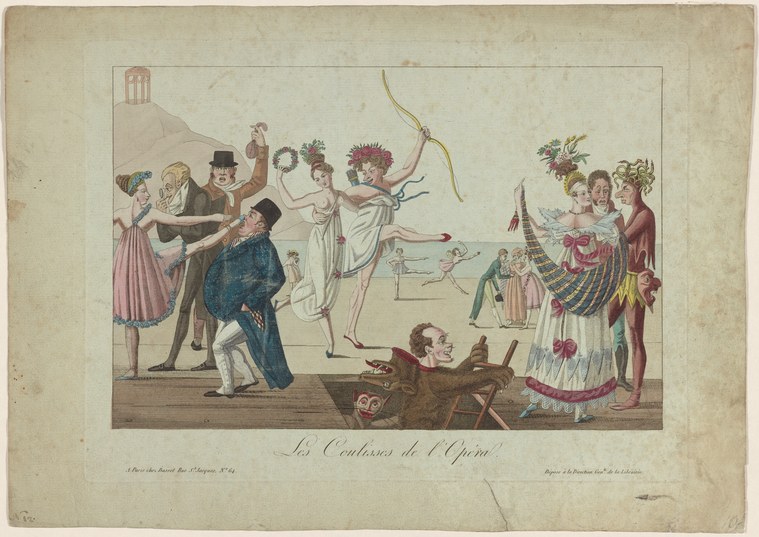
This hand-colored engraving depicts the backstage world of a European opera house, likely from the early 19th century. The composition is divided into two spatial zones: the foreground shows a raised stage or platform where figures in classical dress engage in theatrical activity, while the background reveals the apparatus and personnel of theatrical production. In the center, a nearly nude male figure crowned with laurel stands in a contrapposto pose, holding a bow and arrow—a representation of Cupid or Apollo. Around him move elaborately dressed figures: women in high-waisted Empire gowns with classical drapery, men in tailcoats and top hats, and children in costume. To the left, a stout gentleman in dark coat and hat appears to be demonstrating or explaining something to figures beside him. On the right, a group of costumed attendants holds props and theatrical equipment. The setting includes stage machinery visible in the upper left corner, ropes, and various theatrical apparatus. The overall impression is one of controlled chaos—the ordered business of creating theatrical illusion, with the mythological figures of the stage surrounded by the very earthly world of workers, directors, and mechanicians who make the magic happen.
The dancing
The central male figure exhibits the classical contrapposto stance taught in academic art training—weight shifted onto one leg, the other relaxed, creating an S-curve through the body. His pose is fundamentally static, a demonstration of ideal form rather than active dance movement. The women around him move in a variety of attitudes: some gesture expressively with arms extended or raised, others stand in profile viewing the scene. The man on the left leans forward in an explanatory posture, gesturing with his hand raised. The overall framing suggests theatrical demonstration and tableau rather than balletic or social dance in motion; the figures are arranged for visibility and symbolic clarity rather than captured mid-movement.
The dance depicted
This is a satirical or documentary image of opera production rather than a depiction of dance itself. The title *Les coulisses de l'Opéra* (The Backstage of the Opera) indicates it represents the behind-the-scenes machinery and personnel that created operatic spectacle. The central figure in classical nude male form with attributes (laurel crown, bow and arrow) is a stage *costume* or *tableau vivant* figure—part of what would have been performed. The image appears to document how such figures were managed, directed, and contextualized by the opera house apparatus. There is no evidence of choreographed movement or specific dance style; rather, this shows how theatrical bodies were positioned and presented as tableaux within the larger machinery of 19th-century opera production.
How it was made
This is a hand-colored engraving or aquatint, a medium that allowed for mass circulation and satire in the early 19th century. The precision of the line work and the legible composition suggest this was intended for public consumption—likely a popular print sold to audiences or collectors interested in theatrical life. The hand-coloring, applied after printing, gives the classical figures soft flesh tones that contrast with the darker lines of architecture and machinery. The technique allowed the artist to achieve fine detail in both the elaborate costumes and the theatrical apparatus, making this equally a document of Romantic-era fashion and theatrical practice.
About this work
This engraving records the world behind operatic spectacle at the dawn of the 19th century. It captures a moment when dance and dance-like tableaux vivants were central to operatic entertainment, and when the machinery, personnel, and direction required to produce such spectacles were themselves subjects of public curiosity and satire. The image shows how classical bodies—trained in the poses of academic art and mythology—were positioned and presented as theatrical illusions for audience consumption. This work belongs in a dance gallery not because it depicts choreography, but because it documents how bodies were trained, costumed, directed, and displayed as theatrical spectacle during the period when ballet was emerging as a distinct art form alongside opera.
How to look at it
Attend first to the spatial and social hierarchy of the image: the mythological figure at the center is positioned as an object of direction and demonstration, not as an autonomous agent. Notice how the figures in tailcoats and contemporary dress are actively engaged in explaining, positioning, and managing the classical body. The contrast between the timeless classical form (nude, crowned, armed with mythological attributes) and the contemporary dress of those around it (Regency coats, Empire waists, top hats) creates a satirical tension: this is what *becomes* classical through theatrical direction and costuming. The machinery and apparatus visible at the edges remind us that theatrical spectacle depends on engineering as well as bodily training.
The period
The Romantic opera of the early 19th century—roughly 1810–1830—was characterized by elaborate stage machinery, mythological and exotic subjects, and increasing prominence of dance as a spectacular element. The operatic tableau vivant, often featuring barely clothed classical figures in poses derived from neoclassical sculpture and painting, was a standard feature. This period saw the rise of the professional ballet master as a figure separate from the dancer, responsible for composition and direction. At the same time, popular prints and satirical engravings of theatrical life became a significant market, reflecting public fascination with how theatrical illusions were manufactured. The hand-colored engraving was the dominant medium for mass-market satirical and documentary imagery before the rise of lithography and photography.
Where it lives
This engraving is held in the New York Public Library's collection of prints depicting dance, a collection that emphasizes theatrical and social dance imagery from European print culture. As a catalogued item in a dance-focused collection, it has been selected as evidence of how dance and theatrical spectacle intersected in visual and popular culture.
Dance in this work
Questions about this work
What is this image actually showing?
This engraving shows the backstage world of an opera house, with the machinery, personnel, and direction required to produce operatic spectacle. The central figure—a nearly nude man in classical pose with laurel crown and bow—represents the kind of theatrical tableau vivant that appeared in operatic productions. He is surrounded by directors, costume attendants, and production staff in contemporary dress, illustrating how classical bodies were managed and presented as illusion.
Is this a ballet or opera image?
It is an opera image, but one that shows how dance-like tableaux vivants and classical bodies were central to operatic production in the Romantic era. At this period, ballet had not yet fully separated from opera, and spectacular bodily display was common to both. The image documents the institutional and technical apparatus that made such spectacle possible.
Why is a man in this image, when ballet was becoming associated with women?
In early Romantic opera, male bodies in classical costume were still displayed as mythological or heroic figures. The semi-naked male form, trained in neoclassical poses, was a standard feature of operatic tableau. The eventual shift toward the female form as the primary object of theatrical display in ballet came later in the 19th century. This image preserves an earlier aesthetic moment.
What does the title mean?
*Les coulisses* means 'the wings' or 'backstage'—the areas of a theater outside the audience's view. The title signals that this is a satirical or documentary look at theatrical production itself, not a scene meant to be performed for the public. The artist is inviting viewers to see the machinery and personnel behind theatrical illusion.
More dance artwork





