49 works in this view — arrow keys or swipe to move between them.
Dance in Art
Bal de la courtille
Unknown artist
- Collection:
- Prints depicting dance
- Source:
- New York Public Library
- Rights:
- Public domain — free to use, share and adapt.
- Recorded as:
- Public Domain
The *bal de courtille* represents the radical democratization of the quadrille—a form that originated in aristocratic circles and was restandardized in bourgeois ballrooms—into a vehicle for working-class satire and sexual innuendo. This engraving is one of the few visual records of how the street version actually looked in motion, and its exaggerated gestures and comic body positions tell us how far removed street practice was from ballroom convention. For historians of social dance and class culture, the *courtille* is evidence of how popular performers claimed and subverted elite forms.
What you are looking at
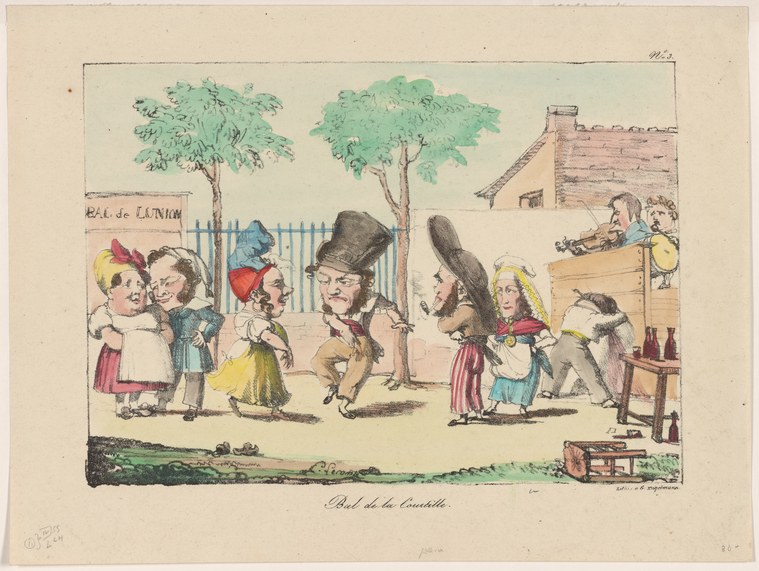
A hand-colored engraving depicting a boisterous street dance or carnival scene set in front of a modest brick building with a blue wooden gate. The composition shows approximately a dozen figures of mixed ages and genders arranged across the foreground, most engaged in or watching an energetic dance. The central figures include a tall man in a dark top hat and coat executing an exaggerated high step or leap, his body tilted dramatically backward; a woman in a yellow dress and red bonnet responds with equally animated movement. Around them, other dancers in bright primary colors—reds, yellows, blues—strike theatrical poses: some with arms raised, others in mid-step, one figure appearing to do a handstand or acrobatic move against the wooden fence on the right. The setting includes trees, a wooden construction or stage platform on the right side where spectators gather, and children watching from various positions. The energy is deliberately comedic and carnivalesque, with exaggerated body positions and the kind of physical abandon associated with popular street entertainment rather than formal dance.
The dancing
The dancers show no formal hold or frame; instead, they move as individuals or in loose opposition, each pursuing highly expressive, idiosyncratic gestures. Bodies are twisted, lifted, and extended in ways that emphasize spectacle over technique: the central male dancer's extreme backward lean, a figure's near-horizontal arm extension, another's handstand-like position. The movements read as improvisational and comic rather than structured; weight appears unstable and positions deliberately ungainly. Children and onlookers are scattered throughout, observing from the periphery, which emphasizes this as street performance rather than participatory group dance.
The dance depicted
This is a *bal de courtille* or *quadrille des rues*—a street quadrille or outdoor carnival dance popular in 19th-century France, particularly among working-class Parisians during festivals and street celebrations. The quadrille was conventionally a four-couple formation dance, but the street version (*courtille* or *contredanse*) became notorious for its anarchic, sexually suggestive movements and mockery of bourgeois ballroom etiquette. This engraving captures the carnivalesque spirit: the dancers are not executing the prescribed figures of a formal quadrille but rather exaggerating and burlesque-ing them—high kicks, backward leans, acrobatic feats—in a spirit of parody and entertainment. The inclusion of children, mixed ages, and the outdoor setting all point to this as popular street culture rather than ballroom practice.
How it was made
This is a hand-colored engraving or possibly aquatint, characteristic of French popular prints from the early-to-mid 19th century. The technique of engraving allowed for relatively quick and inexpensive reproduction, making such images widely distributed among urban audiences as documents of contemporary street life and popular entertainment. The hand-coloring (visible in the bright primary hues of the clothing and the green of the foliage) was applied after printing, a labor-intensive finishing that increased cost but made the scenes more vivid and appealing. The linear engraving style provides crisp definition to gesture and expression, essential for a comic scene where exaggeration and physical clarity drive the humor.
About this work
This is a record of the *bal de courtille*, a democratized and carnivalesque street version of the quadrille that flourished in 19th-century Paris as working-class entertainment. The engraving documents not merely the dance form itself but the spirit in which it was performed: anarchic, sexually charged, anti-bourgeois, and deeply comic. It belongs in a dance gallery because it captures a pivotal moment when a formal ballroom dance was seized by popular culture and turned inside out into parody and spectacle. The image is evidence of how dance genres migrated across class boundaries and were reinvented by those who performed them.
How to look at it
Attend to the deliberate disorder and exaggeration: no two dancers are in the same pose or rhythm, and the positions they strike—the backward lean, the high kick, the handstand—are designed to be physically impossible to sustain and emotionally unstable. This is not a formal dance being danced badly; it is a formal dance being *burlesqued*. Notice too the framing device of the onlookers and the building: the scene is staged for an audience, suggesting street performance as entertainment rather than social participation. The bright colors and comic distortion of the figures mark this as popular satire, not documentary realism.
The period
The quadrille dominated European ballrooms from the 1820s through the 1880s, but by the 1830s–1860s a thriving street and carnival version had emerged in Paris and other cities, performed by and for working-class and lower-middle-class audiences. This period saw the rise of popular prints documenting street life, carnival, and folk entertainment—a genre that celebrated the vitality and humor of urban popular culture even as bourgeois society was anxious about its sexual explicitness and class disorder. The *courtille* existed in explicit tension with ballroom propriety: where the ballroom quadrille was orderly and geometrical, the street version was chaotic, obscene, and acrobatic. Engravers and printmakers treated such scenes as comedy and spectacle, circulating them as documents of 'low life' that could be consumed by respectable audiences.
Where it lives
The work is held in the New York Public Library's Prints collection, which specializes in ephemeral visual materials documenting popular culture, street life, and entertainment. Such prints were mass-produced and hand-colored, circulated cheaply among urban audiences, and have survived in institutional collections because they were recognized as cultural documents of city life.
Dance in this work
Questions about this work
What is a *bal de courtille*?
A street or outdoor version of the quadrille that became popular in 19th-century Paris, especially during carnivals and street festivals. Unlike the ballroom quadrille, which was formal and geometrical, the *courtille* was anarchic, often sexually suggestive, and performed as entertainment rather than social dance. It was associated with working-class culture and was often condemned by respectable society as vulgar and disorderly.
How does this dance relate to the ballroom quadrille?
The quadrille was a four-couple formation dance that originated in France and spread throughout Europe as the dominant ballroom form of the 19th century. The street *courtille* took the quadrille's basic structure and figures and exaggerated, parodied, and sexualized them, turning the orderly ballroom form into chaotic street entertainment. It was a working-class appropriation and mockery of bourgeois dance.
Who danced the *courtille* and why was it controversial?
The *courtille* was danced by urban working-class and lower-middle-class people at street festivals, carnivals, and open-air celebrations. It was controversial because it was sexually explicit, often involving suggestive hip and leg movements, and because it represented a democratization and mockery of ballroom culture. Middle-class observers often condemned it as vulgar and morally dangerous.
More dance artwork





