49 works in this view — arrow keys or swipe to move between them.
Dance in Art
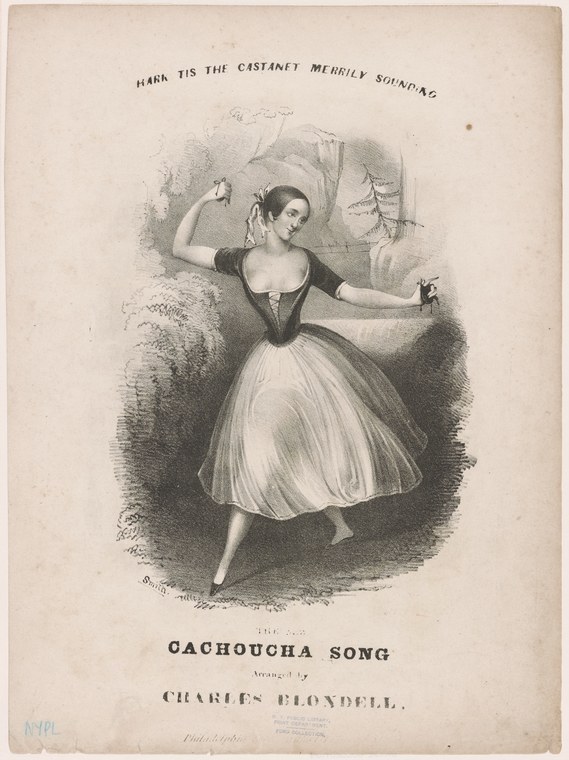
Hark t'is the castanet merrily sounding the Cachucha song.: Arranged by Charles Blondell.
Unknown artist
- Collection:
- Prints depicting dance
- Source:
- New York Public Library
- Rights:
- Public domain — free to use, share and adapt.
- Recorded as:
- Public Domain
The Cachoucha was one of the earliest foreign-origin dances to achieve mass circulation in the English-speaking world, and this image documents how it was packaged and sold as both a stage spectacle and a parlour entertainment. The work also reveals the gendered nature of theatrical and social dance in the early 19th century—the solo female figure, lightly clad and in motion, became a commercial icon. For historians of dance, popular prints like this are invaluable evidence of what people believed dances looked like and how they wanted to perform them.
What you are looking at
A young woman in Romantic-era theatrical dress performs a solo dance against a plain background, rendered in delicate lithographic tones. She wears a fitted black corseted bodice and a pale, voluminous skirt that falls below the knee—the silhouette of 1830s–1840s theatrical costume. Her dark hair is smoothly styled, and her pose captures a moment of exuberant movement: both arms are raised with elbows bent and palms open, her body twisted in contrapposto, one leg extended or about to lift. The composition emphasizes her isolation and the weightlessness of the tulle skirt, which catches light across its folds. The lithographic technique produces soft gradations of grey and black, particularly in the shadowed areas around her figure, creating an atmospheric depth that was a hallmark of dance imagery in this period. The title cartouche at top reads 'Hark t'is the castanet merrily sounding,' and below, 'Cachoucha Song / Arranged by Charles Blondell.'
The dancing
A single female dancer dominates the composition. Her torso is upright but mobile, with both arms raised to shoulder height or above in an open, expressive gesture suggesting joy or exertion. Her legs are in motion or poised mid-turn; the weight appears to shift from one foot to the other, typical of a quick, rhythmic step. The costume and pose convey neither the rigid verticality of classical ballet nor the turned-out positions of academic training, but rather a looser, more naturalistic carriage suited to a popular theatrical dance.
The dance depicted
This is sheet music for a solo dance arrangement of the Cachoucha, a Spanish-derived couple dance that became extremely popular in Romantic-era European and American theatres in the 1820s–1840s. The dance was characterized by sharp rhythmic footwork (often using castanets), quick hip and arm movements, and a passionate but playful quality. Charles Blondell was an arranger and publisher active in London during this period. The image shows the kind of theatrical solo popularized by touring Spanish and Spanish-identified dancers, adapted here for the concert or drawing-room performance of amateurs or professionals. The title's emphasis on the castanet sound marks a key element of the dance's appeal and technique.
How it was made
This is a lithograph, a planographic printing technique that allowed for the soft, graduated tones visible in the figure's shading and the atmospheric background. Lithography was ideal for theatrical imagery and sheet-music covers because it reproduced drawings with fidelity and could be produced economically for mass circulation. The technique also suited the Romantic aesthetic: the delicate modulation of tone in the dancer's skirt and the suggestive rather than photographic rendering of movement are characteristic of lithographic dance prints of the 1820s–1840s. The image was created to market the sheet music to a broad amateur and professional audience.
About this work
This is a lithographic cover illustration for a piano arrangement of the Cachoucha, a Spanish social dance that conquered European theatres during the Romantic era. The image shows a solo female dancer in theatrical dress, captured in a moment of animated motion. As both a musical document and a record of stage practice, it witnesses the popularity of Spanish and Spanish-identified dances in the 19th-century ballroom and theatre, the role of printed music and imagery in disseminating choreography, and the aesthetics of Romantic dance imagery—which privileged lightness, grace, and naturalistic (rather than formally codified) movement. The work belongs to a large corpus of dance-music covers from the same period, many of which present similar iconography (the solitary female figure, the voluminous skirt, the stylized landscape or neutral ground).
How to look at it
Look at the arms and hands: they are loose and expressive rather than formally held, suggesting a dance that prioritized emotional display over strict academic position. Observe the weight in the legs and the angle of the torso—the body is off-vertical, caught mid-phrase in what appears to be a rotational or weight-shifting step. The generous skirt, rendered in pale washes, was central to the visual spectacle of such dances; the artist has taken care to show its volume and movement. The overall pose—energetic, open, direct—was designed to appeal to audiences accustomed to ballet but curious about the novelty of Spanish and Iberian dance idioms.
The artist
Charles Blondell is documented as a London music publisher and arranger of the 1820s–1840s, specializing in theatrical arrangements and popular dances. The artist of the lithograph is not recorded. Such sheet-music covers were often produced by in-house illustrators or commissioned from theatrical specialists. Blondell's output included numerous dance arrangements and would have been directed at both professional theatres and the domestic music market.
The period
The 1820s–1840s were the height of the Romantic movement in dance and visual art, and the Cachoucha's rise coincided with a European fascination with Spain, Italy, and the near Mediterranean—exotic, passionate cultures imagined as a counterweight to northern restraint. Spanish dances were performed by touring professionals (often women) and subsequently absorbed into ballroom repertoires and theatrical entertainment. Lithography, commercially mature by 1820, made such dance imagery affordable and collectible; thousands of similar prints survive. The period also saw the rise of the female dancer as a commercial and artistic icon, and the sheet-music cover was a primary vehicle for marketing both the music and the dancer.
Where it lives
This is a sheet-music cover from the New York Public Library's collection of dance-related prints. As printed ephemera, it would have been widely circulated among musicians, dancers, and music consumers in Britain and America during the 1820s–1840s.
Dance in this work
Questions about this work
What is the Cachoucha?
The Cachoucha is a Spanish or Spanish-derived couple dance, typically in duple or triple time, characterized by rhythmic footwork and the use of castanets. It became a sensation in European theatres in the early 19th century, where it was often performed as a solo by female dancers in theatrical costume. It combines elements of Spanish folk dance with Romantic-era theatrical convention and was frequently adapted for ballroom performance.
Was this a real dance people performed, or just theatrical?
Both. The Cachoucha originated as a Spanish social dance and was performed at court and in ballrooms. However, it became most famous through theatrical performances by touring dancers and was subsequently adapted into parlour dances for amateurs. This sheet music represents the parlour version, marketed to middle-class musicians who wanted to perform a fashionable, 'exotic' dance at home.
Who is the dancer in this image?
The dancer is not identified. This is a generic representation created to market the sheet music, not a portrait of a famous performer. However, the style and costume are based on actual stage performances of the period, particularly by Spanish or Spanish-identified professional dancers.
What does 'Arranged by Charles Blondell' mean?
Blondell took an existing piece (likely a Spanish or European composition) and adapted it for piano, probably for domestic performance. Arrangement was a standard practice in the 19th century, allowing orchestral or theatrical music to be performed in the home.
More dance artwork





