49 works in this view — arrow keys or swipe to move between them.
Dance in Art
Mademoiselle du Fort dansant a l'Opera
Unknown artist
- Collection:
- Prints depicting dance
- Source:
- New York Public Library
- Rights:
- Public domain — free to use, share and adapt.
- Recorded as:
- Public Domain
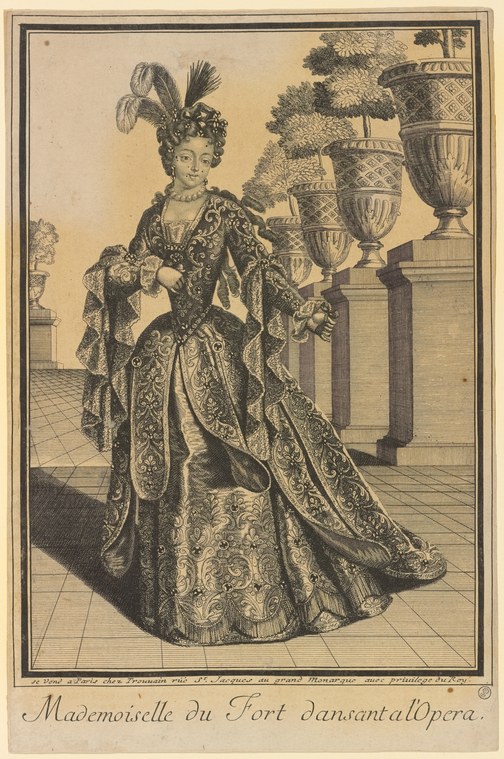
Prints of this kind are among the few surviving records of how early modern opera performers actually looked in costume and how they positioned their bodies for public view. The inscription naming the performer makes this a rare document: we know who this person was and that she had enough prominence to be immortalized in an engraved portrait. The print preserves both the material culture of dress and the visual conventions by which theatrical status and femininity were conveyed.
What you are looking at
A woman in elaborate theatrical dress stands in an architectural setting of classical columns and urns, posed as if mid-performance. She wears a heavily patterned coat or robe of brocaded fabric, decorated with ornate embroidery, worn over a full-length underdress. Her hair is dressed high and crowned with an elaborate headdress topped with feathers. The setting suggests a grand interior—a colonnade with large decorative urns placed symmetrically in the background. The figure stands on a tiled floor rendered in perspective. The inscription identifies her as "Mademoiselle du Fort" performing at the Opera. The print is executed in a tonal technique with hand-coloring (the garment shows warm ochre tones), typical of late 17th- or early 18th-century theatrical portraiture.
The dancing
A single standing figure, the body turned three-quarters to the viewer, weight seemingly on the back leg in a posed, presentational stance rather than an active movement. The arms are positioned away from the body—one extended gracefully, the other at the side—in an attitude of display rather than dance action. The long train of the garment pools behind the figure on the floor, adding to the impression of formal presentation. There is no visible suggestion of the energetic, elevated positions or the turned-out positions that would become canonical in later ballet.
The dance depicted
This is a portrait of a performer at the Opéra, likely from a court ballet or early theatrical dance production of the late 1600s or early 1700s. The dress, setting, and pose are consistent with the baroque court ballet tradition, though the figure is shown in costume rather than in active performance. The theatrical context and the grand architectural framing suggest a woman of status performing in a courtly or operatic setting. However, without documentation of what dance form she performed or what work is depicted, only the costume and context can identify the tradition. The pose itself is one of formal presentation—what dancers would call a révérence or formal salutation—rather than a step or figure from a specific dance.
How it was made
This is a hand-colored engraving or etching, a print medium that allowed for wide circulation among the educated elite and theater-goers. The technique is evident in the fine parallel lines used to model form and fabric, and in the considerable detail lavished on the embroidered coat. The hand-coloring—warm ochres and blacks—was applied after printing, a labor-intensive process that suggests this was a prestigious, possibly commissioned work made for a specific market. Such prints were collected as records of celebrated performers and as fashion documents; they circulated in portfolios and sold individually at theaters.
About this work
This is a portrait print of a named performer, Mademoiselle du Fort, documenting her appearance in a production at the Opéra in the late 17th or early 18th century. It belongs to the tradition of theatrical portraiture that recorded the appearance and costume of celebrated dancers and singers, often for circulation among theater patrons and fashion-conscious collectors. The work is valuable not as a record of a specific dance movement or technique, but as evidence of how an opera performer dressed, presented herself, and was memorialized in print. The architectural setting and formal pose place the figure within a world of aristocratic spectacle and court aesthetics. Such prints are crucial primary documents for understanding the visual culture of early modern theater and the status accorded to named performers.
How to look at it
Attend to the costume as evidence of status and artistry: the profusion of embroidery, the expensive dyes, the fashionable silhouette, and the elaborate headdress all signal a performer of rank and resources. Notice the architectural setting—the classical columns and urns—which frames her body and places her within the world of refined taste. The pose is not a dance position but a formal address to the viewer, a moment of rest or salutation. The print records not a movement but a presence: how the performer stood, what she wore, and how she was to be remembered and admired.
The period
This print dates to the era of the Académie Royale de Danse and the early development of formalized ballet technique, though the figure shown is dressed and posed as an opera performer rather than as a dancer practicing technique. In this period, the distinction between singer, dancer, and actor was not always sharp; performers at the Opéra were often trained in multiple disciplines. The elaborate dress and architectural framing reflect the courtly aesthetics of the ancien régime, when the Opéra was a royal institution and performers were celebrities within aristocratic circles. The print format itself was a dominant medium for recording and circulating images of celebrated performers, particularly actresses and opera singers.
Where it lives
This print is held in the New York Public Library's collection of prints depicting dance. The inscription in French identifies the figure and venue, suggesting it was created for a French or French-educated audience. Such prints were often bound into folios or sold individually at theaters.
Dance in this work
Questions about this work
What dance is being performed here?
The print does not depict active dancing, but rather a formal portrait of a performer in costume. The woman is posed in a presentational stance, not executing a step or figure. The theatrical context and costume suggest she performed in court ballet or opera, but the specific choreography is not recorded.
Why is she dressed so elaborately?
The ornate coat, feathered headdress, and jewelry were standard costume for opera performers and court dancers of this period, particularly for roles of noble or elevated status. The expense and artistry of the costume were part of the spectacle and helped establish the performer's rank and prestige.
Who was Mademoiselle du Fort?
The inscription identifies her as performing at the Opéra, suggesting she was a known and celebrated performer of her time. However, detailed biographical information is not available from the print itself. Such named performance records are valuable precisely because they preserve the names of individuals who might otherwise be forgotten.
How were prints like this made and used?
This is a hand-colored engraving, a printmaking technique that allowed multiple copies to be produced and sold. Prints of celebrated performers were collected as souvenirs, circulated among theater audiences, and kept as fashion documents. They served both as publicity for the performers and as records of theatrical taste.
More dance artwork





