49 works in this view — arrow keys or swipe to move between them.
Dance in Art
Dance on music covers
Unknown artist
- Collection:
- Prints depicting dance
- Source:
- New York Public Library
- Rights:
- Public domain — free to use, share and adapt.
- Recorded as:
- Public Domain
The cover illustrates how 19th-century musicians and publishers packaged historical dance forms as cultural markers of refinement, and how visual representations of dance in popular media shaped public understanding of older styles. For dancers and historians studying the reception and revival of baroque and classical dance in the Victorian era, this object is a primary source showing what 'gavotte,' 'minuet,' and 'gigue' meant visually and socially to a European audience decades after these dances had ceased to be living social practice.
What you are looking at
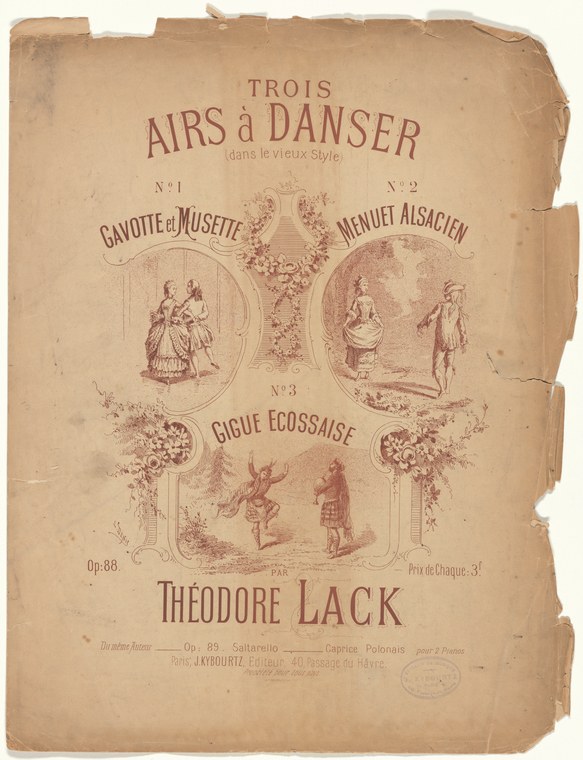
A printed music cover for solo piano from the 19th century, arranged in three sections to present three short dance pieces in old-style forms. The title *Trois Airs à Danser* (Three Airs to Dance) appears at the top in serif capitals. Below it are three oval vignettes, each containing sepia-toned figurative scenes: on the left, a *Gavotte à Musette*, showing two figures in courtly dress—a woman in a full skirt and a man—in a formal stance suggestive of a court dance; at top right, a *Menuet Alsacien* depicting two figures, one appearing to gesture or bow; and below, a *Gigue Écossaise* showing what appears to be more spirited movement with multiple figures. The vignettes are surrounded by ornamental botanical flourishes—roses and foliage in the rococo manner. At the bottom, the composer's name, Theodore Lack, is printed in heavy serif type, along with publication details indicating Op. 88 and a price notation (Prix de l'Dique: 3 f). The overall design is characteristic of Victorian-era sheet music, using sepia reproduction to evoke both historical precedent and artistic sophistication.
The dancing
Each vignette presents figures in the formal upright carriage and extended limbs typical of historical dance notation and popular historical illustration. The gavotte pair stand in a controlled, symmetrical arrangement suggesting the restrained elegance of the form; the alsacien figures display a courtly interaction; the gigue figures appear to occupy a more active, less geometrically formal space. The illustrator has chosen poses that suggest the music's character without attempting to capture mid-movement action—these are representative attitudes rather than documentary snapshots. No extreme flexibility or athleticism is suggested; the figures embody the social and technical conventions of 19th-century reception of these older forms.
The dance depicted
This is a music publication from the era when Romantic composers and pedagogues looked back to 18th-century baroque and classical court dances as models of elegance and historical authenticity. The three pieces—gavotte, minuet, and gigue—are archaic forms already one or two centuries old by the time Lack wrote them. The cover illustrations are not meant to teach technique but to evoke the *character* of each dance as understood in the Victorian era: the gavotte as a moderate, refined dance of couples; the minuet as the epitome of courtly grace; the gigue as a faster, more animated Scottish or Celtic variant. Whether Lack's pieces follow baroque structural models or adapt them to Victorian salon idiom cannot be read from the cover; the images function as historical wallpaper, marketing the nostalgia and refinement of the contents.
How it was made
This is a chromolithograph or relief-printed reproduction, likely a high-quality commercial music cover from Paris or another European publishing center. The sepia and cream palette and the fine detail of the botanical ornament suggest skilled chromolithography rather than simpler wood engraving. The technique allowed the publisher to produce an ornate, visually appealing cover that could be printed in large quantities; the oval vignettes and rococo flourishes signal a mid-to-late 19th-century aesthetic. The survival of a worn, edge-damaged copy indicates this was a popular or at least a functional commercial product, handled and consulted rather than collected.
About this work
This is a commercial music publication cover presenting three short dance pieces composed in historical styles. The three vignettes illustrate each dance's assumed character through figure poses and period dress: the gavotte and minuet in formal court attitudes, the gigue in a more active disposition. The cover is both a functional wrapper for a pedagogical or salon piano work and an artifact of the 19th-century practice of framing new music as revival or homage to earlier forms. For a dance historian, it documents how specific baroque and classical dances were visualized and understood in the Victorian era—not as living social practices but as historically resonant character types that could be invoked through costume, posture, and ornament. The work is a minor commercial product, yet it captures a significant moment when dance history entered popular commercial culture through illustrated sheet music.
How to look at it
Attend to the posture and spacing of each pair or group of figures and to the differences among the three vignettes. The gavotte and minuet are rendered in controlled, symmetrical poses that emphasize courtly formality and mutual respect; the gigue is shown with more dynamic, less regular positioning. The ornamental frame—the roses and botanical flourishes—is not incidental but a period marker: it signals that this is a work about historical beauty and refinement, not about technical innovation or contemporary passion. The wear and aging of the printed surface—the foxing and edge damage—is part of the history: this was not a luxury art object but a working score that lived in musicians' homes and studios.
The artist
Theodore Lack (1821–1900) was a French composer and pianist known chiefly for salon and pedagogical piano works. His output was large and his works were published widely across Europe; Op. 88 places this work in his mature productive period. Lack was typical of mid-19th-century salon composers in his cultivation of character pieces, historical references, and works designed for amateur musicians and drawing-room performance. His name and opus number appear prominently, and the publication details suggest a professional, established composer with access to quality commercial reproduction.
The period
The 1860s–1880s saw a pronounced revival of interest in baroque and classical dance forms among European composers and dance reformers. Choreographers and composers looked to the minuet, gavotte, and gigue as models of structural clarity and historical continuity; these forms appeared not only in concert works but in ballet and in pedagogical contexts. At the same time, chromolithographic sheet music covers had become a major medium for marketing music and shaping public taste. The illustrated cover—with its sepia vignettes and rococo ornament—was both a commercial strategy and an expression of the historical and aesthetic preoccupations of the era.
Where it lives
The work is held in the New York Public Library's collection of prints depicting dance, a broad collection that preserves commercial, pedagogical, and artistic representations of dance across media and centuries. The condition and format indicate this was a commercial music publication, one of thousands produced for the European and American markets. The collection preserves it as evidence of how dance was visualized and sold to the public, not as an exceptional or rare artistic achievement.
Dance in this work
Questions about this work
Who were these dances meant for?
These were salon and pedagoical piano pieces for amateurs, students, and drawing-room musicians. The three dances were not meant to be social dances but rather concert or practice pieces in historical styles—ways for pianists to explore and reference older musical and choreographic traditions.
Are the pictures on the cover accurate representations of how these dances were actually done?
The vignettes are character illustrations rather than documentary representations. They convey the mood and aesthetic context each dance was understood to embody in the Victorian era—formal elegance for gavotte and minuet, liveliness for gigue—but they do not depict actual steps or the full range of historical variation in how these dances were performed.
Why would a 19th-century composer write minuets and gavottes when these dances were already centuries old?
By the 1800s these forms were understood as historical and cultural touchstones rather than living social dances. Writing in these forms was a way of claiming kinship with the European classical tradition and signaling refinement and historical knowledge to an educated audience.
More dance artwork





