49 works in this view — arrow keys or swipe to move between them.
Dance in Art
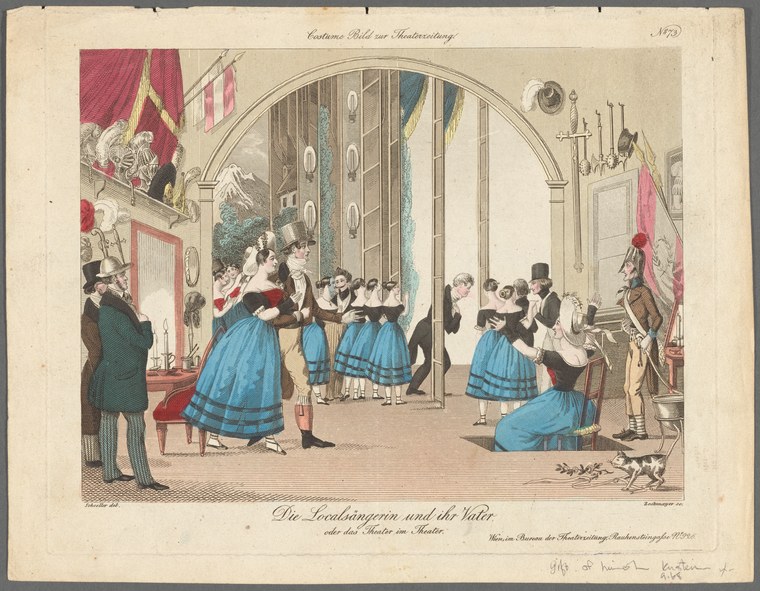
Die Localsängerin und ihr Vater: oder das Theater im Theater
Unknown artist
- Collection:
- Prints depicting dance
- Source:
- New York Public Library
- Rights:
- Public domain — free to use, share and adapt.
- Recorded as:
- Public Domain
This engraving is one of few surviving images that document social dancing in an interior setting during the Regency period, showing not the steps themselves but the posture, grouping, and atmosphere of parlor dance as lived practice rather than technique. The 'theater within theater' framing reveals how the period understood even social dancing as a kind of performance—a display of breeding, taste, and bodily elegance governed by convention. For historians of dance and social manners, the image is a primary source on the visual culture of early 19th-century courtship and leisure.
What you are looking at
An elegantly appointed interior theater or concert hall is the setting for this hand-colored engraving. A grand arched colonnade with tall fluted columns defines the space, and the architectural detailing—the dado, friezes, and ornamental wall panels—speaks to refined taste. The scene depicts a mixed social gathering in which music-making and dancing are intertwined. At center, a group of young women in pale blue dresses with darker blue trim and ribbons are dancing or preparing to dance, their postures graceful and their attention focused on the musicians. At left, a man in dark coat and breeches stands watching; on the right, another figure plays a stringed instrument while seated. In the upper left, beyond an archway hung with red drapery, spectators observe from a raised gallery or adjoining room. A small dog appears in the lower right foreground. The lighting is even and naturalistic, typical of the period's treatment of interior scenes, and the composition balances the activity of the dancers with the architectural grandeur of the setting.
The dancing
The dancers—all female, dressed identically in high-waisted Empire silhouette gowns—stand or move in relaxed, social postures rather than formal ballroom position. None are in a closed hold with a partner; instead they appear to be standing in casual groupings, some with arms at their sides, others with hands gesturing lightly. Their weight is poised and upright, consistent with Regency-era deportment. The men present—a gentleman observer on the left, and a seated musician on the right—are not dancing, but participating as musicians and audience. The overall frame suggests a parlor dance or social gathering rather than a formal ballet or cotillion with its prescribed holds and positions.
The dance depicted
The title indicates this is a scene of 'The Local Singer and Her Father: or, Theater within Theater'—a narrative engraving likely referencing a contemporary play or entertainment. The dancing depicted is social ballroom dancing of the Regency period, not theatrical dance, but the play-within-the-picture format suggests the scene is staged or dramatized. The young women's attire and the architectural setting place this firmly in the early 19th century. The mix of casual grouping, the presence of musicians, and the social rather than competitive nature of the movement suggest Regency-era country dances, cotillions, or quadrilles—the fashionable parlor dances of the era. The image documents not performance but social practice, though framed and presented as a theatrical scene.
How it was made
This is a hand-colored engraving, identifiable by the fine line work, the precision of the architectural rendering, and the application of watercolor or gouache over the printed line. The German or German-speaking origin is suggested by the title in German. The technique allowed for the faithful reproduction of interior spatial detail and the subtle rendering of light and fabric texture. The hand coloring—particularly the pale blue of the dresses and the red of the theater drapery—adds narrative and compositional emphasis. This would have been an expensive, luxury object, circulated among educated, affluent viewers interested in theater, fashion, and social manners.
About this work
This is a Regency-era social scene presented as theater: a parlor in an elegant neoclassical interior where young women in fashionable Empire-waist gowns dance while musicians play and spectators observe. The engraving documents the intersection of performance and social practice in the early 19th century, when drawing-room dancing was itself a form of aesthetic and social display. The composition—the theatrical architecture, the gallery of observers, the title's reference to 'theater within theater'—suggests the artist understood dancing as a framed and socially meaningful act. The work belongs in a gallery of dance because it renders the body, dress, spatial frame, and social function of Regency ballroom dancing with precision and narrative intelligence.
How to look at it
Attend first to the architectural frame: the colonnade, the gallery, and the red drapery all signal that this is a represented scene, a picture of a picture. Then observe the dancers themselves—their relaxed postures, their lack of formal hold, and their blue dresses, which coordinate them as a visual group without denoting a specific choreographic formation. Notice the musicians and the single standing male observer: they establish the social structure of the scene, where women dance for display and men listen, watch, and facilitate. The artist has chosen a moment of relative stillness, not extreme motion, which allows the viewer to read the room's architecture and the figures' dress with equal clarity.
The period
This engraving dates to the Regency era (approximately 1811–1820), a period of intense interest in theatrical entertainment, social dancing, and the aesthetics of the interior. In this period, the ballroom and the parlor replaced the formal court as the primary venue for social dance. Dancing masters published voluminous instruction manuals, and popular theater featured comedies and melodramas centered on courtship and social manners. The style of dress—high-waisted, classicizing silhouettes influenced by Napoleonic neoclassicism—and the neoclassical interior architecture were markers of current fashion and educated taste. The engraving itself was a primary medium for the circulation of fashion plates, theatrical scenes, and domestic interiors to middle- and upper-class audiences.
Where it lives
The work is held in the New York Public Library's collection of prints depicting dance, part of its broader holdings in 19th-century social and theatrical imagery. The German title and the engraving technique suggest this was produced in a German-speaking region, likely for circulation among educated, urbane audiences interested in contemporary theater and fashion.
Dance in this work
Questions about this work
What is 'theater within theater' in the title?
The title suggests the scene depicted is from a play or entertainment in which a theatrical performance or social event is staged. The architectural frame, the raised gallery with spectators, and the formal composition all support this reading: we are being shown a scene that is itself presented as a dramatic or theatrical moment, not simply a documentary view of a real parlor.
What kind of dance are these women doing?
Based on their posture, dress, and the Regency-era setting, they are engaged in social ballroom dancing—likely cotillions, quadrilles, or country dances that were fashionable in drawing rooms of the period. The relaxed grouping and the informal postures suggest a social gathering rather than a formalized theatrical ballet with predetermined steps and positions.
Why are the women all in the same blue dress?
The matching pale-blue gowns with dark blue trim visually coordinate the dancers as a group, making them the compositional and narrative focus of the scene. In Regency fashion, such coordinated dress also signaled social conformity and refined taste. The color choice—pale blue with darker accent—was fashionable for young women of the period and appears frequently in contemporary fashion plates and theatrical depictions.
More dance artwork





