49 works in this view — arrow keys or swipe to move between them.
Dance in Art
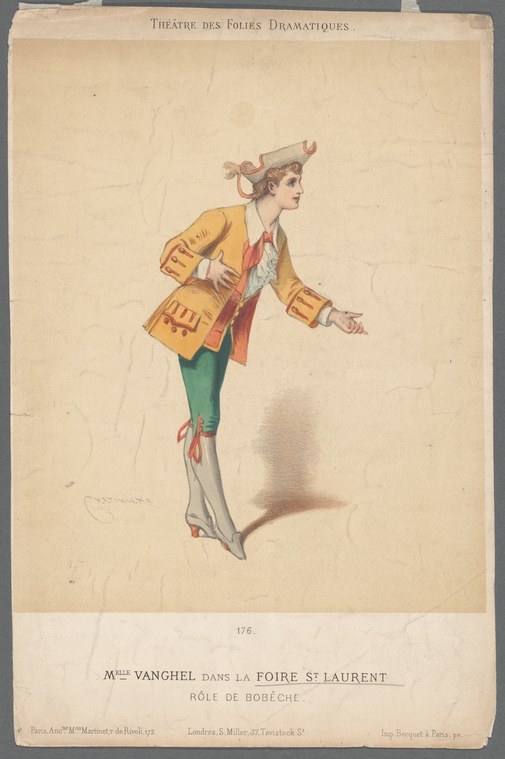
Melle Vanghel dans La foire St Laurent, rôle de Bobêche
Unknown artist
- Collection:
- Prints depicting dance
- Source:
- New York Public Library
- Rights:
- Public domain — free to use, share and adapt.
- Recorded as:
- Public Domain
Character prints like this are primary evidence for how nineteenth-century theatrical performance actually looked on stage—what bodies did, how they were dressed, what was considered striking or comic. Bobêche was a known character type, and this image fixes one performer's interpretation in a specific moment. For historians of popular theatre, vaudeville, and the social history of French performance venues, such prints are invaluable; they show that theatrical dance was only one strand of a much larger ecosystem of physical performance.
What you are looking at
A single figure in theatrical costume strikes a dynamic, off-balance pose against a plain background. The dancer wears a yellow-gold jacket or tunic with black text or lettering across the back and front, green tights, and a white stockinged lower leg with a red shoe or slipper. The head is crowned with an elaborate tall headdress or bonnet in soft tones. The body leans forward and to one side, one arm extended outward in a gesture of exuberant movement, the other bent near the body. The pose suggests mid-action—a moment of comic physical business rather than classical line. The figure casts a shadow on the ground, establishing a sense of stage space. The overall composition is a costume study: the work documents how this character looked in motion.
The dancing
A single performer, viewed from the side and slightly front, captured in an exaggerated, off-centre pose. The weight appears to shift forward and to the right, the extended arm loose and gestural rather than formally framed. There is no closed or partnered hold; this is a solo turn or moment of solo performance business. The silhouette is lean and tall, the carriage comic and deliberately ungainly—the slouched shoulder and angled spine suggest character work rather than ballet technique. The head position and extended arm convey a sense of urgency or surprise.
The dance depicted
This is almost certainly a document of nineteenth-century French theatrical dance, specifically a costume study of the character Bobêche, a figure from the pantomime or comedic vaudeville tradition. The title credits Mlle Vanghel in the role. Bobêche was a popular comic character in early-nineteenth-century French popular theatre, associated with street fairs and musical comedy. The pose and dress suggest acrobatic or comic pantomime performance—physical comedy and character work rather than ballet. The yellow jacket and tall bonnet are recognisable character costume rather than ballet dress.
How it was made
This is a hand-coloured lithograph or colour engraving, printed and then tinted by hand with watercolour or gouache. The line work is precise and confident, suggesting a professional theatre print house. The technique allowed rapid, inexpensive production of costume studies for circulation among performers, patrons, and enthusiasts. The scale and presentation—a single figure centred on the page with the title in neat type below—is typical of theatrical portrait prints of the 1820s–1850s. The registration of the printed line and the soft, uneven hand-colouring are characteristic of commercial theatre documentation of the period.
About this work
This is a nineteenth-century French theatrical costume print documenting a specific performer, Mlle Vanghel, in a named role. It belongs to a large body of commercial theatre prints that recorded actors and dancers in character, circulated to audiences and collectors. The work is evidence of how French popular theatre—pantomime, vaudeville, and fair-ground comedy—was dressed and performed. It is not a record of ballet, but of comedic theatrical performance, a genre that shared the same venues and audience as theatrical dance but operated by different physical and narrative conventions. The print preserves a moment of theatrical history that left little other documentation.
How to look at it
Attend to the silhouette and the costume detail. The elaborate bonnet and the yellow jacket with its inscribed text are not decorative—they are the character. Note the off-balance pose and the loose gesture of the arm; this is not ballet carriage or formal theatrical stance, but comic exaggeration. The shadow on the ground and the plain background frame this as a stage moment, a single memorable turn or tableau. The artist has chosen a moment of apparent motion or surprise, not a static display of the costume.
The artist
The artist is not recorded. The print bears the imprints of London publishers (S. Miller, 27 Ivybridge Street) and a Parisian printer (Imp. Pinot à Paris), suggesting it was created for circulation in both markets. The precision of the costume rendering and the professional finish indicate a commercial theatre print house working to standard theatrical portrait formats. Such prints were often drawn by house artists whose names were not retained.
The period
The 1820s–1850s were the height of European theatrical costume printing. In France, the foire Saint-Laurent (St. Laurence Fair) was a major venue for popular entertainment—pantomime, acrobatics, musical comedy, and variety performance. This was the age of the *féerie*, the spectacular pantomime, and the rise of character-focused comedy. The style of dress and bonnet and the exaggerated pose reflect the comic physical traditions of French vaudeville. At the same time, Romantic ballet was emerging as a high-art form; this print shows a parallel popular tradition operating in the same venues and for overlapping audiences.
Where it lives
The print is held in the New York Public Library's collection of prints depicting dance. It carries the imprints of S. Miller (London) and Imp. Pinot (Paris), suggesting it was a commercially printed theatrical portrait, likely distributed to theatre patrons and collectors in both cities.
Dance in this work
Questions about this work
Who was Bobêche?
Bobêche was a popular comic character in early nineteenth-century French pantomime and vaudeville, associated with fairs and variety performance. The role was performed by various actors, and this print documents one performer's specific interpretation. The character was known for exaggerated physical comedy and acrobatic business rather than refined theatrical performance.
What is the foire Saint-Laurent?
The St. Laurence Fair was a major annual fair held in Paris, a venue for popular entertainment including pantomime, acrobatics, and musical comedy. It was an important site for non-elite theatrical performance and a proving ground for entertainers. Theatrical prints like this often documented performers at the fair.
Is this ballet?
No. This is a record of popular theatrical comedy and pantomime, a different tradition from ballet. While both operated in similar venues and for overlapping audiences, pantomime relied on acrobatic physical comedy and character work, not on the formal technique and narrative structures of ballet. The pose and dress make this clear.
Why print costume studies like this?
Theatrical costume prints served multiple purposes: they documented performers for posterity, advertised shows to audiences, and circulated as collectible souvenirs. They allowed patrons who had seen a performance to remember it, and allowed those who hadn't to imagine what they had missed. They were inexpensive and portable, ideal for mass circulation.
More dance artwork





