49 works in this view — arrow keys or swipe to move between them.
Dance in Art
Caricature
Unknown artist
- Collection:
- Prints depicting dance
- Source:
- New York Public Library
- Rights:
- Public domain — free to use, share and adapt.
- Recorded as:
- Public Domain
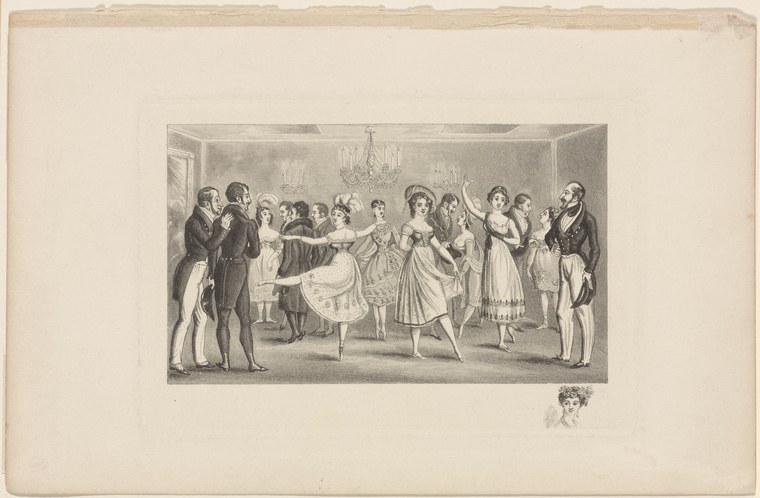
For dance historians, this engraving provides rare visual documentation of how Regency-era ballroom dance was actually performed—the posture, the frame, the social distance between dancers and spectators. For social historians, it registers anxiety about correct performance of fashionable dance as a marker of class status, capturing a moment when dancing masters and etiquette books were proliferating to guide the newly wealthy through the codes of genteel behavior.
What you are looking at
A formal ballroom scene rendered in engraving shows approximately fifteen figures in Regency-era dress arranged in a rectangular room lit by a chandelier. The composition is staged as a social gathering centred on a dance in progress. In the foreground, a couple performs while others watch from the periphery—men in dark tailcoats and breeches stand to left and right, while women in high-waisted white muslin gowns with long skirts occupy the middle ground and background. The room itself is plainly furnished with classical proportions and a coffered ceiling. The print's title—'Caricature'—signals that the work offers satirical commentary on ballroom manners rather than a straightforward documentary: the artist exaggerates certain postures and expressions to mock the dancers and spectators, catching them in awkward moments of social pretension, stiffness, or affected refinement.
The dancing
The central dancing couple occupy a closed frame typical of Regency-era ballroom propriety, though rendered with enough distortion to suggest ridicule. The woman's posture and the man's bearing are formalized but strained. Around them, onlookers adopt rigid, observant stances; the men stand with arms at their sides or gestured in conversation, while women cluster in groups, some turned toward the dancers with expressions of interest or disapproval that the engraver has emphasized through exaggerated facial features. No footwork is clearly legible, but the overall impression is of weight held upright and still, with movement confined to the upper body and the woman's skirt.
The dance depicted
This appears to depict a Regency quadrille or cotillion—the most fashionable set dances of the 1810s–1820s—though the caricatural treatment makes precise identification difficult. The formal dress, the structured group arrangement, and the presence of spectators all point to an elite social dance. The satire targets the stiffness and social anxiety of the participants rather than the dance form itself, suggesting that this was a recognizable enough practice to merit mockery. The engraving may be recording anxieties about the correct performance of fashionable dance among the aspiring middle classes or satirizing the pretensions of particular dancers or hosts.
How it was made
This is an engraving on paper, executed with fine parallel lines (hatching and cross-hatching) to build tone and shadow. The technique allows sharp detail in facial features and the rendering of fabric texture—the contrast between the men's dark wool and the women's white muslin is particularly effective. Engraving was the standard print medium for social satire and satirical commentary on manners in early nineteenth-century Britain and Europe, allowing for wide circulation at modest cost. The crisp black line and the capacity for fine tonal gradation made it ideal for caricature, where exaggeration of features depends on clear legibility.
About this work
A Regency-era ballroom scene rendered as a caricature in engraving, depicting fashionable dancers and spectators in a formal social setting. The work sits at the intersection of dance history and social satire: it documents the appearance and conduct of elite ballroom dance while simultaneously mocking the rigidity, social anxiety, and affected manner of its practitioners. The satire suggests that the 'correct' performance of fashionable dance was a matter of public scrutiny and social anxiety, particularly for those seeking to demonstrate gentility. Such prints circulated widely among the educated classes and offer historians both visual evidence of dance costume and practice, and insight into contemporary attitudes toward formality and social performance.
How to look at it
Attend to the exaggeration in the figures' faces and postures—the stiffness of the dancers' spines, the intensity of the spectators' observation, the anxiety suggested by certain profiles. Notice how the woman's raised skirt dominates the centre of the composition, while the man beside her is rendered almost as a prop. The engraver has chosen the moment of the dance itself but frozen the participants in a state of social discomfort that suggests the real subject is not the dance but the dancers' awareness of being watched and judged. The formal rules and prescribed figures of the quadrille or cotillion become a vehicle for satire on social performance itself.
The period
The Regency period (1811–1820) saw an explosion of printed social satire in Britain, responding to rapid social change and the aspiration of the commercial and professional classes to enter genteel society. Dancing masters and published guides to ballroom etiquette proliferated during this era, suggesting widespread anxiety about correct performance. Quadrilles and cotillions, imported from France and refined in London ballrooms, were the height of fashion and required both knowledge of the prescribed figures and the social confidence to execute them before an audience of peers. The print form was ideally suited to satirizing such aspirations: engravings of this kind were affordable, quickly produced, and circulated among the educated middle and upper classes who formed their audience.
Where it lives
Held in the New York Public Library's collection of prints depicting dance. The work is catalogued only as 'Caricature' with no artist, date, or medium attributed in the current record.
Dance in this work
Questions about this work
What dance is this?
Most likely a Regency-era quadrille or cotillion, based on the formal dress, group arrangement, and social setting. The caricatural treatment makes definitive identification difficult, but these were the fashionable set dances of the 1810s–1820s among the British upper and aspiring middle classes.
Why is it called a caricature if it shows a real dance?
The artist has exaggerated the postures, expressions, and awkwardness of the dancers and spectators to mock their social pretension and the rigid formality of ballroom conduct. The satire targets the performers' anxiety about correct behavior rather than the dance form itself.
How do we know this is Regency era?
The women's high-waisted muslin gowns with long skirts, the men's tailcoats and breeches, and the classical interior design all correspond to fashionable dress and taste of the 1810s–1820s. The type of ballroom satire was particularly popular in Britain during the Regency period.
What was a quadrille?
A quadrille was a set dance for four couples arranged in a square, with prescribed figures that all dancers executed in sequence. It required knowledge of the steps and figures, making it a marker of genteel education. Dancing masters taught quadrilles to aspiring genteel families.
More dance artwork





