49 works in this view — arrow keys or swipe to move between them.
Dance in Art
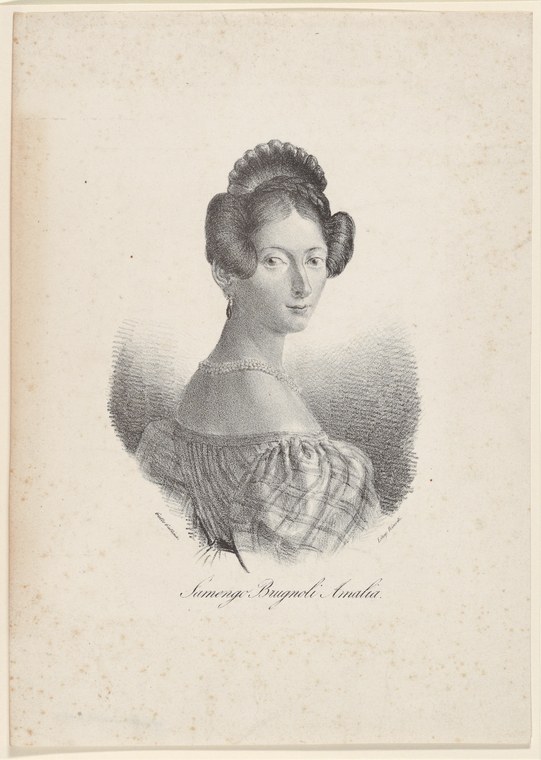
Samango Brugnoli Amalia
Unknown artist
- Collection:
- Prints depicting dance
- Source:
- New York Public Library
- Rights:
- Public domain — free to use, share and adapt.
- Recorded as:
- Public Domain
This print records a now-obscure performer whose career and artistry survive largely through such portraiture. It is evidence of the commercial infrastructure of 19th-century theater—the production and circulation of images of dancers as a form of publicity and cultural consumption. For historians of Romantic ballet and its stars, such portraits are often the primary surviving record of individual dancers.
What you are looking at
A three-quarter-length portrait of a young woman rendered in fine engraving or lithography, set against a plain background. She is shown from roughly the waist up, turned slightly to her right, with her face in three-quarter profile looking toward the viewer. Her dark hair is arranged in the elaborate coiffure of the 1830s–40s, with loops and coils pinned high on the head and ringlets falling at the temples. She wears a low-necked dress of fine plaid or checked fabric, with the bodice fitted and the shoulders bare or nearly bare, characteristic of the Romantic era. The neckline is modest despite the low cut, and she wears what appears to be a delicate pearl or jewelled necklace. The dress fabric is rendered with careful cross-hatching to suggest the weave; the bodice shows vertical pleating or gathering. The lighting is soft and frontal, with gentle shadow modeling the face and neck. The composition is that of a theatrical portrait—a head-and-shoulders study of the kind used to promote and commemorate performers.
The dancing
The figure is upright and composed, with her body weight centered and her gaze engaging the viewer directly despite the three-quarter turn. Her shoulders are relaxed and level. The arms are not visible below the lower frame, so no active gesture or dance position can be assessed. The posture suggests repose rather than movement or exertion; this is a formal portrait pose rather than a moment captured mid-performance.
The dance depicted
The inscription below the image reads 'Amneige Brugnoli Amalia', identifying the subject as a Romantic-era ballerina. Amalia Brugnoli (sometimes Brugnola) was an Italian dancer active in the 1830s and 1840s, known for her work in European ballet theaters. The engraving style, costume, and hairstyle are consistent with theatrical portraiture of that period and genre. However, this is a portrait of a dancer rather than a depiction of dance itself. No movement, choreography, or dance position is visible; the work documents the dancer's appearance and status rather than her art.
How it was made
This is an engraving or lithographic print, executed in black ink on paper with fine parallel line-work (hatching and cross-hatching) to model form and suggest texture. The technique allows for the precise rendering of facial features and the intricate detail of the elaborate hairstyle and dress fabric. The quality and finish suggest a commercial theatrical print—the kind produced for distribution to audiences, opera-goers, and collectors as a souvenir or promotion of a celebrated performer. Such prints were typically made in editions and circulated widely in the 19th century.
About this work
This is a formal theatrical portrait engraving of Amalia Brugnoli, an Italian dancer of the Romantic ballet era, printed in the 1830s–40s. It belongs in a gallery of dance in art not because it depicts choreography or movement, but because it documents how Romantic-era dancers were visually promoted and remembered. The portrait format—elegant, flattering, and carefully composed—reveals the social status and celebrity of the ballerina and the conventions of how female performers were presented to the public. The costume and styling are consistent with the Romantic ballet aesthetic, even though the figure is static.
How to look at it
Look at the careful attention to the dancer's face and the elaborate styling of her hair—these were the markers of fame and status in theatrical culture. Note how the engraver has rendered the texture and weave of the plaid dress fabric with cross-hatching, and how the lighting is modeled to flatter the subject's features and create a sense of intimacy despite the formal composition. The portrait format itself is the point: it presents the dancer as a cultured, beautiful woman and a public figure, not as an athlete or performer in action. Compare this to later photographic portraits of dancers, which would eventually dominate.
The artist
The artist is not recorded. Theatrical portrait engravings of this kind were produced by commercial printing houses and professional engravers working in Paris, London, Milan, and other major opera centers. Individual artists often remained uncredited, and the authorship of such prints is frequently difficult to establish. The work was likely produced by a Parisian publisher, as that city dominated theatrical print production in the 1830s–40s.
The period
This print dates to the height of Romantic ballet in Europe, when dancers like Maria Taglioni, Fanny Elssler, and their contemporaries achieved celebrity status unprecedented in the history of dance. The female dancer became the principal attraction of the ballet, often displacing male dancers to secondary roles. Theatrical portraiture flourished in this period as a form of fan culture and artistic documentation. The Romantic aesthetic privileged ethereal beauty, delicate femininity, and emotional expressivity—qualities encoded in the portrait's soft lighting, elegant pose, and fashionable dress. Ballet itself was dominated by the pointe work and filmy tutus that are iconic of the era, though neither is visible in this formal portrait.
Where it lives
This is a theatrical portrait engraving held in the NYPL's collection of prints depicting dance. The collection contains similar portrait engravings and lithographs of 19th-century performers, many of them now documented only in such prints.
Dance in this work
Questions about this work
Was Amalia Brugnoli a famous dancer?
Amalia Brugnoli (also Brugnola) was an Italian ballerina active in European theaters during the 1830s–40s, during the Romantic ballet era. Little is recorded about her repertoire or career beyond such portraits and occasional mentions in theater programs. She was likely a soloist in opera-ballet or independent ballet productions rather than a prima ballerina of the first rank, but her appearance in such a professionally produced portrait indicates she had achieved some public recognition.
Why is this a portrait and not a dance scene?
In the 19th century, theatrical portrait engravings served as the primary visual record and promotion of dancers. Producing action scenes from choreography required larger canvases, more elaborate composition, and greater expense. Portrait prints were cheaper, faster to produce, and served the practical purpose of promoting a performer to audiences and the public. They were sold at theaters and through print shops as souvenirs.
How can I identify the style of ballet from this image?
You cannot reliably identify specific choreography or technique from a portrait alone. However, the costume, hairstyle, and date are consistent with Romantic ballet (ca. 1830–1870). If you want to know what Brugnoli danced, you would need to consult theater archives, reviews, or choreographic records from the period—this image documents her appearance, not her art.
Is this a lithograph or engraving?
The fine parallel line-work visible in the image is consistent with steel or copper engraving rather than lithography, which would show broader tonal areas. The technique and finish suggest a high-quality commercial engraving suitable for theatrical distribution.
More dance artwork





